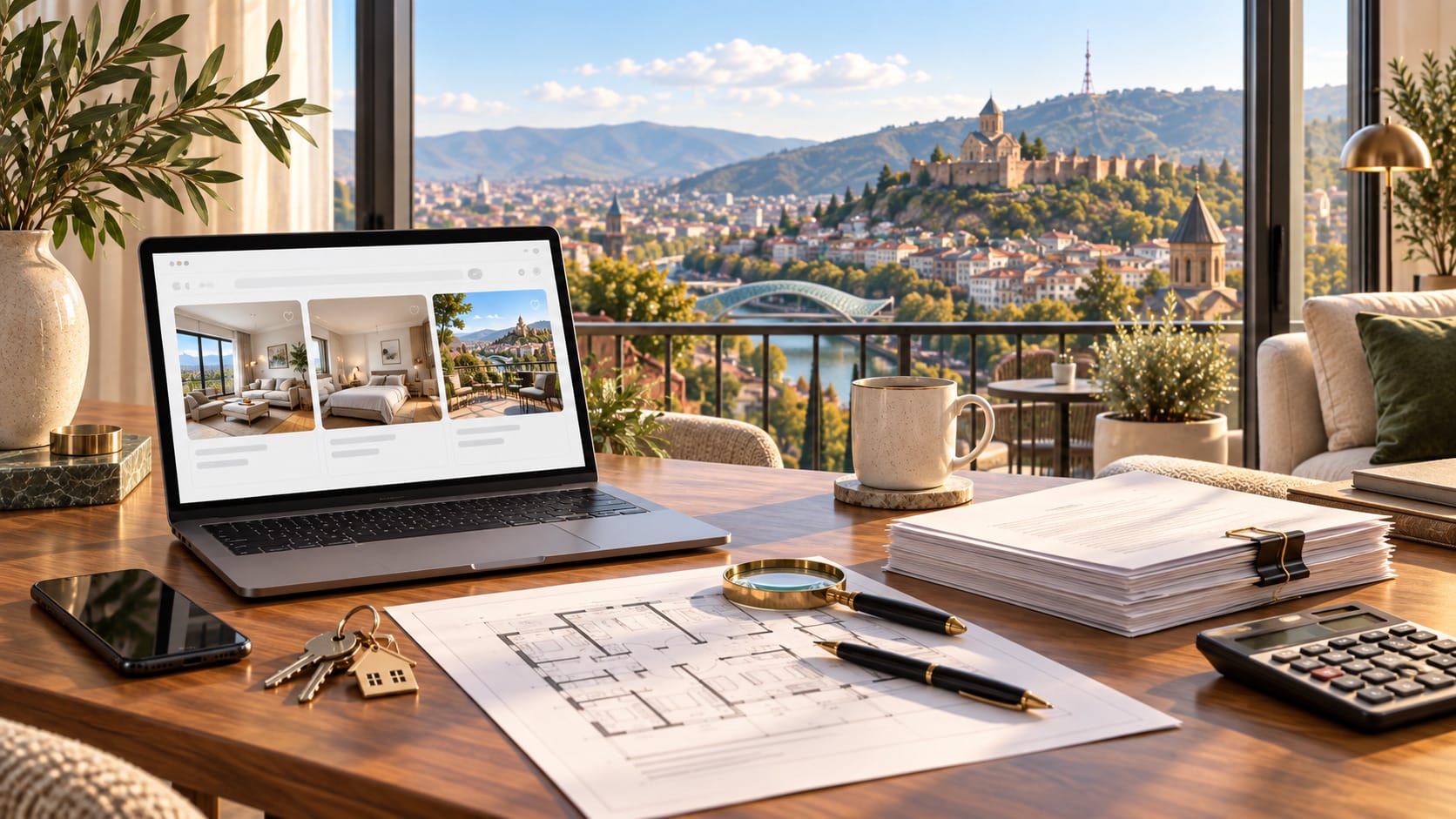
Buying Property in Tbilisi in 2026: What to Check Before You Buy
Buying property in Tbilisi can look almost suspiciously easy from the outside, because once you have found an apartment, agreed on the price and prepared the necessary documents, Georgia has a registration system capable of completing the formal transfer of ownership very quickly.
That speed is real, but it is easy to draw the wrong conclusion from it. A fast Public Registry can register ownership efficiently once the necessary documents have been submitted, but it will not decide whether you have chosen the right neighbourhood, whether the building is in good condition, whether the apartment is worth the asking price, whether the terrace in the photographs is actually part of the registered property, or whether the beautiful view will still exist when construction begins on the empty plot next door.
After more than twenty years in legal practice, I have developed a strong preference for discovering inconvenient facts before money changes hands, and property purchases reward that habit rather well.
I moved to Tbilisi in 2023, so this guide combines what I have learned from living here with a lawyer’s instinct for documents, sequence and questions that are much easier to ask before a transaction than after it. I am not licensed to practice Georgian law, and where a particular purchase requires a formal legal opinion under Georgian law, that part of the review should be carried out by a lawyer qualified in Georgia.
This article was updated in September 2026.
Buying Property in Tbilisi Starts With Why You Are Buying
Before looking seriously at apartments, it helps to decide what the property is supposed to do for you, because a home for your own family, an apartment intended for rental income and a property purchased partly because of residence plans may all stand in the same building while requiring completely different decisions.
If you are buying for yourself, I would think about an ordinary Tuesday rather than a pleasant Sunday viewing. Where do you need to get every day, what happens with traffic and parking, can you walk to the shops comfortably, does the lift work, how noisy is the street in the evening, and does the hill that looked picturesque in September still seem charming when you are carrying groceries home in February?
If you are buying as an investment, your own taste matters less than the likely tenant, the supply of similar properties nearby, maintenance costs and the question of how easily the apartment might eventually be sold.
Residence planning introduces another consideration. Under the current rules published by the Georgian Public Service Development Agency, property based residence depends on the qualifying market value of the property established according to the official requirements, rather than simply on the amount written in the purchase agreement. If residence status forms part of your reason for buying, this should be checked before you commit to the property.
I cover the immigration side separately in Residence Permit in Georgia in 2026.
One apartment can be an excellent home, a mediocre investment and the wrong property for a residence application at the same time.
Can a Foreigner Buy Property in Tbilisi?
For a foreign buyer, the most important distinction is usually between an ordinary apartment or other non agricultural property and agricultural land.
Foreign nationals can acquire ordinary real estate in Georgia, while agricultural land is subject to a separate legal regime and specific restrictions under the Organic Law of Georgia on Agricultural Land Ownership.
For someone buying a standard apartment in a Tbilisi apartment building, agricultural land will normally not be the central issue, but the situation becomes more important when the property includes a house, villa or land plot.
This is one of the reasons I would never try to determine the legal status of land simply from the way the property looks. A beautiful garden can tell you whether someone has taken good care of the roses, but it tells you nothing at all about the cadastral classification of the land beneath them.
If the property includes land, its registered designation should be checked before the purchase rather than inferred from an advertisement or from what the seller calls it during the viewing.
What to Check When Buying Property in Tbilisi
There is a moment in almost every property search when the photographs become less interesting and the cadastral code becomes much more interesting.
Georgia’s National Agency of Public Registry maintains the official Real Estate Registry and provides extracts containing registered property information. For a buyer, the basic questions are straightforward: who is registered as the owner, whether there is one owner or several, what property and area are registered, and whether there are mortgages, restrictions or other registered rights that require explanation.
If the person negotiating with you is not the registered owner, ask what authority that person is acting under. If an entry in the registry is unclear, clarify it before paying a deposit rather than allowing optimism to translate it for you.
I would also want a current extract close to the transaction date. A document obtained several months earlier is useful as background, but rights and restrictions can change, and one of the advantages of having an accessible Public Registry is that the buyer does not have to rely entirely on what was true when somebody last checked.
NAPR publishes the current fees and processing times for extracts through its informational services page.
The registry does not replace proper due diligence, but it gives you a very good place to begin it.
The Apartment and the Documents Should Describe the Same Property
Square metres sound wonderfully objective until property marketing becomes involved.
An advertisement may show one area, a floor plan another, a developer may use its own measurement, and the registered property may have a different official description, so the important question is not simply how large the apartment feels but what exactly you will become the registered owner of.
If the sale includes a terrace, storage room, parking space, enclosed balcony or additional room, ask how that space appears in the documents and whether it forms part of the registered property.
This becomes particularly important with older apartments that have been altered over time, where walls may have moved, balconies may have been enclosed or additional living space may have appeared long before anyone considered whether the registration should change with it.
A room does not acquire a different legal history merely because somebody has painted it beautifully and placed a sofa inside it.
The physical apartment and the registered property do not need to be described in the language of an interior designer, but they should at least be talking about the same thing.
Resale Apartments and New Developments Need Different Checks
A resale apartment has one obvious advantage: it already exists, which means you can walk through it, open the windows, run the water, look for damp, inspect the common areas, listen to the lift and discover whether the neighbours have been renovating since the collapse of the Soviet Union or merely since last Tuesday.
With a new development, especially when you buy before completion, a much larger part of what you are purchasing still exists in plans, documents and contractual promises, so the questions shift towards the developer, the land, the project, the construction stage and the agreement.
You need to understand what is actually being built, what you are acquiring at the current stage, how payments are structured, what standard the developer promises to deliver and what the contract says if completion takes longer or the finished property differs from what you expected.
A brochure is designed to make you want the apartment. The contract has a different job.
For a particular development, this is also where Georgian legal and technical due diligence becomes more important, because a beautiful visualisation tells you very little about the legal structure behind the project.
The Contract, Payment and Registration Should Form One Clear Sequence
I do not judge a property agreement by the number of pages it contains. By the time you finish reading it, you should understand who is selling the property, what exactly is being sold, the agreed price, how and when the money is paid, when registration is supposed to happen and whether either party still has obligations to perform before the property is handed over.
Currency deserves attention because property prices in Tbilisi are often discussed in US dollars while settlement may ultimately take place in Georgian lari. If conversion is involved, there should be no mystery about which exchange rate will be used and when it is determined.
If furniture, appliances, lighting or other items form part of what you believe you are buying, record that as well. The sentence “of course everything stays” sounds perfectly convincing while everyone is standing in the kitchen, but it becomes much less useful if the expensive appliance has disappeared before handover.
For a property that is still under construction, the agreement also needs to make the future object understandable, including the completion standard, payment stages, timing and what happens if the project does not develop exactly as expected.
Registration is the other part of the same sequence. Article 183 of the Civil Code of Georgia provides that acquisition of immovable property by agreement requires the transaction to be made in writing and the buyer’s ownership to be registered in the Public Registry.
Georgia’s registration system can work very quickly, and NAPR publishes the current options and fees on its immovable property registration page, but the speed of the registry gives the buyer no reason to compress the investigation of the property into the same period.
Before signing, I would want the whole closing sequence to make sense: when the agreement is signed, when the money is transferred, when the registration application is filed, how payment is evidenced and what happens if registration is suspended or cannot be completed as expected.
Large property payments are a poor place for improvisation, and the transaction becomes considerably calmer when both sides understand the sequence before anyone starts moving money.
Do Not Buy the Renovation
A beautiful renovation is very good at making everything else in an apartment temporarily disappear.
You notice the kitchen, flooring, light and furniture immediately, while the roof, pipes, common areas, heating system and construction plot next door wait quietly for your attention.
I would spend more time on the things that will be difficult or expensive to change after purchase. If this is the top floor, what condition is the roof in? If the apartment is in an older building, are there signs of damp? Can you hear the lift or neighbours from the bedroom? What condition are the entrance and common areas in? Is something likely to be built on the empty land in front of your windows?
A beautiful kitchen can always be replaced later, whereas persistent problems with the building, roof, common areas or location tend to become part of everyday life for considerably longer.
Location deserves the same treatment. Five hundred metres on a map and five hundred metres in Tbilisi sometimes have a surprisingly formal relationship with each other, so I would test the actual street, traffic and everyday route rather than buying the reputation of the neighbourhood.
I compare the city in more detail in Best Neighbourhoods in Tbilisi in 2026.
If You Are Buying as an Investment, Calculate the Return Yourself
Investment property is often sold with a projected yield, and the percentage becomes useful only after you understand what assumptions produced it.
I would want to know the rent used in the calculation, expected occupancy, furnishing and maintenance costs, management costs where applicable, periods without a tenant and the other expenses that stand between gross rent and the amount that actually reaches you.
The property also has to make sense without the spreadsheet. Who is likely to rent it, how many similar apartments compete for the same tenant, what will the building look like several years from now and who is likely to buy the property from you if your plans change?
Projected returns can become considerably more attractive when a few assumptions in a spreadsheet are changed, while an apartment with weak rental demand or poor resale prospects tends to be rather less cooperative.
The same caution applies to claims that an area is certain to become the next fashionable district or that a particular type of apartment is guaranteed to rise in value. These may turn out to be excellent predictions, but they remain part of the investment argument rather than facts already registered in the Public Registry.
The Hardest Time to Ask Questions Is When You Already Love the Apartment
Property due diligence becomes hardest when the buyer has already decided emotionally that this is the apartment and now wants every remaining question to produce the right answer.
The seller says somebody else is interested, the property suddenly feels unique, another day of checking begins to look dangerous, and a perfectly reasonable request for another document starts to feel like an obstacle between you and the keys.
That is usually the moment when the questions matter most.
A good review is not supposed to find a reason to reject every property or turn an ordinary purchase into an investigation. Its purpose is to make sure that if you decide to buy, you understand the physical property, the registered rights, the agreement and the payment sequence well enough to know what you are committing to.
If all of those still make sense after the first excitement has settled, Georgia’s fast registration system becomes exactly what it should be: a convenient final stage of the purchase rather than a reason to rush everything that comes before it.
Planning to Buy Property in Tbilisi?
Looking for an apartment or house to buy in Tbilisi? Write to me. If you have already found a property you like, I can help you look at the practical side of the purchase and identify the questions worth asking about the property, the documents and the transaction before you commit. Where a formal legal opinion under Georgian law is required, that part of the review should be handled by a lawyer qualified in Georgia.
Need help?
For questions about renting, buying property or residency in Georgia, get in touch.