Chapter 3. Money in Marriage: Everyone Keeps Score, Even Those Who Say They Don’t
The next morning I opened the banking app before my email, which was in itself a fairly telling sign, because normally I had a whole ritual: messages first, then email, then the news, then messages again, on the grounds that in the seven minutes it took me to read the news the world might well have sent me something urgent, and only after all that would I move, with a certain caution, to money, which I preferred to check only when I was in a good mood, ideally after coffee and before anyone in the house had a chance to announce that the dog food had run out, the car had broken down, the school fees needed paying urgently, or there was an absolutely incredible discount on something we had been living perfectly well without only yesterday. But now the price of the house was sitting there on my phone screen, the figure the landlord had named the day before, and it had that unpleasant quality shared by property everywhere: while another person is saying it out loud, it sounds like a big number, but the moment you start measuring it against your own account, it suddenly turns into years of your life.
I sat in the kitchen with my coffee and calculated, not because I intended to buy the house that day, and not even because I had decided to buy it, but because if you tell a lawyer a price, she will start calculating regardless, even when it concerns her own marriage and it would be far more sensible to just play the part of a normal woman capable of saying “let me think about it” and going off to drink her coffee with a clear conscience. I subtracted what couldn’t be touched, looked at the money I actually had, converted the currency back and forth in my head, and then caught myself already working out the costs of registering a house we hadn’t even started haggling over, and, mildly annoyed with myself, closed the app.
A minute later I opened it again.
Max came into the kitchen in tracksuit bottoms, put a bag of bread on the table, and looked at me with that familiar expression of a man who immediately senses that his wife isn’t just sitting there, but is busy with some private morning arithmetic of her own.
“Why so serious this early?”
“Calculating.”
“The house?”
“The house.”
He nodded as calmly as if we’d been discussing a new washing machine rather than our future together, and, by the look of it, had already mentally moved on to breakfast, because he immediately asked how it was going, and on hearing that the house, against all expectations, still cost money, observed philosophically that he’d suspected as much, and began getting out the bread, the cheese and the tomatoes, which after yesterday’s conversation had taken on an almost symbolic significance in our family, though they themselves, naturally, had no idea.
“The landlord’s asking too much, obviously,” said Max, not looking up from the chopping board. “We’ll have to haggle. I reckon we can knock the price down a bit.”
“Possibly,” I said, and he looked at me with that mixture of tenderness and mild irritation that appeared whenever I answered too briefly and too professionally at the same time.
“You’re answering like a lawyer again.”
“I am a lawyer.”
“You’re allowed a break at home sometimes.”
“Tell that to the people who sign contracts at home.”
He smirked and went on cutting the cheese, and I watched his hands and thought about how yesterday we’d spent almost an hour discussing buying the house and hadn’t once said the most obvious thing out loud, which was in a way even rather lovely: two grown adults sitting in a kitchen, discussing the price, the roof, the gate, the internet, the builders and the awning on the terrace as though the entire financial side of the matter consisted purely of persuading the landlord to give us a discount, and when I finally took a sip of coffee and asked how much Max himself could put in, he didn’t stop cutting the cheese, the knife just slowed down a little.
“For the house?”
“No, Max. For the cheese. Of course for the house.”
“Well, I’d have to check.”
I knew that phrase well, because married life develops its own dictionary fairly quickly, one in which perfectly ordinary words take on entirely different meanings: “we’ll see” sometimes means “never,” “just a second” can stretch to forty minutes, “we need to buy” almost always means that the buying will be done by whoever happens to have the banking app open at that moment, and the phrase “I’d have to check,” when it’s about money, means that a conversation is about to begin in which there will most likely be considerably less money than words.
“Check what, exactly?”
“How much I’ve got right now.”
I set my cup down rather more pointedly than necessary and asked if he really didn’t know how much money he had.
“Roughly.”
That amused me almost exactly as much as it annoyed me. When I asked what “roughly” meant, Max put down the knife and looked at me as if to ask what I was getting at, which only confirmed something I’d long suspected about conversations about money between married people: they begin with an innocent number, and within three minutes one person is asking the other why they’re using that tone.
“I’m not driving at anything. We’re discussing buying a house. Yesterday you said, ‘I’d buy it.’ I’m trying to understand the maths of that statement.”
“I said the house was worth buying.”
“No. You said, ‘I’d buy it.'”
“Anna, don’t split hairs.”
For someone who had spent more than twenty years earning a living precisely by splitting hairs, hearing this was especially funny, but I decided not to dwell on the irony and simply asked how much. He sighed and said, “Not much right now,” which at least sounded more like a number, though still not one I could put in a table.
When I asked exactly how much “not much” meant, he wanted to know whether I was interrogating him.
“I’d at least have a written record at an interrogation,” I pointed out.
Max finally looked at me and named a sum. I said nothing, and he named it again, as though hoping that on the second telling it might grow a little.
It didn’t grow.
I had somehow expected more, and not because Max had ever shown me bank statements or told me he had savings, but simply because somewhere in my head, a grown man who’d spoken that confidently about buying a house ought to have had some money to put towards it: not half, not even a third, but at least a sum you could name without then having to spend a long time studying the cheese.
“I see,” I said.
“See what?”
“How much money you have.”
“And?”
“Nothing,” I had to admit, though my “nothing” in this house had long meant anything but nothing, as Max was quick to point out, and I in turn observed that his “I’d have to check” had just turned out to equal roughly seven per cent of the price of the house.
He asked why exactly seven.
“Because I worked it out.”
“Of course you worked it out,” he said, without any anger but with that expression that appeared whenever my figures started interfering with his general sense that everything would somehow sort itself out.
At that moment Thor appeared in the kitchen and sat down next to Max, because he possessed a remarkable talent for turning up at precisely the moment when meat, cheese or a family conflict materialised on the table, and in all three cases he took up the same position, close to Max, and when Max said “don’t look at me like that,” I didn’t immediately grasp that this was addressed to the dog rather than to me, and when I did, I remarked that Thor was evidently just assessing his parents’ solvency, to which Max replied that in that case the dog had clearly picked the wrong one, and we both laughed, which was also rather inconvenient, because it sometimes seemed to me that genuinely difficult marriages ought to look quite different: people ought to slam doors, go weeks without speaking, hate each other over breakfast and ideally possess one big, dramatic, presentable-to-your-friends conflict, whereas ours kept turning out remarkably unprofessional, because we could perfectly well be talking about something that genuinely stung me and a minute later be laughing at the dog, and Max would make me an omelette, and the problem would still be there between us, completely intact, only now there was a plate beside it.
“I never said I had the money for half a house,” he said, and when I agreed that he hadn’t, he then asked what the problem was, and I looked at him and realised it was genuinely hard to answer, because the problem in fact wasn’t that he didn’t have half the price of the house: we had never agreed that we ought to contribute equally, we had no prenuptial agreement either, and we hadn’t got married in the first place in order to run a joint enterprise, and at different points in life one person may earn more, the other less, one works, one is temporarily not working, one pays for the flat, the other looks after the children, and over time that balance may well shift, and all of this I knew perfectly well, could explain in detail and would probably even have written a decent article about, except that the theory of household economics has the same flaw as many good theories: it works beautifully right up until you open your own banking app.
When Max asked what I wanted to understand, I said, “How we live.” He frowned and said we lived fine, at which point any sensible person could safely have stopped, but I didn’t stop and clarified that I wasn’t talking about quality of life at all, but about money, and when he reasonably observed that I earned more anyway, I tried to explain that this wasn’t an answer. Then he asked what answer I wanted, and once again I had nothing to say, which only made the whole conversation more irritating, because if I could have formulated a concrete accusation everything would have been much simpler, but I didn’t want to accuse him at all, because Max genuinely did an enormous number of things in the house that I couldn’t stand doing myself: he cooked almost every day, went to the market, bought the groceries, drove my son to school and picked him up, looked after the dogs, found tradesmen and solved minor domestic catastrophes before I’d even managed to notice they’d happened, and whenever some incomprehensible symbol lit up on the dashboard, I would simply photograph it and send it to Max, and if the gas ran out, I would also tell Max, and if we needed to work out where to buy decent meat, dog food, a light bulb of some strange shape or a part for the gate that I was convinced didn’t exist in nature at all, Max would somehow find a man named Givi, Levan or Zura who knew another man and could come round after four.
You couldn’t say Max did nothing. That would have been untrue. But you couldn’t say we shared the financial load equally either. That would have been untrue too.
I opened the banking app again. Max asked what I was looking at.
“Our spending.”
“Why?”
“I got curious.”
He laughed quietly.
“Now that’s dangerous.”
And he was entirely right, because I began scrolling through last month’s transactions, where rent gave way to school, school to groceries, groceries to dogs, dogs to the car, the car to utilities, and between them, again and again, appeared restaurants, more groceries and various purchases I couldn’t even remember. When he looked over my shoulder and asked whether I was conducting a family audit, I told him it was only a preliminary review.
“Do I need a lawyer?”
“Too late. The lawyer’s already acting for the other side.”
He set an omelette down in front of me and told me to eat before it got cold, and I put the phone away, and the omelette really was excellent, which was also very inconvenient.
Over breakfast we talked no more about the house: Max mentioned we needed to buy dog food, since the bag would last two days at most, my son texted to say he didn’t need picking up after school today because he was going somewhere with friends, Nora asked to be let into the yard, and Thor stole a piece of bread off the table and then spent a good five minutes pretending he had no idea what bread we were talking about, so that after a few minutes you could quite easily have thought there had been no conversation about money that morning at all.
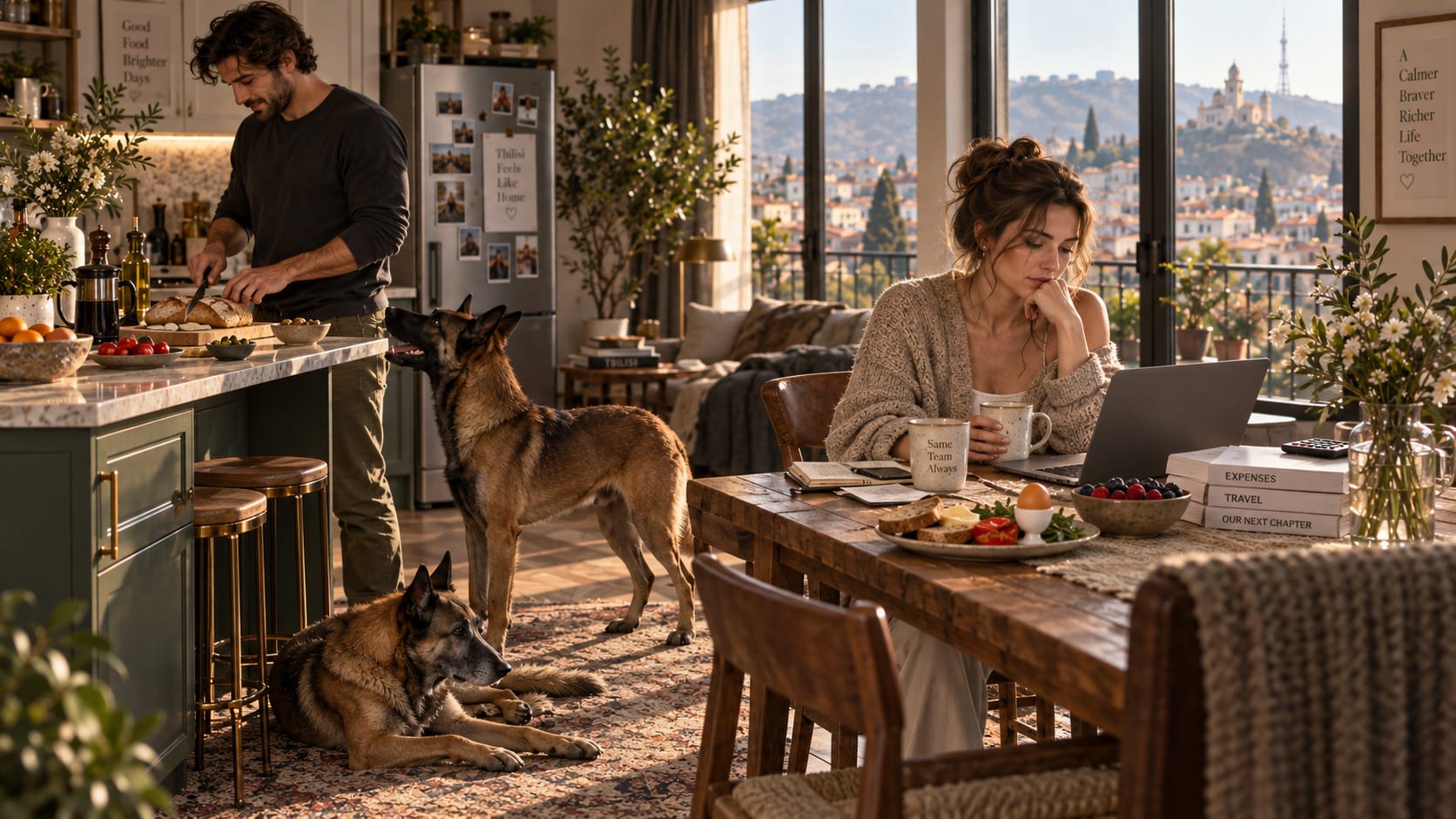
But after lunch I did sit down to count, and not Max, but us, and first decided to look at one month, then three, then reasoned that if I was going to lose my mind I might as well do it on an adequate statistical sample, and pulled up six months’ worth of transactions, telling myself for the first twenty minutes that I was not, in fact, drawing up an indictment, until a table appeared, and once a table appears in front of a lawyer there is usually no way back, so I entered the rent, the utilities, the school, the groceries, the dogs, the car, the household expenses, the restaurants, the trips and everything else I could reconstruct from the bank transactions: some expenses were obvious at once, others I recognised only by the name of the shop, and some remained a mystery, because four months later it’s almost impossible to work out how anyone managed to spend a hundred and twenty lari in a place whose name now means absolutely nothing to them.
After an hour the figure at the bottom of the table had become fairly unpleasant, after an hour and a half I opened another period, after two I closed the laptop, then opened it again, but the figure, naturally, hadn’t gone anywhere, and I sat looking at it with that specific irritation you feel not towards a person but towards your own capacity to spend far too long not noticing the obvious.
He came back towards evening with dog food, two bags of groceries and some new sauce for the barbecue, and when he proudly showed me the bottle and I remarked that we already had sauces, he replied that we definitely didn’t have this one, and here I nearly said the thing I would have considered petty and stupid five minutes later, and not because of the sauce, which in itself was entirely blameless, but because after two hours spent with the table I suddenly saw in that little bottle not a little bottle but a whole system, because Max had a perfectly reasonable explanation for every purchase of this kind: this was on offer, we had to go there anyway, it was cheaper to get it now, and that one had simply come up at a good price. And no single purchase ever looked like a problem in itself, because life rarely bankrupts a person with one big bottle of sauce. It does it much more delicately. A little at a time. On offer.
“Any good?” I asked.
“Don’t know. We’ll try it.”
Max put the bottle in the fridge, and I said nothing, and it was probably at that moment that I first truly understood that money becomes a problem in a relationship far earlier than it runs out: sometimes there’s plenty of it, it’s just that one person knows exactly what it’s worth, and the other knows which sauce was on offer today.
Between Us
There’s a very comforting phrase: “We never counted who contributed what.” It sounds lovely, almost like proof of real love. Other people, supposedly, have their bookkeeping, their dividing things up, their mine and yours, who paid for dinner and who bought the washing machine, while with us everything is shared because we’re apparently above all that, and I used to think much the same way. The point isn’t even that you absolutely must split every bill in half, because that, to my mind, is a rather strange way to spend many years beside a person: in one family one earns more and the other less, one contributes money, the other gives time, one cooks dinner and the other pays for the house, and that balance shifts back and forth, and sometimes isn’t expressed in any figures at all.
But there’s a difference between not counting and not knowing, and I never wanted to present Max with a bill for the years we’d spent together, and I wasn’t about to put a cash value on his trips to the market, the dinners he’d cooked, his school runs and the endless tradesmen he somehow seemed to know, because love is terrible at bookkeeping, and too much of what matters simply can’t be entered into any column at all, but the house suddenly demanded figures, and it turned out that I’d been calling some things “ours” for years simply because it felt nicer that way.
Our house. Our expenses. Our plans. Our money.
The house was a little more complicated. We were planning to buy it together, but the only real money available for it was what remained from the sale of my St Petersburg flat, which I’d owned before I met Max.