On Entrances, Counts and Food Delivery | St Petersburg. This Is Normal. – Chapter 3
The wonderful thing about a St Petersburg paradnaya is that you never know what you’ll find behind the door. From the street, you may be looking at a magnificent late-nineteenth-century building with stone Atlantes supporting a balcony, elaborate plasterwork above the windows and a memorial plaque informing you that an important person lived here from 1898 to 1903. You’ll forget the name within a minute, but the wording makes it perfectly clear that the person was distinguished.
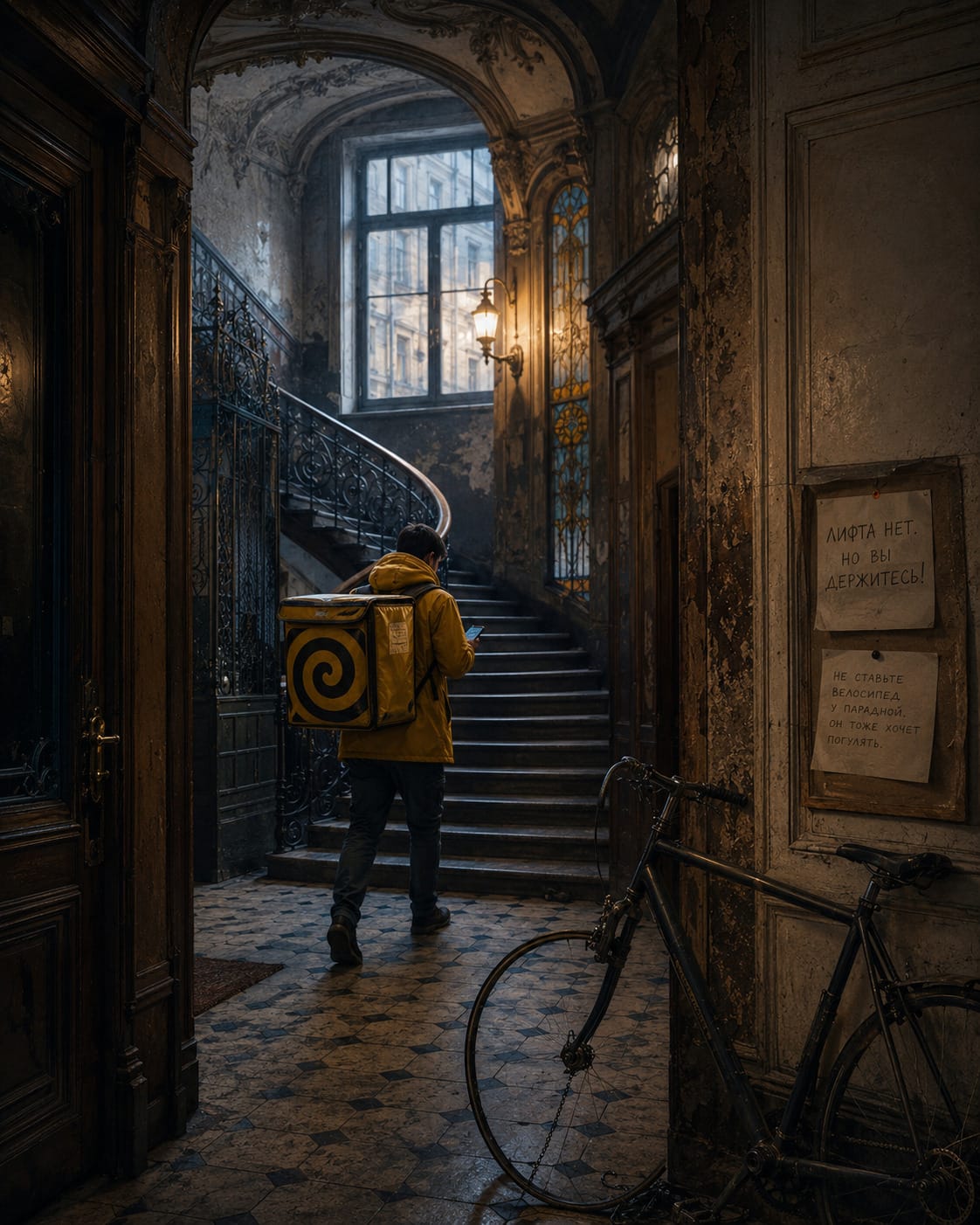
You open the heavy door and the first thing you see is a bicycle with no front wheel.
Why it has no front wheel, where the wheel went and who the bicycle belongs to are unknown. Perhaps it has been standing there since 1898 along with the distinguished person. On the wall nearby is a notice asking residents not to leave rubbish on the stairs, and directly beneath the notice is a bag of rubbish. Slightly higher up is another appeal politely but firmly requesting that residents keep the entrance door closed.
The door, naturally, does not close.
The notices in St Petersburg entrances could probably fill a book of their own, because you can reconstruct the entire history of relations between the residents from them. It begins politely: “Dear neighbours, please do not leave bicycles by the entrance.” A week later, a new notice appears in larger type: “REMOVE THE BICYCLES.” A few days after that, somebody adds underneath in pen: “WHERE TO?”
At this point the parties usually move on to face-to-face communication, and the written record comes to an end.
Then you look up and see the old plasterwork, cast-iron railings, fragments of stained glass, enormous windows and a broad staircase that is almost impossible to climb quickly because you keep wanting to stop and look at the details. At precisely that moment, a delivery rider carrying a huge brightly coloured bag comes down from upstairs, carefully steps around the wheel-less bicycle and asks where apartment forty-seven is.
That, perhaps, is St Petersburg in its purest form.
Merchants, civil servants, professors and actual state councillors once lived in these buildings. People held parties, argued about literature, survived a revolution, divided apartments, squeezed more families into them, divided them again, moved out, sold individual rooms, joined them back together, installed European-style renovations and then ripped those renovations out in an attempt to restore the historic interior. Now a young man in a helmet is trying to locate what may once have been a count’s study because someone has ordered tom yum to it.
I particularly enjoy the stories residents of old buildings tell about the history of their apartments. Almost inevitably, it turns out that a count once lived there. Exactly which count is usually unclear, but everyone knows for certain that the large room was his study, the smaller one was probably his bedroom, and something extremely valuable used to stand over there until the Revolution happened.
Ask how they know all this and the answer is usually:
“Our neighbour told us.”
The neighbour is eighty-seven and moved into the apartment in 1964, but the information is considered completely reliable.
I never argue. In St Petersburg, there is little point in arguing with someone who tells you that a count once lived in their apartment. He very well may have. It isn’t even particularly surprising here. If you listen carefully to enough stories from residents of the city’s old housing stock, you may eventually conclude that pre-revolutionary St Petersburg contained roughly as many counts as the city now contains delivery riders, but St Petersburg likes these stories and has never been particularly interested in fact-checking them.
Besides, the truth here is usually no less strange. A count really might have lived in that apartment.
It’s just that his study is now a parcel collection point.
And that’s perfectly normal.