Book Appointment Now



Read Nobody Told Me About Tbilisi FreeThe prologue and first five chapters of Olga Sverchkova’s book
I came to Tbilisi for a little while. At least, that was how it started. Then the suitcases were unpacked, the streets became familiar, and there were neighbours, dogs, favourite places and stories that somehow seem to happen only here.
On this page, you can read the prologue and first five chapters of Nobody Told Me About Tbilisi for free. No sign-up and no jumping from page to page. Just start reading and see whether you’d like to stay in this Tbilisi a little longer.
On this page, you can read the prologue and first five chapters of Nobody Told Me About Tbilisi for free. No sign-up and no jumping from page to page. Just start reading and see whether you’d like to stay in this Tbilisi a little longer.
Prologue of Nobody Told Me About Tbilisi
I Came to Tbilisi for a Little While

Any resemblance to real people is purely coincidental. Any resemblance to Tbilisi is inevitable.
I came to Tbilisi for a little while. At least, that’s what I kept telling everyone. It’s funny how useful the phrase “just for a little while” can be. It lets you avoid making plans, buying too much, getting attached, finding a favourite café, learning street names, or thinking too far ahead.
I’ll stay a bit, then move on. That’s what I believed.
Then I found my favourite bakery. Then there was the shopkeeper who greeted me before I had the chance to greet her. Then the dog that seemed to be waiting for me on the same street almost every morning. Then the taxi driver who insisted he knew the way better than Google Maps. Sometimes he actually did.
And somehow, without noticing, those little things became my everyday life. This isn’t a guidebook. You won’t find a list of places you simply have to visit. Not because those places don’t exist, but because everyone has their own. For some, it’s an old carved wooden balcony. For others, it’s the smell of fresh shoti bread early in the morning. Or a quiet courtyard where children play until dusk. Or a conversation with a complete stranger that somehow ends as if you’ve known each other for years.
I’m not trying to explain Tbilisi. Honestly, I’m not even sure that’s possible. I simply want to tell a few stories – about a city, about its people, and about the quiet moment when a place that wasn’t yours somehow becomes home.
Because that’s how it always begins. “I’m only here for a little while.”
I came to Tbilisi for a little while. At least, that’s what I kept telling everyone. It’s funny how useful the phrase “just for a little while” can be. It lets you avoid making plans, buying too much, getting attached, finding a favourite café, learning street names, or thinking too far ahead.
I’ll stay a bit, then move on. That’s what I believed.
Then I found my favourite bakery. Then there was the shopkeeper who greeted me before I had the chance to greet her. Then the dog that seemed to be waiting for me on the same street almost every morning. Then the taxi driver who insisted he knew the way better than Google Maps. Sometimes he actually did.
And somehow, without noticing, those little things became my everyday life. This isn’t a guidebook. You won’t find a list of places you simply have to visit. Not because those places don’t exist, but because everyone has their own. For some, it’s an old carved wooden balcony. For others, it’s the smell of fresh shoti bread early in the morning. Or a quiet courtyard where children play until dusk. Or a conversation with a complete stranger that somehow ends as if you’ve known each other for years.
I’m not trying to explain Tbilisi. Honestly, I’m not even sure that’s possible. I simply want to tell a few stories – about a city, about its people, and about the quiet moment when a place that wasn’t yours somehow becomes home.
Because that’s how it always begins. “I’m only here for a little while.”
Chapter 1 of Nobody Told Me About Tbilisi
On People Who Say, “I’ll Be Right Back”

There is one sentence in Tbilisi that I don’t believe anymore: “I’ll be right back.” During my first month here, I believed everyone. If someone said, “I’m just going out to buy some bread,” I honestly expected them back in ten minutes. Then I learned that bread isn’t really the point. In this story, bread is just an excuse.
One day I decided to buy some bread myself. Five minutes, I thought – ten at the most. I didn’t even take my phone. I was only going to the bakery.
Two minutes later I was stopped by my neighbour from the third floor, the one who knows everything before everyone else. Sometimes even before it happens.
“Hello! How are you?” You can’t answer “fine” and keep walking. Not in Tbilisi – that’s just how the conversation starts. A few minutes later I knew her grandson Giga had got a place at university. She said it as if the whole building had got in.
Then I knew where to buy the best tomatoes that day. Then we talked about the new produce shop. “It’s all right,” she said. “But the old one was better.” “Where was the old one?” I asked. I don’t know why I asked. I was never going to go there. But somehow it already mattered to me. I was finally about to leave when she lowered her voice, the way people here lower it only for important things: “There’s fresh shoti coming out of the oven on the next street. If you’re buying some, go now.”
Now that mattered, because good shoti doesn’t wait. Tomorrow it’s just yesterday’s bread. By the time I reached the bakery, the bread was gone. I came home almost an hour later, without bread. But I knew where to buy the best tomatoes, where the old produce shop used to be, where to find the best shoti – and that my neighbour’s grandson is called Giga.
Since then, whenever someone in Tbilisi says, “I’ll be right back,” I just nod. Because I know how this story ends. You really can buy bread in five minutes – you just have to avoid running into anyone.
✦ Word of the Day: Male (MAH-leh) – “soon”. The most honest word in the language: it promises nothing specific.
One day I decided to buy some bread myself. Five minutes, I thought – ten at the most. I didn’t even take my phone. I was only going to the bakery.
Two minutes later I was stopped by my neighbour from the third floor, the one who knows everything before everyone else. Sometimes even before it happens.
“Hello! How are you?” You can’t answer “fine” and keep walking. Not in Tbilisi – that’s just how the conversation starts. A few minutes later I knew her grandson Giga had got a place at university. She said it as if the whole building had got in.
Then I knew where to buy the best tomatoes that day. Then we talked about the new produce shop. “It’s all right,” she said. “But the old one was better.” “Where was the old one?” I asked. I don’t know why I asked. I was never going to go there. But somehow it already mattered to me. I was finally about to leave when she lowered her voice, the way people here lower it only for important things: “There’s fresh shoti coming out of the oven on the next street. If you’re buying some, go now.”
Now that mattered, because good shoti doesn’t wait. Tomorrow it’s just yesterday’s bread. By the time I reached the bakery, the bread was gone. I came home almost an hour later, without bread. But I knew where to buy the best tomatoes, where the old produce shop used to be, where to find the best shoti – and that my neighbour’s grandson is called Giga.
Since then, whenever someone in Tbilisi says, “I’ll be right back,” I just nod. Because I know how this story ends. You really can buy bread in five minutes – you just have to avoid running into anyone.
✦ Word of the Day: Male (MAH-leh) – “soon”. The most honest word in the language: it promises nothing specific.
Chapter 2 of Nobody Told Me About Tbilisi
On the Bread That Never Makes It Home Whole
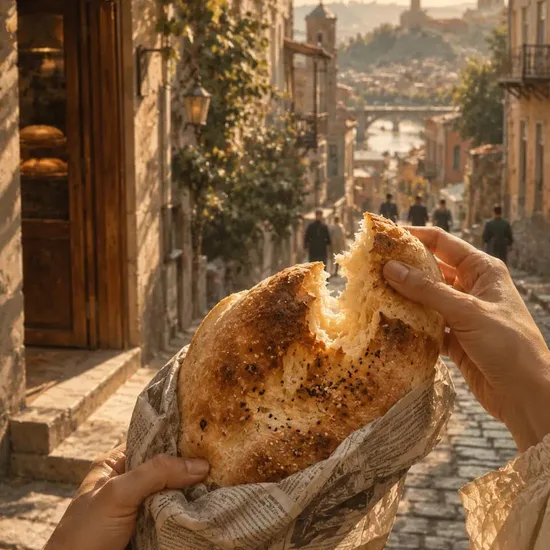
Hot bread is never as big as you remember it. Fresh shoti exists in two states: before the first piece is torn off, and after. The baker wraps it in a newspaper. Not the whole thing – just enough to protect your hand. The smell takes care of itself.
For the first twenty steps, you behave yourself. Then you break off a tiny corner – just to check if it’s still hot. Then another. After that, it’s too late to stop. Then someone spots the bread – a neighbour, the woman selling herbs, someone you’ve seen maybe twice in your life. They look at you first, then at the newspaper bundle. Always with the same expression.
“Hot?”
“Hot.”
“Let me try.”
You break off another corner, not for yourself this time.
By the end of the block, it’s obvious you’re no longer taking the whole loaf home. At home they’ll ask: “Was it really that small?” And you’ll answer honestly: “No. It was much bigger.” They won’t believe you, but they won’t argue either – they would have done exactly the same.
There is probably someone in Tbilisi who has carried a hot shoti all the way home without breaking off a single piece. I’ve just never met them.
✦ Word of the Day: Shoti (SHOH-tee) – a traditional Georgian bread that somehow gets smaller with every step from the bakery to your home.
For the first twenty steps, you behave yourself. Then you break off a tiny corner – just to check if it’s still hot. Then another. After that, it’s too late to stop. Then someone spots the bread – a neighbour, the woman selling herbs, someone you’ve seen maybe twice in your life. They look at you first, then at the newspaper bundle. Always with the same expression.
“Hot?”
“Hot.”
“Let me try.”
You break off another corner, not for yourself this time.
By the end of the block, it’s obvious you’re no longer taking the whole loaf home. At home they’ll ask: “Was it really that small?” And you’ll answer honestly: “No. It was much bigger.” They won’t believe you, but they won’t argue either – they would have done exactly the same.
There is probably someone in Tbilisi who has carried a hot shoti all the way home without breaking off a single piece. I’ve just never met them.
✦ Word of the Day: Shoti (SHOH-tee) – a traditional Georgian bread that somehow gets smaller with every step from the bakery to your home.
Chapter 3 of Nobody Told Me About Tbilisi
On Balconies, Where Half of Life Is Kept

Hot bread is never as big as you remember it. Fresh shoti exists in two states: before the first piece is torn off, and after. The baker wraps it in a newspaper. Not the whole thing – just enough to protect your hand. The smell takes care of itself.
For the first twenty steps, you behave yourself. Then you break off a tiny corner – just to check if it’s still hot. Then another. After that, it’s too late to stop. Then someone spots the bread – a neighbour, the woman selling herbs, someone you’ve seen maybe twice in your life. They look at you first, then at the newspaper bundle. Always with the same expression.
“Hot?”
“Hot.”
“Let me try.”
You break off another corner, not for yourself this time.
By the end of the block, it’s obvious you’re no longer taking the whole loaf home. At home they’ll ask: “Was it really that small?” And you’ll answer honestly: “No. It was much bigger.” They won’t believe you, but they won’t argue either – they would have done exactly the same.
There is probably someone in Tbilisi who has carried a hot shoti all the way home without breaking off a single piece. I’ve just never met them.
✦ Word of the Day: Shoti (SHOH-tee) – a traditional Georgian bread that somehow gets smaller with every step from the bakery to your home.
For the first twenty steps, you behave yourself. Then you break off a tiny corner – just to check if it’s still hot. Then another. After that, it’s too late to stop. Then someone spots the bread – a neighbour, the woman selling herbs, someone you’ve seen maybe twice in your life. They look at you first, then at the newspaper bundle. Always with the same expression.
“Hot?”
“Hot.”
“Let me try.”
You break off another corner, not for yourself this time.
By the end of the block, it’s obvious you’re no longer taking the whole loaf home. At home they’ll ask: “Was it really that small?” And you’ll answer honestly: “No. It was much bigger.” They won’t believe you, but they won’t argue either – they would have done exactly the same.
There is probably someone in Tbilisi who has carried a hot shoti all the way home without breaking off a single piece. I’ve just never met them.
✦ Word of the Day: Shoti (SHOH-tee) – a traditional Georgian bread that somehow gets smaller with every step from the bakery to your home.
Chapter 4 of Nobody Told Me About Tbilisi
On the Salt That Comes Down From the Third Floor

One day I ran out of salt. I did what anyone from my previous life would do: I took my bag and headed for the shop. I made it as far as the courtyard.
“Where are you going?” asked my neighbour from the third floor. The one who knows everything before everyone else.
“To buy salt.”
“Why?!”
She said it as if I’d announced I was going to Kutaisi for salt. “Listen, do you have any salt?” she called upstairs – and a minute later, from the third floor, on a clothesline tied to a wicker basket, salt actually came down.
Nobody in the courtyard found this strange. It’s simply logistics the rest of the world hasn’t figured out yet. Later I learned that the basket works both ways. Up goes whatever is needed urgently. Down – whatever is too good to throw away: half a lavash, three tomatoes, a greeting card from last New Year.
In the evenings, the same clothesline becomes a witness to far more serious negotiations. I listen to them from my balcony.
“The loquats are worse this year than last.”
“Worse? You haven’t tried Gia’s.”
“Gia’s are always better. Even Gia’s asphalt is better.”
The argument is conducted with the intonation of an election dispute, not a conversation about four trees in a courtyard. It always ends the same way: nowhere. Until the next evening. By then the basket is already back upstairs – waiting for someone to urgently need something again.
As for the salt – I never did buy any. I have a feeling I’ll never need to.
✦ Word of the Day: Loquat – in Georgian, mushmula (moosh-moo-LAH) – a small yellow fruit that every summer starts arguments capable of outliving any friendship.
“Where are you going?” asked my neighbour from the third floor. The one who knows everything before everyone else.
“To buy salt.”
“Why?!”
She said it as if I’d announced I was going to Kutaisi for salt. “Listen, do you have any salt?” she called upstairs – and a minute later, from the third floor, on a clothesline tied to a wicker basket, salt actually came down.
Nobody in the courtyard found this strange. It’s simply logistics the rest of the world hasn’t figured out yet. Later I learned that the basket works both ways. Up goes whatever is needed urgently. Down – whatever is too good to throw away: half a lavash, three tomatoes, a greeting card from last New Year.
In the evenings, the same clothesline becomes a witness to far more serious negotiations. I listen to them from my balcony.
“The loquats are worse this year than last.”
“Worse? You haven’t tried Gia’s.”
“Gia’s are always better. Even Gia’s asphalt is better.”
The argument is conducted with the intonation of an election dispute, not a conversation about four trees in a courtyard. It always ends the same way: nowhere. Until the next evening. By then the basket is already back upstairs – waiting for someone to urgently need something again.
As for the salt – I never did buy any. I have a feeling I’ll never need to.
✦ Word of the Day: Loquat – in Georgian, mushmula (moosh-moo-LAH) – a small yellow fruit that every summer starts arguments capable of outliving any friendship.
Chapter 5 of Nobody Told Me About Tbilisi
On Taxi Drivers Who’ve Already Decided
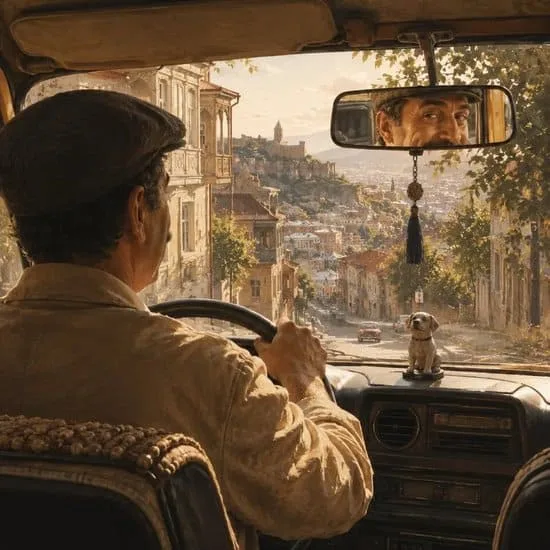
In Tbilisi, a taxi driver never asks how to get there. He only asks for the address. Everything else has already been decided. When you tell him the address, he nods. That doesn’t mean he agrees. It means he’s already chosen a different route and is politely waiting for you to finish talking.
A minute later, you’ll learn that your street is closed – even though it isn’t. That there are roadworks – even though there aren’t. And that he knows a shorter way: through a courtyard, past the market, along the river. It doesn’t matter where. What matters is that it isn’t the way you suggested.
If you try to argue, you catch his eye in the rearview mirror. It’s the look of a man who genuinely feels sorry for you. Because you still haven’t understood one simple thing: the decision has already been made.
“Why go that way, genatsvale? This way’s shorter.”
Prayer beads hang from the rearview mirror. Nobody touches them. They’re there exclusively for the passengers who are beginning to panic. On the way, he’ll honk twice – not in anger, just saying hello. Once he’ll pull over by a fruit stall, exchange a few words with the vendor, and drive on. You’ll start to get nervous. Don’t. The meter won’t notice – but the driver now knows the figs aren’t worth buying today. Tomorrow they’ll be better.
And somehow, you really do arrive faster than the GPS predicted. Just not exactly where you thought you were going. But exactly where, as it turns out, you needed to be.
Arguing is pointless. Not because he’s right. Because he’s already decided he is.
✦ Word of the Day: Genatsvale (geh-nahts-VAH-leh) – a word that can mean “dear friend”… or “I’m about to explain why you’re wrong.”
A minute later, you’ll learn that your street is closed – even though it isn’t. That there are roadworks – even though there aren’t. And that he knows a shorter way: through a courtyard, past the market, along the river. It doesn’t matter where. What matters is that it isn’t the way you suggested.
If you try to argue, you catch his eye in the rearview mirror. It’s the look of a man who genuinely feels sorry for you. Because you still haven’t understood one simple thing: the decision has already been made.
“Why go that way, genatsvale? This way’s shorter.”
Prayer beads hang from the rearview mirror. Nobody touches them. They’re there exclusively for the passengers who are beginning to panic. On the way, he’ll honk twice – not in anger, just saying hello. Once he’ll pull over by a fruit stall, exchange a few words with the vendor, and drive on. You’ll start to get nervous. Don’t. The meter won’t notice – but the driver now knows the figs aren’t worth buying today. Tomorrow they’ll be better.
And somehow, you really do arrive faster than the GPS predicted. Just not exactly where you thought you were going. But exactly where, as it turns out, you needed to be.
Arguing is pointless. Not because he’s right. Because he’s already decided he is.
✦ Word of the Day: Genatsvale (geh-nahts-VAH-leh) – a word that can mean “dear friend”… or “I’m about to explain why you’re wrong.”
Stay in Tbilisi a Little Longer
You’ve Reached the End of the Free Chapters
You’ve read the prologue and the first five chapters. The full edition continues with 25 more illustrated stories about everyday life in Tbilisi.