

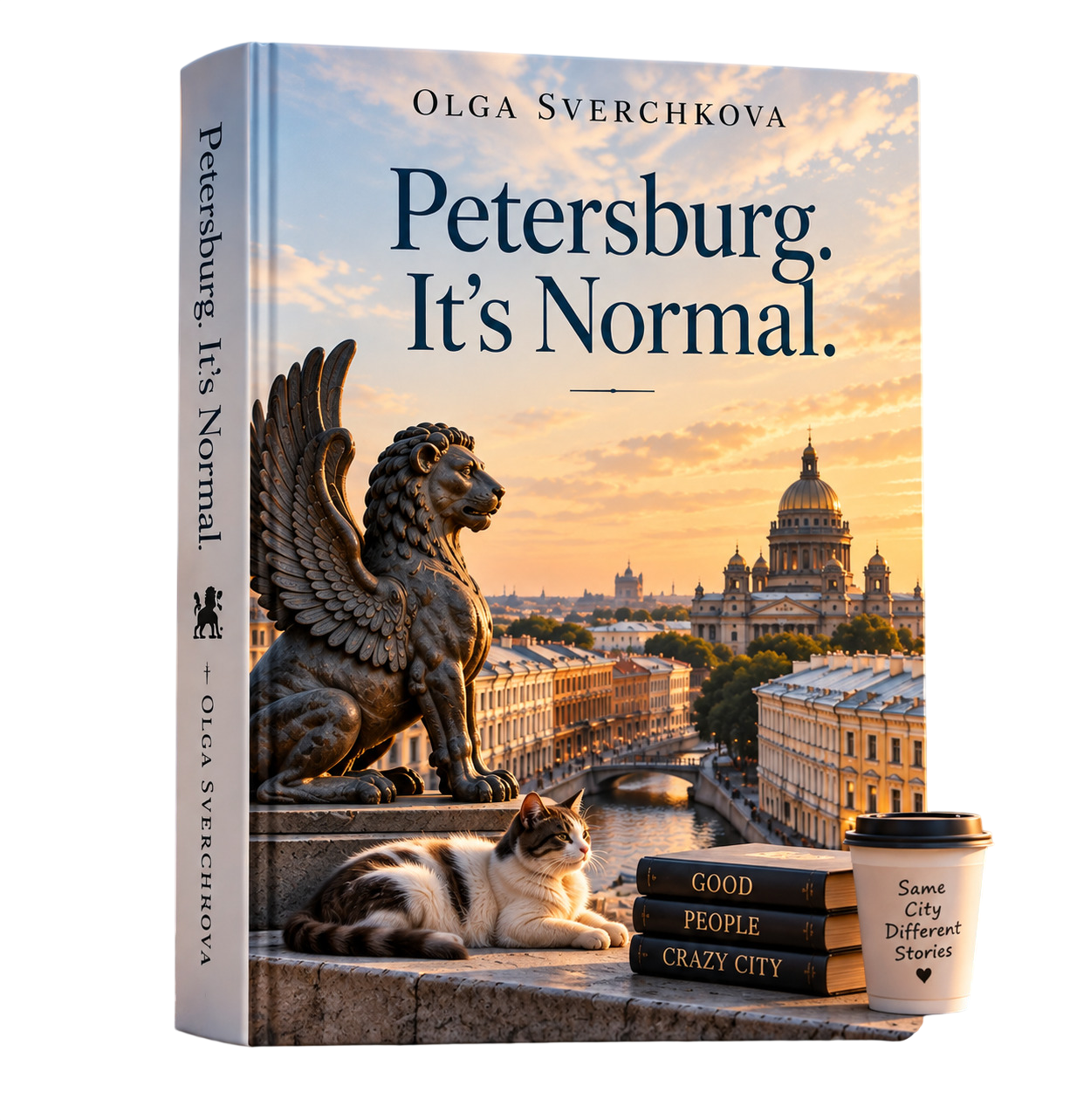
Read Petersburg. It’s Normal. FreeThe first three chapters of Olga Sverchkova’s book about St Petersburg
St Petersburg knows how to make a beautiful first impression: palaces, canals, embankments and White Nights. But live there long enough and a different city gradually begins to appear, one where the weather forecast guarantees very little, perfectly ordinary words suddenly need translating, and you can never be entirely sure what you will find behind the door of an old entrance.
Petersburg. It’s Normal. is a collection of short, ironic stories about everyday life in a city where I lived and worked for more than twenty years. There is no need to go looking for extraordinary events. Sometimes it is enough simply to pay attention to the ordinary ones.
On this page, you can read the first three chapters for free: “On Weather You Can’t Trust”, “On the Language St Petersburg Speaks” and “On Entrances, Counts and Food Delivery”. All three chapters are here on one page, with no sign-up required.
Petersburg. It’s Normal.
Chapter 1. On Weather You Can’t Trust
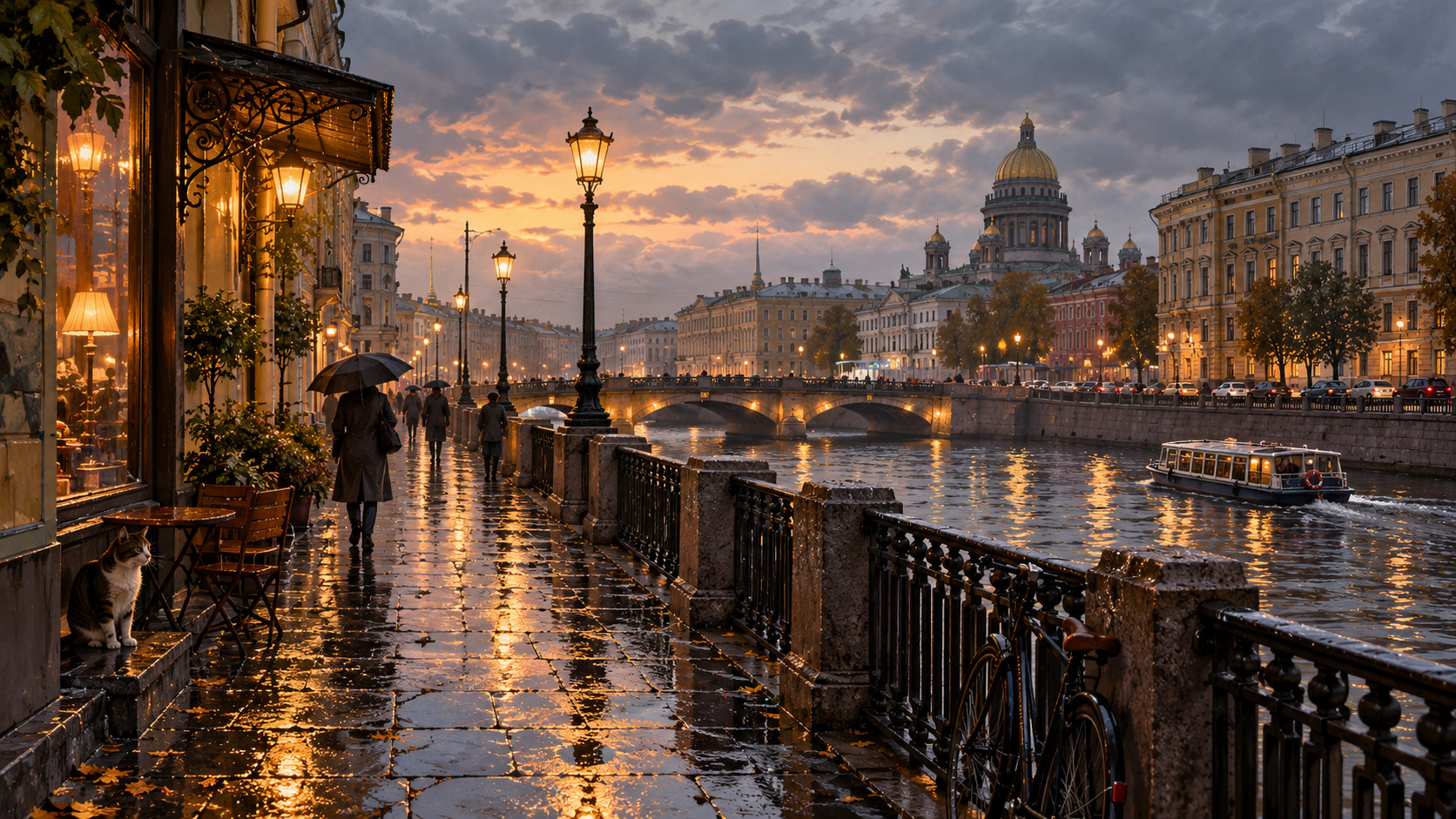
There is very little point in discussing the weather in St Petersburg, because by the time you finish discussing it, it will already have changed. You can leave home in the morning under a perfectly respectable blue sky, put on sunglasses and spend several minutes believing that all those stories about the St Petersburg climate have been greatly exaggerated by people who simply don’t know how to enjoy life. Twenty minutes later, you’ll be standing under the awning of some shop watching the rain fly along Nevsky Prospekt. And I do mean fly, because falling vertically seems far too conventional for St Petersburg rain.
For years, I kept checking the weather forecast anyway, although I have no idea why. Probably for much the same reason people sometimes read horoscopes: it’s interesting to see what you’ve been promised for the day. Your phone says eighteen degrees, partly cloudy, ten per cent chance of rain, and an hour later you arrive at a meeting with wet hair and trousers sticking to your legs. The rain usually isn’t even heavy enough for you to announce with any dignity that you were caught in a downpour. No, it’s the fine, persistent sort that has been quietly ruining you all the way there and then stops the exact moment you step indoors.
The person you’re meeting looks through the window at the perfectly dry street and asks:
“Was it raining?”
I usually resist the temptation to say that I decided to take a quick swim in the Fontanka on my way over.
At least rain is straightforward. The St Petersburg wind is much more interesting. It has an extraordinary ability to find the one part of your body you failed to protect. You can put on a coat and a scarf, button yourself up to the chin and leave home completely confident that you’ve prepared for everything, only to discover three minutes later on the embankment that there are two square centimetres of exposed neck somewhere between your collar and your scarf, and the entire force of the Gulf of Finland is now being directed precisely there.
This is why the phrase “It’s warm today” means absolutely nothing in St Petersburg. Fifteen degrees can indeed feel warm if there is no wind, the sun is shining and you’re standing in a sheltered courtyard. The same fifteen degrees on the embankment can turn into February within five minutes, and you start wondering why you didn’t bring a jacket, a scarf, gloves and your emigration papers.
The people of St Petersburg, meanwhile, accept all of this with remarkable calm. If it snows in May, people say it happens. If it rains in January, well, that’s the kind of winter we’re having. If it’s twelve degrees in July, nobody considers that an event at all. Real concern begins when the weather stays nice for several days in a row. By the third or fourth day, people start looking suspiciously at the cloudless sky and saying, “It’s been warm for quite a while.” There isn’t much joy in that sentence. It’s the quiet suspicion of people who know from experience that the city may simply be saving up its strength for something.
But the moment real sunshine appears, St Petersburg changes instantly. People pour onto the embankments, sit on the steps by the water, occupy every outdoor table, buy coffee and turn their faces towards the sun as if it were a touring celebrity and they’d somehow managed to get tickets. On days like these, even the city itself looks slightly surprised, as though it hadn’t expected things to turn out quite this well.
Perhaps that’s why you can never postpone a beautiful day in St Petersburg until tomorrow. If the sun is shining today, you go for a walk today, even if you have work to do, even if you had planned to do something useful, and especially if the forecast promises the same weather all week.
We know what those promises are worth.
Petersburg. It’s Normal.
Chapter 2. On the Language St Petersburg Speaks
I never understood why people found the word porebrik so amusing. To me, a porebrik had always been a porebrik, a paradnaya was a paradnaya, and shaverma was shaverma. It was only much later that I discovered these weren’t simply words but a kind of identification system St Petersburg had installed at its borders without any assistance from the immigration authorities.
It’s actually quite easy to determine whether someone belongs to the city. You don’t need to ask where they were born, how long they’ve lived here or whether they can get from Nevsky Prospekt to Rubinstein Street without consulting a map. Just point at the edge of the pavement. If they call it a bordyur, you know.
Nobody will correct them, of course. St Petersburg is a cultured city. People here rarely tell someone directly that they’re wrong. They simply look at them for a moment.
That particular St Petersburg look deserves a study of its own. There’s no aggression in it and hardly any judgement. It’s closer to mild regret that a grown adult has managed to live this long without knowing something so elementary. It’s roughly the expression an old-school literature professor might give a student who has just confused Pushkin with Lermontov. It’s too late to be angry. One can only accept what has happened.
But porebrik is only the beginning. St Petersburg has an entire language of its own, and the people who live here usually don’t even notice that they’re speaking it. A perfectly ordinary conversation can begin with, “I’m on Petrogradka,” and nobody feels the need to provide a street, a building number or the nearest landmark. The person has stated their position with what they consider sufficient geographical precision. The rest is your problem.
It’s equally natural to suggest meeting “by Gostinka”. Exactly where beside Gostiny Dvor, which takes up an entire city block, is something you can work out later, sometimes after both people have spent fifteen minutes standing on opposite sides of the building texting each other, “I’m here.” The best part is that both of them really are there, and both genuinely fail to understand how the other person has managed to get lost.
St Petersburg measures distance in its own way too. Ask, “Is it far?” and you may receive the perfectly comprehensive answer, “No, just two stops.” Metro stops, obviously. Nobody sees any reason to specify this. Admittedly, two stops can sometimes turn into a modest expedition involving a transfer, a long escalator, another passageway and that peculiar moment when you’re standing somewhere deep underground and can no longer quite remember why you came down here in the first place.
The city is also remarkably quick to give everything affectionate nicknames. Petrogradskaya becomes Petrogradka, Vasilyevsky Island becomes Vaska, and Gostiny Dvor becomes Gostinka. For three centuries St Petersburg has presented the world with palaces, colonnades, granite and imperial grandeur, while its residents speak about all of it among themselves as though it belongs to one large family and everyone agreed long ago that there was no need to be formal.
Even shaverma has its rightful place in this system. Newcomers from Moscow may arrive confidently saying shaurma, as they do at home, but St Petersburg has time on its side. A few years later, some of them find themselves quietly wincing when they hear somebody else say it.
And then there is paradnaya: the St Petersburg word for what most of Russia calls a podyezd and an English speaker would probably just call an entrance. At first it sounds like one more local peculiarity. Then one day, in another city, you say, “Let’s meet by the paradnaya,” and someone asks, “By the what?”
That may be the moment when you finally become a Petersburger.
By then, St Petersburg has long since made the decision for you.
Petersburg. It’s Normal.
Chapter 3. On Entrances, Counts and Food Delivery
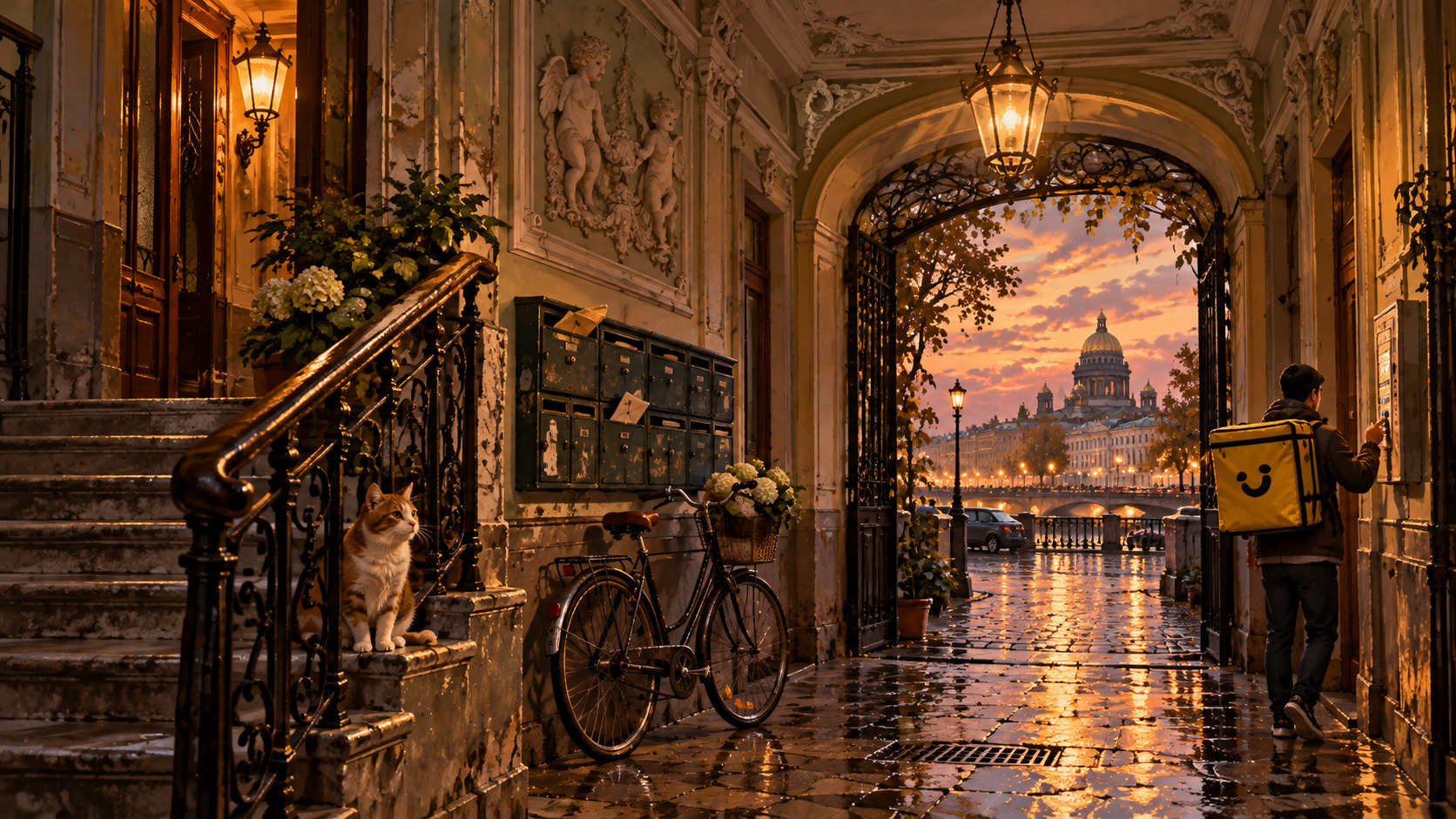
The wonderful thing about a St Petersburg paradnaya is that you never know what you’ll find behind the door. From the street, you may be looking at a magnificent late-nineteenth-century building with stone Atlantes supporting a balcony, elaborate plasterwork above the windows and a memorial plaque informing you that an important person lived here from 1898 to 1903. You’ll forget the name within a minute, but the wording makes it perfectly clear that the person was distinguished.
You open the heavy door and the first thing you see is a bicycle with no front wheel.
Why it has no front wheel, where the wheel went and who the bicycle belongs to are unknown. Perhaps it has been standing there since 1898 along with the distinguished person. On the wall nearby is a notice asking residents not to leave rubbish on the stairs, and directly beneath the notice is a bag of rubbish. Slightly higher up is another appeal politely but firmly requesting that residents keep the entrance door closed.
The door, naturally, does not close.
You could probably reconstruct the entire history of relations between the residents from the notices in a St Petersburg entrance. It begins politely: “Dear neighbours, please do not leave bicycles by the entrance.” A week later, a new notice appears in larger type: “REMOVE THE BICYCLES.” A few days after that, somebody adds underneath in pen: “WHERE TO?”
At this point the parties usually move on to face-to-face communication, and the written record comes to an end.
Then you look up and see the old plasterwork, cast-iron railings, fragments of stained glass, enormous windows and a broad staircase that is almost impossible to climb quickly because you keep wanting to stop and look at the details. At precisely that moment, a delivery rider carrying a huge brightly coloured bag comes down from upstairs, carefully steps around the wheel-less bicycle and asks where flat forty-seven is.
Merchants, professors and high-ranking officials once lived in these buildings. People held parties, argued about literature, survived a revolution, divided flats, squeezed more families into them, divided them again, moved out, sold individual rooms, joined them back together, gave them glossy “Euro-renovations” and then ripped those renovations out in an attempt to restore the historic interior.
Now a young man in a helmet is trying to locate what may once have been a count’s study because someone has ordered tom yum to it.
That is St Petersburg in its purest form.
I particularly enjoy the stories residents of old buildings tell about the history of their flats. Almost inevitably, it turns out that a count once lived there. Exactly which count is usually unclear, but everyone knows for certain that the large room was his study, the smaller one was probably his bedroom, and something extremely valuable used to stand over there until the Revolution happened.
Ask how they know all this and the answer is usually:
“Our neighbour told us.”
The neighbour is eighty-seven and moved into the flat in 1964, but the information is considered completely reliable.
I never argue. In St Petersburg, there is little point in arguing with someone who tells you that a count once lived in their flat. He very well may have. It isn’t even particularly surprising here. If you listen carefully to enough stories from residents of the city’s old housing stock, you may eventually conclude that pre-revolutionary St Petersburg contained roughly as many counts as the city now contains delivery riders, but St Petersburg likes these stories and has never been particularly interested in fact-checking them.
Besides, the truth here is usually no less strange. A count really might have lived in that flat.
It’s just that his study is now a parcel collection point.
And that’s perfectly normal.
Contact the Author
Questions about the book, reviews, interviews, or collaborations? You can reach me directly.