Book Appointment Now



Read The Alibi of St. Petersburg FreeThe first three chapters of Olga Sverchkova’s crime novel
Twenty-two years ago, Olga Vorontsova defended Alexei Gromov against a murder charge and won her first acquittal. She remembered the weaknesses in the prosecution’s case, the contradictions in the evidence and the verdict that allowed everyone involved to move on.
Now Olga is closing her St Petersburg office and preparing to leave for Tbilisi when a message arrives from an unknown number:
“You saved a murderer back then.”
On this page, you can read the first three chapters of The Alibi of St. Petersburg for free. No sign-up and no jumping between pages. Start with Olga’s last day as an advocate, return to Marina Lebedeva’s apartment on the evening of her murder, and meet the man Olga defended twenty-two years ago.
Now Olga is closing her St Petersburg office and preparing to leave for Tbilisi when a message arrives from an unknown number:
“You saved a murderer back then.”
On this page, you can read the first three chapters of The Alibi of St. Petersburg for free. No sign-up and no jumping between pages. Start with Olga’s last day as an advocate, return to Marina Lebedeva’s apartment on the evening of her murder, and meet the man Olga defended twenty-two years ago.
The Alibi of St. Petersburg
Chapter One. The Last Day

After more than twenty years of legal practice, I discovered that an entire life could fit into a few cardboard boxes, provided you did not ask yourself too many questions about why an old business card, a book you had not opened in ten years, or a photograph of someone whose number had long since disappeared from your phone had seemed important enough to occupy space in your office for so long.
The books were the easiest part. The ones I genuinely intended to reread one day went into one box, the rest into another, and then came the notebooks, diaries, conference photographs, other people’s business cards, gifted pens and endless stacks of paper whose purpose had once been perfectly obvious and now required a small investigation of their own. I labelled one box “Archive”, another “Give Away” and a third “Throw Out”, but a few minutes later I crossed out the last label and replaced it with “Think About It”. By evening, that box had become the heaviest, which, in a way, described my personality rather accurately.
When I became an advocate, none of this existed. There was no office, no steady stream of clients and certainly no habit of scheduling consultations for ten in the morning while knowing perfectly well that at ten sharp I would still be drinking coffee and convincing myself that being five minutes late hardly counted. Back then I genuinely believed that any criminal case could be understood if you read the documents carefully enough, checked the dates and were not afraid to ask people the questions they would rather avoid answering. As the years passed, the paperwork multiplied and the certainty slowly disappeared.
My phone rang while I was trying to decide the fate of an old volume of Russian Supreme Court rulings. Taking it to Tbilisi made no sense, but throwing it away felt wrong, even though I had probably not opened it since the days when important phone numbers were written down in paper diaries and somehow managed not to disappear forever.
It was Velsky.
He informed me that my farewell to the profession was far too quiet and that, in his opinion, there should have been flowers, journalists and at least a few grateful former clients waiting outside the office. I pointed out that the last part sounded especially realistic, and Velsky replied that some of them probably still remembered my name.
“Some of them probably still hate it.”
He laughed, while I absent-mindedly opened the book and noticed an old note on the inside cover.
Never trust a witness simply because he sounds confident.
Below it, in different handwriting, someone had added:
Or an advocate. A.V.
I could no longer remember when Velsky had written it. Judging by my own handwriting in the first line, it must have been a very long time ago, back when I highlighted legal articles with coloured markers and believed that a good advocate should remember Supreme Court rulings the way normal people remembered birthdays.
Velsky asked whether I was still at the office and when my flight was. When I told him it was the day after tomorrow, he said there was still plenty of time to change my mind.
“Alexander Lvovich, we’ve been having this conversation for three months.”
“Three months isn’t nearly enough time to get used to somebody else’s stupidity.”
“You got used to your own much faster.”
“Exactly. That’s what makes me an expert.”
I walked over to the window. Outside was a perfectly ordinary St Petersburg evening at the end of August, when people still sat on outdoor terraces during the day, tourists wandered along Nevsky Prospect in T-shirts, and then the wind rose towards evening and reminded everyone that summer was already over, even if the calendar had not quite caught up.
St Petersburg was my home. I had been born here, grown up here, built my life here and become an advocate here, and it was also where I had learned not to trust overly confident witnesses or explanations that sounded a little too neat. The idea of leaving felt strange, as though I were not simply packing up an office and an apartment but leaving part of my own history behind.
I looked at the familiar rooftops, the people hurrying somewhere and the façades I had stopped noticing years ago. The city had changed over time in the quiet, almost invisible way cities do: restaurants closed, new cafés appeared, streets were repaired and familiar signs disappeared, while St Petersburg remained around me as the circumstances of my own life kept changing. Perhaps that was why the thought of being the one to leave still felt slightly absurd.
Velsky asked whether I had truly made up my mind, and this time there was no trace of his usual sarcasm. I told him I had, and when he asked how long I intended to stay in Tbilisi, I admitted I had no idea. It might be a month, it might be a year, or perhaps two weeks before I called him and demanded the keys to my office back.
He threatened to throw them away, I told him he would not, and after a brief pause he admitted that, of course, he would not.
An old photograph lay on the windowsill, where I had left it after finding it that morning between a stack of magazines. Velsky and I were standing outside a courthouse. I looked younger, thinner and carried the expression of someone who had not yet learned to doubt her own conclusions, while Velsky stood slightly behind me, looking at me rather than at the camera. I put the photograph into the box with my personal things.
Before hanging up, Velsky told me to call him when I finally finished packing. When I asked why, he said he wanted proof that I had actually left because there was a very real danger that I would discover a corpse in the archives at the last moment and stay for another twenty years.
“All my corpses are neatly filed and catalogued.”
“That’s exactly what worries me.”
After the call, the book joined the “Think About It” box and I moved on to the final cabinet. Most of my old case files had long since been destroyed, some documents had been returned to clients and others had been digitised, but a handful of folders still occupied the bottom shelf even though there was no practical reason to keep them any more. They were not the biggest cases or even the most difficult ones. Each had simply found its own reason to remain in my memory: my first real defeat, the client who insisted he was innocent and lied to me from the beginning, the case that kept me awake for nights, and the client who confessed to a crime he had not committed because he could no longer endure the investigation.
Among them was the Gromov file.
The label on the spine read:
Alexei Viktorovich Gromov. Part 1 of Article 105 of the Russian Criminal Code.
I had not opened it in years, but some cases are like that. You can leave a file untouched for fifteen years and still remember it better than something you worked on last week.
A copy of the acquittal judgment lay on top, beginning with the familiar words:
In the name of the Russian Federation…
After that, I barely needed to read because I still remembered most of the circumstances.
Alexei Gromov had been thirty-one, a married businessman. He had been involved with Marina Lebedeva, a relationship he preferred not to discuss with either his wife or the investigators. Shortly before the murder they had argued, his fingerprints were found in her apartment, a neighbour heard a man’s voice, and Gromov lied about where he had been that evening.
To the prosecution, the story had looked straightforward, but it had never convinced me. I was twenty-nine in 2004 and had held my advocate’s status for only a year, so I still approached the profession with the seriousness of someone who believed every contradiction had an explanation if you kept asking the right questions. If the prosecution claimed Gromov had been in Marina’s apartment at a specific time while an expert suggested she might have died earlier, then I believed that contradiction had to be explained.
The contradiction was never properly explained. Instead, the deeper I went into the file, the more questions appeared: inconsistencies in the crime scene report, witness statements that contradicted one another and evidence collected in ways that made it difficult to establish where certain items had originally been found. Little by little, the prosecution’s version of events stopped looking as convincing as it had at the beginning, and Gromov was acquitted.
I remembered that day clearly: the wooden benches, the smell of wet coats, the dull light in the corridor, the judge’s calm voice and Gromov gripping the bars so tightly that his knuckles turned white. After the hearing, Velsky was waiting outside. He did not congratulate me and he did not hug me. We walked a short distance from the courthouse before he looked at me and said:
“Today you became an advocate.”
Formally, I had already been one for a year, but I understood exactly what he meant, and perhaps that was why I never forgot it.
I began turning the pages, moving from reports to photographs, expert opinions and witness statements. In one photograph, Gromov looked impossibly young, and that was when my phone vibrated.
The message came from an unknown number.
You saved a murderer back then.
I read it twice, then placed the phone face down and only a few moments later realised that I was still holding my finger between the pages of the file as though I did not want to lose my place.
Over the years, I had received all kinds of messages. Threats, gratitude, insults, people claiming to possess state secrets and people insisting they knew what had really happened. A few anonymous words should not have meant much, especially without a signature or explanation, so I deleted the message, closed the file and placed it in the archive box.
Almost immediately, I changed my mind and took the folder back out, telling myself the box was already full and the file simply did not fit properly. After years of legal practice, I had become far better at recognising lies in other people’s statements than in my own explanations, so I decided not to argue with myself and left the file on the desk.
By half past eight, the office was almost empty. The metal plaque on the door still read:
Advocate Olga Sergeyevna Vorontsova
I could not bring myself to remove it and decided to leave it until tomorrow, but at that moment Velsky called again.
He asked whether I had finished.
“Almost,” I said.
“That’s such a lawyer’s answer.”
I told him that was precisely why I was leaving the profession. Velsky laughed, then unexpectedly asked whether I had found anything interesting.
I would have said no to anyone else, but with Velsky I told the truth.
“An old case.”
“Which one?”
“Gromov.”
There was a short pause.
He asked why I still kept the file, and when I said sentimentality, he advised me to throw it away. I reminded him that it had been my first acquittal and that advocates did not usually throw cases like that into the rubbish.
Sometimes, he said, old cases were exactly the things that should be thrown away.
His tone was perfectly ordinary, and the conversation moved calmly back to my departure. Before hanging up, he told me not to get lost.
I asked whether he meant in Tbilisi.
“Just in general.”
I laughed and told him it was far too late for warnings.
That evening, I could think of little besides the anonymous message and my decision to take the Gromov file home. I slipped the folder into my bag, switched off the lights and left the plaque on the door for one more night. My flight was only two days away, my suitcase was still almost empty, and at the time that seemed like the most immediate problem I had.
The books were the easiest part. The ones I genuinely intended to reread one day went into one box, the rest into another, and then came the notebooks, diaries, conference photographs, other people’s business cards, gifted pens and endless stacks of paper whose purpose had once been perfectly obvious and now required a small investigation of their own. I labelled one box “Archive”, another “Give Away” and a third “Throw Out”, but a few minutes later I crossed out the last label and replaced it with “Think About It”. By evening, that box had become the heaviest, which, in a way, described my personality rather accurately.
When I became an advocate, none of this existed. There was no office, no steady stream of clients and certainly no habit of scheduling consultations for ten in the morning while knowing perfectly well that at ten sharp I would still be drinking coffee and convincing myself that being five minutes late hardly counted. Back then I genuinely believed that any criminal case could be understood if you read the documents carefully enough, checked the dates and were not afraid to ask people the questions they would rather avoid answering. As the years passed, the paperwork multiplied and the certainty slowly disappeared.
My phone rang while I was trying to decide the fate of an old volume of Russian Supreme Court rulings. Taking it to Tbilisi made no sense, but throwing it away felt wrong, even though I had probably not opened it since the days when important phone numbers were written down in paper diaries and somehow managed not to disappear forever.
It was Velsky.
He informed me that my farewell to the profession was far too quiet and that, in his opinion, there should have been flowers, journalists and at least a few grateful former clients waiting outside the office. I pointed out that the last part sounded especially realistic, and Velsky replied that some of them probably still remembered my name.
“Some of them probably still hate it.”
He laughed, while I absent-mindedly opened the book and noticed an old note on the inside cover.
Never trust a witness simply because he sounds confident.
Below it, in different handwriting, someone had added:
Or an advocate. A.V.
I could no longer remember when Velsky had written it. Judging by my own handwriting in the first line, it must have been a very long time ago, back when I highlighted legal articles with coloured markers and believed that a good advocate should remember Supreme Court rulings the way normal people remembered birthdays.
Velsky asked whether I was still at the office and when my flight was. When I told him it was the day after tomorrow, he said there was still plenty of time to change my mind.
“Alexander Lvovich, we’ve been having this conversation for three months.”
“Three months isn’t nearly enough time to get used to somebody else’s stupidity.”
“You got used to your own much faster.”
“Exactly. That’s what makes me an expert.”
I walked over to the window. Outside was a perfectly ordinary St Petersburg evening at the end of August, when people still sat on outdoor terraces during the day, tourists wandered along Nevsky Prospect in T-shirts, and then the wind rose towards evening and reminded everyone that summer was already over, even if the calendar had not quite caught up.
St Petersburg was my home. I had been born here, grown up here, built my life here and become an advocate here, and it was also where I had learned not to trust overly confident witnesses or explanations that sounded a little too neat. The idea of leaving felt strange, as though I were not simply packing up an office and an apartment but leaving part of my own history behind.
I looked at the familiar rooftops, the people hurrying somewhere and the façades I had stopped noticing years ago. The city had changed over time in the quiet, almost invisible way cities do: restaurants closed, new cafés appeared, streets were repaired and familiar signs disappeared, while St Petersburg remained around me as the circumstances of my own life kept changing. Perhaps that was why the thought of being the one to leave still felt slightly absurd.
Velsky asked whether I had truly made up my mind, and this time there was no trace of his usual sarcasm. I told him I had, and when he asked how long I intended to stay in Tbilisi, I admitted I had no idea. It might be a month, it might be a year, or perhaps two weeks before I called him and demanded the keys to my office back.
He threatened to throw them away, I told him he would not, and after a brief pause he admitted that, of course, he would not.
An old photograph lay on the windowsill, where I had left it after finding it that morning between a stack of magazines. Velsky and I were standing outside a courthouse. I looked younger, thinner and carried the expression of someone who had not yet learned to doubt her own conclusions, while Velsky stood slightly behind me, looking at me rather than at the camera. I put the photograph into the box with my personal things.
Before hanging up, Velsky told me to call him when I finally finished packing. When I asked why, he said he wanted proof that I had actually left because there was a very real danger that I would discover a corpse in the archives at the last moment and stay for another twenty years.
“All my corpses are neatly filed and catalogued.”
“That’s exactly what worries me.”
After the call, the book joined the “Think About It” box and I moved on to the final cabinet. Most of my old case files had long since been destroyed, some documents had been returned to clients and others had been digitised, but a handful of folders still occupied the bottom shelf even though there was no practical reason to keep them any more. They were not the biggest cases or even the most difficult ones. Each had simply found its own reason to remain in my memory: my first real defeat, the client who insisted he was innocent and lied to me from the beginning, the case that kept me awake for nights, and the client who confessed to a crime he had not committed because he could no longer endure the investigation.
Among them was the Gromov file.
The label on the spine read:
Alexei Viktorovich Gromov. Part 1 of Article 105 of the Russian Criminal Code.
I had not opened it in years, but some cases are like that. You can leave a file untouched for fifteen years and still remember it better than something you worked on last week.
A copy of the acquittal judgment lay on top, beginning with the familiar words:
In the name of the Russian Federation…
After that, I barely needed to read because I still remembered most of the circumstances.
Alexei Gromov had been thirty-one, a married businessman. He had been involved with Marina Lebedeva, a relationship he preferred not to discuss with either his wife or the investigators. Shortly before the murder they had argued, his fingerprints were found in her apartment, a neighbour heard a man’s voice, and Gromov lied about where he had been that evening.
To the prosecution, the story had looked straightforward, but it had never convinced me. I was twenty-nine in 2004 and had held my advocate’s status for only a year, so I still approached the profession with the seriousness of someone who believed every contradiction had an explanation if you kept asking the right questions. If the prosecution claimed Gromov had been in Marina’s apartment at a specific time while an expert suggested she might have died earlier, then I believed that contradiction had to be explained.
The contradiction was never properly explained. Instead, the deeper I went into the file, the more questions appeared: inconsistencies in the crime scene report, witness statements that contradicted one another and evidence collected in ways that made it difficult to establish where certain items had originally been found. Little by little, the prosecution’s version of events stopped looking as convincing as it had at the beginning, and Gromov was acquitted.
I remembered that day clearly: the wooden benches, the smell of wet coats, the dull light in the corridor, the judge’s calm voice and Gromov gripping the bars so tightly that his knuckles turned white. After the hearing, Velsky was waiting outside. He did not congratulate me and he did not hug me. We walked a short distance from the courthouse before he looked at me and said:
“Today you became an advocate.”
Formally, I had already been one for a year, but I understood exactly what he meant, and perhaps that was why I never forgot it.
I began turning the pages, moving from reports to photographs, expert opinions and witness statements. In one photograph, Gromov looked impossibly young, and that was when my phone vibrated.
The message came from an unknown number.
You saved a murderer back then.
I read it twice, then placed the phone face down and only a few moments later realised that I was still holding my finger between the pages of the file as though I did not want to lose my place.
Over the years, I had received all kinds of messages. Threats, gratitude, insults, people claiming to possess state secrets and people insisting they knew what had really happened. A few anonymous words should not have meant much, especially without a signature or explanation, so I deleted the message, closed the file and placed it in the archive box.
Almost immediately, I changed my mind and took the folder back out, telling myself the box was already full and the file simply did not fit properly. After years of legal practice, I had become far better at recognising lies in other people’s statements than in my own explanations, so I decided not to argue with myself and left the file on the desk.
By half past eight, the office was almost empty. The metal plaque on the door still read:
Advocate Olga Sergeyevna Vorontsova
I could not bring myself to remove it and decided to leave it until tomorrow, but at that moment Velsky called again.
He asked whether I had finished.
“Almost,” I said.
“That’s such a lawyer’s answer.”
I told him that was precisely why I was leaving the profession. Velsky laughed, then unexpectedly asked whether I had found anything interesting.
I would have said no to anyone else, but with Velsky I told the truth.
“An old case.”
“Which one?”
“Gromov.”
There was a short pause.
He asked why I still kept the file, and when I said sentimentality, he advised me to throw it away. I reminded him that it had been my first acquittal and that advocates did not usually throw cases like that into the rubbish.
Sometimes, he said, old cases were exactly the things that should be thrown away.
His tone was perfectly ordinary, and the conversation moved calmly back to my departure. Before hanging up, he told me not to get lost.
I asked whether he meant in Tbilisi.
“Just in general.”
I laughed and told him it was far too late for warnings.
That evening, I could think of little besides the anonymous message and my decision to take the Gromov file home. I slipped the folder into my bag, switched off the lights and left the plaque on the door for one more night. My flight was only two days away, my suitcase was still almost empty, and at the time that seemed like the most immediate problem I had.
The Alibi of St. Petersburg
Chapter Two. Marina
2004
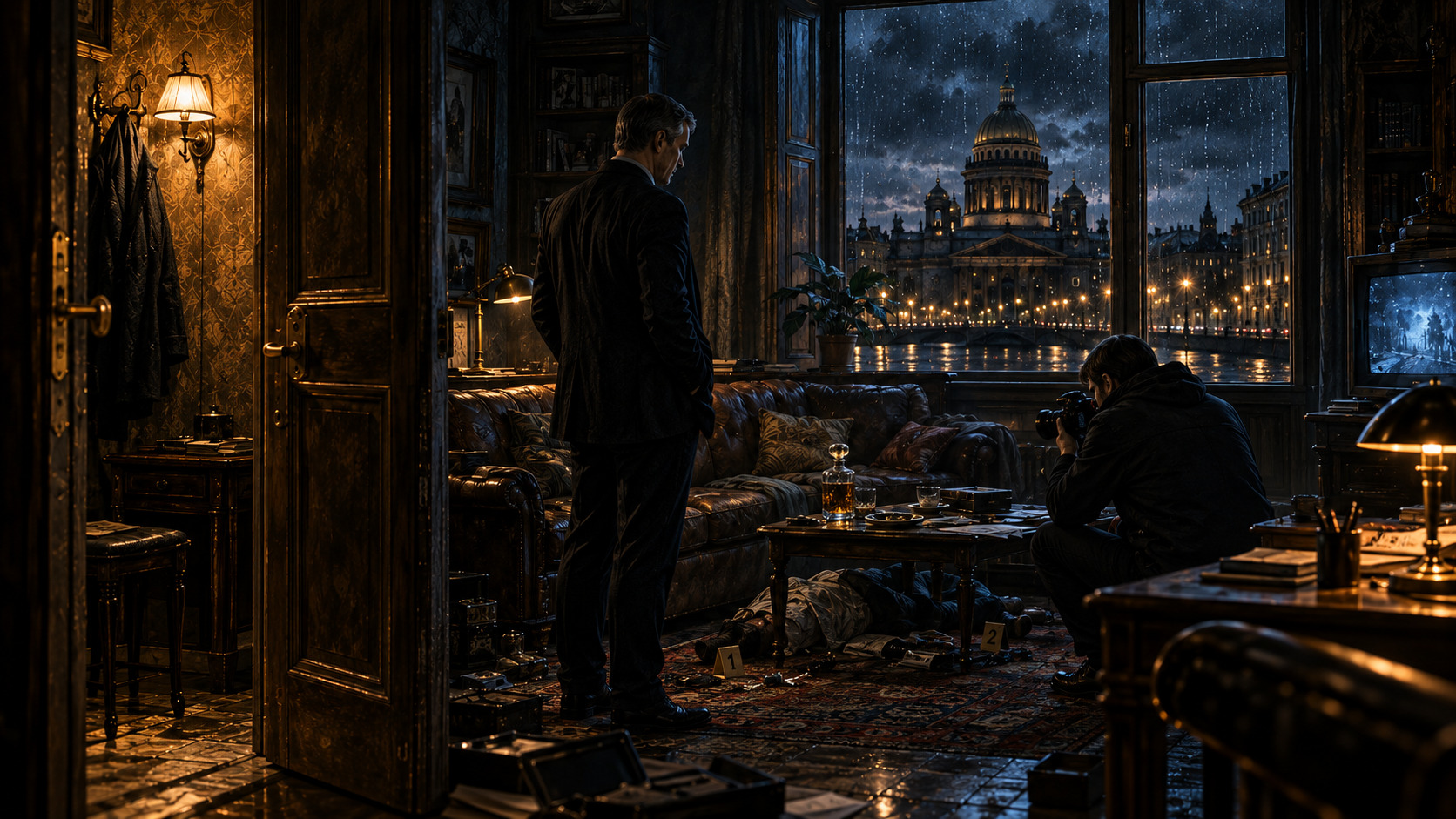
The door to Marina Lebedeva’s apartment was closed but not locked, so Larisa Belova simply pressed down on the handle, called out to her neighbour and stepped inside, still unaware that within a few hours she would be asked to return to that exact moment again and again, explaining to complete strangers how the door had been positioned, whether it had been firmly shut and whether she had needed to use any force to open it. The hallway light was on, and a pair of black high-heeled shoes stood neatly against the wall, a detail Larisa would later remember more clearly than almost anything else she saw that evening. A television was playing somewhere in the apartment, a male voice calmly predicting rain and colder weather, while the kitchen light was on as well and two coffee cups stood on the table, one empty and the other with a little coffee left inside, beside a packet of cigarettes that immediately struck Larisa as wrong because Marina did not smoke.
They had lived on opposite sides of the same wall for four years, and in old St Petersburg apartment buildings neighbours sometimes know more about one another than relatives do, simply because they hear everything: who comes home late, who leaves early, who has visitors, who argues and how long the doors keep slamming after everyone has supposedly calmed down. Marina did not answer, so Larisa walked further into the apartment. First she saw a hand beside the sofa. Then she took another step and saw Marina herself, lying between the sofa and the coffee table with her hair covering part of her face and a dark stain spreading across the parquet beneath her head.
Larisa did not scream, although later she would find that oddly difficult to understand. People screamed in films, but real life rarely followed the rules of cinema so neatly, and sometimes a person simply stood there staring while the mind struggled to catch up with what the eyes had already understood. She backed away, returned to the hallway and called the police, and when the woman on the emergency line asked whether Marina was breathing, Larisa said she did not know and would not go back into the room to check.
Before long, the landing filled with people. Police officers arrived, a local district officer appeared, neighbours emerged from their apartments and gathered near the stairwell, some smoking by the window, some trying to peer into Marina’s apartment over other people’s shoulders, while others had already managed to construct detailed theories of what had happened and were explaining them with the confidence of people who had apparently been present at the murder in person. Every apartment building seems to contain at least one resident who solves the crime before the investigation has properly begun, and this building was no exception.
Larisa was given a chair and a glass of water. A young district officer asked whether she had heard anyone visiting Marina that evening, and Larisa said there had been a man, although she had not seen him and could only remember his voice. When the officer asked whether there had been one male voice or more, she first answered confidently that there had been one, then hesitated and admitted that later she might have heard someone else as well, perhaps another man, although by the end of the conversation she could no longer say for certain whether she had really heard a second voice or whether the detail had appeared later, somewhere among other people’s questions and other people’s versions.
A man in a dark suit came up the stairs while she was still trying to decide what she really remembered, showed his identification and introduced himself as Sergei Andreevich Kornev, an investigator from the prosecutor’s office. He spoke to Larisa separately and was noticeably calmer than the district officer, never rushing or interrupting her, and several times bringing her gently back to what she actually remembered rather than what she thought she might have remembered. In the end he suggested that, for now, they record only what she was certain about, because within a few hours it would become difficult to separate her own recollections from everything she would hear from neighbours, police officers and the inevitable collection of people who would soon be ready to explain to her exactly what had happened in the apartment. Larisa thought about it and agreed that she was certain of one thing: she had heard one male voice.
Back inside the apartment, Kornev asked what time the call had come in. Someone told him 21:47, and after glancing at his watch he asked for the official start of the crime scene examination to be recorded as 21:53. The forensic expert pointed out that the time the body had been discovered would be recorded separately, Kornev agreed, and the exchange ended with the same dry routine as dozens of other conversations that took place at crime scenes every day.
Pavel Rudenko had begun photographing the apartment before all the objects had been catalogued and prepared for collection, which made sense because the first task was to preserve the room exactly as it had been found. Soon enough people would begin opening cupboards, moving objects, collecting samples and turning the scene into an ordinary workspace where everyone got in everyone else’s way, and by then the original arrangement of things would already be gone. One of Rudenko’s photographs included a blue folder lying on the writing desk beside several sheets of paper. It looked no different from the other papers and folders scattered across the desk, and Rudenko photographed the room, then the desk, the window, the doorway and several details near the sofa before moving into the corridor.
Kornev, meanwhile, was examining the kitchen, where the two coffee cups and the packet of cigarettes still sat on the table, and later asked the forensic expert whether there were any signs of forced entry at the front door. The expert said there were none and suggested that Marina had either let the visitor in herself or had simply left the door unlocked.
“The door was closed,” Kornev said.
The expert looked at him and asked how he knew that. Kornev hesitated briefly before saying that the neighbour had told him. The expert did not pursue the matter. In the corridor, Kornev asked Rudenko whether he had photographed the entrance door, the lock and the passage into the living room, and Rudenko looked at him with the expression of a man who had just been offered a beginner’s lesson in using a camera.
“Sergei Andreevich, I’ve been photographing dead bodies for twenty years.”
“You’re thirty-two.”
“I started very young.”
Kornev looked at him, and Rudenko grinned.
“All right. Twenty years was approximate.”
He photographed the door, the lock and the windows again anyway, then asked whether Kornev would also like a picture of the ceiling. Kornev did not answer, which Rudenko appeared to take as permission to leave the ceiling alone. Later, when the roll of film was finished, Kornev asked for the cassette.
“It needs to be developed first,” Rudenko said. “If you open it now, all you’ll get are some extremely expressive black squares.”
Kornev simply held out his hand, and after looking at him for a moment Rudenko removed the cassette and handed it over. Kornev slipped it into the inside pocket of his jacket, took several steps and then stopped.
“Where’s the second one?”
Rudenko did not answer immediately.
“The second what?”
“The film.”
“There isn’t one.”
For a moment they simply looked at each other.
“Of course,” Kornev said, and left the kitchen.
Rudenko waited until his footsteps had faded down the corridor, then slipped a hand into the inside pocket of his own jacket and felt the second cassette still there. By midnight, the apartment had almost emptied. Marina’s body had been removed, Larisa had been allowed to go home, the forensic expert and photographer had left, the police officers gradually disappeared from the stairwell and the neighbours retreated behind their doors, although some of them continued talking quietly for a while longer. By then, the blue folder was no longer on the writing desk, but it did not appear on the list of seized items either. Nobody noticed the omission that night because there had been too many papers, too many objects and too many people moving through the apartment for the disappearance of one ordinary blue folder to seem worthy of a separate question.
Kornev reviewed the paperwork once more and paused at the recorded start time of the examination, 21:53. Everything had been documented exactly as he had asked, so he closed the file, went downstairs and got into his car. For several minutes he sat watching the illuminated windows of Marina’s apartment before taking out his phone and dialling a number.
“We’re finished.”
He listened to the reply.
“No.”
There was another pause before he added:
“Nothing yet.”
The person on the other end continued speaking, because Kornev frowned and repeated, more sharply this time:
“I said there’s nothing yet.”
He ended the call, tossed the phone onto the passenger seat and remained there for another minute before starting the engine and driving away.
The case file would record 21:53 as the official start of the crime scene examination, and for twenty-two years there would be no obvious reason for anyone to question that time. The documents agreed with one another, the investigation had long since ended, the trial was over and the man accused of Marina’s murder had been acquitted.
The second roll of film, however, had never disappeared.
The door to Marina Lebedeva’s apartment was closed but not locked, so Larisa Belova simply pressed down on the handle, called out to her neighbour and stepped inside, still unaware that within a few hours she would be asked to return to that exact moment again and again, explaining to complete strangers how the door had been positioned, whether it had been firmly shut and whether she had needed to use any force to open it. The hallway light was on, and a pair of black high-heeled shoes stood neatly against the wall, a detail Larisa would later remember more clearly than almost anything else she saw that evening. A television was playing somewhere in the apartment, a male voice calmly predicting rain and colder weather, while the kitchen light was on as well and two coffee cups stood on the table, one empty and the other with a little coffee left inside, beside a packet of cigarettes that immediately struck Larisa as wrong because Marina did not smoke.
They had lived on opposite sides of the same wall for four years, and in old St Petersburg apartment buildings neighbours sometimes know more about one another than relatives do, simply because they hear everything: who comes home late, who leaves early, who has visitors, who argues and how long the doors keep slamming after everyone has supposedly calmed down. Marina did not answer, so Larisa walked further into the apartment. First she saw a hand beside the sofa. Then she took another step and saw Marina herself, lying between the sofa and the coffee table with her hair covering part of her face and a dark stain spreading across the parquet beneath her head.
Larisa did not scream, although later she would find that oddly difficult to understand. People screamed in films, but real life rarely followed the rules of cinema so neatly, and sometimes a person simply stood there staring while the mind struggled to catch up with what the eyes had already understood. She backed away, returned to the hallway and called the police, and when the woman on the emergency line asked whether Marina was breathing, Larisa said she did not know and would not go back into the room to check.
Before long, the landing filled with people. Police officers arrived, a local district officer appeared, neighbours emerged from their apartments and gathered near the stairwell, some smoking by the window, some trying to peer into Marina’s apartment over other people’s shoulders, while others had already managed to construct detailed theories of what had happened and were explaining them with the confidence of people who had apparently been present at the murder in person. Every apartment building seems to contain at least one resident who solves the crime before the investigation has properly begun, and this building was no exception.
Larisa was given a chair and a glass of water. A young district officer asked whether she had heard anyone visiting Marina that evening, and Larisa said there had been a man, although she had not seen him and could only remember his voice. When the officer asked whether there had been one male voice or more, she first answered confidently that there had been one, then hesitated and admitted that later she might have heard someone else as well, perhaps another man, although by the end of the conversation she could no longer say for certain whether she had really heard a second voice or whether the detail had appeared later, somewhere among other people’s questions and other people’s versions.
A man in a dark suit came up the stairs while she was still trying to decide what she really remembered, showed his identification and introduced himself as Sergei Andreevich Kornev, an investigator from the prosecutor’s office. He spoke to Larisa separately and was noticeably calmer than the district officer, never rushing or interrupting her, and several times bringing her gently back to what she actually remembered rather than what she thought she might have remembered. In the end he suggested that, for now, they record only what she was certain about, because within a few hours it would become difficult to separate her own recollections from everything she would hear from neighbours, police officers and the inevitable collection of people who would soon be ready to explain to her exactly what had happened in the apartment. Larisa thought about it and agreed that she was certain of one thing: she had heard one male voice.
Back inside the apartment, Kornev asked what time the call had come in. Someone told him 21:47, and after glancing at his watch he asked for the official start of the crime scene examination to be recorded as 21:53. The forensic expert pointed out that the time the body had been discovered would be recorded separately, Kornev agreed, and the exchange ended with the same dry routine as dozens of other conversations that took place at crime scenes every day.
Pavel Rudenko had begun photographing the apartment before all the objects had been catalogued and prepared for collection, which made sense because the first task was to preserve the room exactly as it had been found. Soon enough people would begin opening cupboards, moving objects, collecting samples and turning the scene into an ordinary workspace where everyone got in everyone else’s way, and by then the original arrangement of things would already be gone. One of Rudenko’s photographs included a blue folder lying on the writing desk beside several sheets of paper. It looked no different from the other papers and folders scattered across the desk, and Rudenko photographed the room, then the desk, the window, the doorway and several details near the sofa before moving into the corridor.
Kornev, meanwhile, was examining the kitchen, where the two coffee cups and the packet of cigarettes still sat on the table, and later asked the forensic expert whether there were any signs of forced entry at the front door. The expert said there were none and suggested that Marina had either let the visitor in herself or had simply left the door unlocked.
“The door was closed,” Kornev said.
The expert looked at him and asked how he knew that. Kornev hesitated briefly before saying that the neighbour had told him. The expert did not pursue the matter. In the corridor, Kornev asked Rudenko whether he had photographed the entrance door, the lock and the passage into the living room, and Rudenko looked at him with the expression of a man who had just been offered a beginner’s lesson in using a camera.
“Sergei Andreevich, I’ve been photographing dead bodies for twenty years.”
“You’re thirty-two.”
“I started very young.”
Kornev looked at him, and Rudenko grinned.
“All right. Twenty years was approximate.”
He photographed the door, the lock and the windows again anyway, then asked whether Kornev would also like a picture of the ceiling. Kornev did not answer, which Rudenko appeared to take as permission to leave the ceiling alone. Later, when the roll of film was finished, Kornev asked for the cassette.
“It needs to be developed first,” Rudenko said. “If you open it now, all you’ll get are some extremely expressive black squares.”
Kornev simply held out his hand, and after looking at him for a moment Rudenko removed the cassette and handed it over. Kornev slipped it into the inside pocket of his jacket, took several steps and then stopped.
“Where’s the second one?”
Rudenko did not answer immediately.
“The second what?”
“The film.”
“There isn’t one.”
For a moment they simply looked at each other.
“Of course,” Kornev said, and left the kitchen.
Rudenko waited until his footsteps had faded down the corridor, then slipped a hand into the inside pocket of his own jacket and felt the second cassette still there. By midnight, the apartment had almost emptied. Marina’s body had been removed, Larisa had been allowed to go home, the forensic expert and photographer had left, the police officers gradually disappeared from the stairwell and the neighbours retreated behind their doors, although some of them continued talking quietly for a while longer. By then, the blue folder was no longer on the writing desk, but it did not appear on the list of seized items either. Nobody noticed the omission that night because there had been too many papers, too many objects and too many people moving through the apartment for the disappearance of one ordinary blue folder to seem worthy of a separate question.
Kornev reviewed the paperwork once more and paused at the recorded start time of the examination, 21:53. Everything had been documented exactly as he had asked, so he closed the file, went downstairs and got into his car. For several minutes he sat watching the illuminated windows of Marina’s apartment before taking out his phone and dialling a number.
“We’re finished.”
He listened to the reply.
“No.”
There was another pause before he added:
“Nothing yet.”
The person on the other end continued speaking, because Kornev frowned and repeated, more sharply this time:
“I said there’s nothing yet.”
He ended the call, tossed the phone onto the passenger seat and remained there for another minute before starting the engine and driving away.
The case file would record 21:53 as the official start of the crime scene examination, and for twenty-two years there would be no obvious reason for anyone to question that time. The documents agreed with one another, the investigation had long since ended, the trial was over and the man accused of Marina’s murder had been acquitted.
The second roll of film, however, had never disappeared.
The Alibi of St. Petersburg
Chapter Three. Gromov

The following morning I woke up earlier than usual and immediately found myself thinking about Gromov, even though I had intended to spend the day thinking exclusively about suitcases, tickets and the move. Life has a habit of showing just how little it cares about our plans: all you have to do is decide that a new chapter begins on Monday, and by Sunday evening a person, an old murder case or at least a broken tap will appear and somehow become more important than all your carefully considered decisions.
Instead of packing, I made coffee and opened the grey folder again. It still contained old addresses, phone numbers and information about Gromov’s family and work, most of it long out of date, so I opened my laptop and quickly discovered that his company no longer existed, other people now lived at his former address and he himself had almost completely disappeared from public view.
What I did find was an old newspaper article about his acquittal, and beneath it was a quotation attributed to me:
“Justice has been served.”
I read it twice and decided that I did not particularly like the woman who had said it. At twenty-nine, I had apparently thought that winning one case gave me the right to make sweeping statements about justice itself. These days I would put it more simply: my client had been acquitted. That was enough. In the photograph accompanying the article, Gromov was leaving the courthouse, I was walking beside him and Velsky stood a step behind us. I closed the page and continued searching until I found a phone number for Gromov’s older brother, although I still waited until nine before calling because legal practice destroys many ordinary human habits, but basic manners occasionally survive even that.
The man recognised my surname and informed me, without any obvious enthusiasm, that I had once been his brother’s lawyer. When I asked how I could contact Alexei now, he wanted to know why I was looking for him twenty-two years later. I explained that I had come across an old case by accident and wanted to clarify a few things. He gave a short laugh and remarked that after ten years the call would have seemed strange, whereas after twenty-two it was almost amusing, then added that Alexei could decide for himself whether he wanted to speak to me.
“Could you give him my number?”
“I will.”
He was about to hang up when I asked why he found the call unusual in the first place.
“Unusual? No,” he said. “Late.”
The conversation ended there, but I sat looking at my phone for a while afterwards, trying to understand why that one word had stayed with me. Relatives of former clients rarely feel much affection towards their advocates, so the coldness itself meant very little, but the word late would not go away. At around half past nine, Velsky called. I did not answer because I had no desire to explain why I was spending the morning searching for a man connected to a twenty-two-year-old murder case instead of packing for my move, and a minute later he sent a message asking if I was alive.
Unfortunately, yes, I replied.
He sent back a laughing emoji, and that was the end of the conversation. I spent the rest of the morning reading through Gromov’s case file and gradually remembering details that had not crossed my mind in years. One of them was his first interrogation, during which he claimed he had seen Marina two days before her death, although it later emerged that he had visited her the day before the murder.
I remembered our conversation in the detention centre as well. Gromov sat across from me, pale, unshaven and furious, while I explained that if he intended to lie to me the way he lied to the investigator, there was very little I could do for him. He insisted that he had not killed Marina, and I kept telling him that, at that moment, we were discussing something else entirely while asking again where he had been that evening. I never received an answer, which even then struck me as unusual. People accused of murder usually cling to every possible opportunity to prove they were somewhere else, remembering phone calls, meetings, receipts, petrol stations and people whose names they barely know, building an alibi out of anything available. Gromov did the opposite and seemed almost determined to leave several hours of his life completely blank.
Shortly before eleven, an unfamiliar number appeared on my screen, and I did not recognise the voice immediately. Gromov informed me that his brother had already called him, and when I suggested we meet, he wanted to know why, so I told him about the anonymous message I had received the previous evening. When he heard the words You saved a murderer back then, he did not sound offended and did not ask whether I believed the murderer was him. Instead, he wanted to know who had sent it. I asked why that was the first thing he wanted to know, but rather than answering he asked for the sender’s number. I refused, and Gromov said that the case had ended many years ago, he had been acquitted and had no intention of revisiting any of it. That was when I finally asked the question that had been bothering me all morning.
“Where were you that night?”
He pretended not to understand which night I meant, although we both knew perfectly well. When I clarified that I meant the night Marina was killed, he reminded me that he had heard the same question twenty-two years earlier and had not answered it then either.
“Things are different now,” I said.
“What exactly is different?”
“I believed you then.”
For a moment he said nothing, and when he spoke again his voice sounded calmer.
“So now you’re checking whether you made a mistake?”
Then he said that in 2004 I had been interested not in whether he had killed Marina but in whether Kornev could prove it. The irritating part was that he was right. At twenty-nine, I often said something very similar myself: my job was not to uncover the ultimate truth, but to decide whether the prosecution had proved its case. Now, however, the same idea sounded different. I suggested meeting again, but Gromov refused.
“Why?”
He was silent for a moment before answering.
“Because you’re late again.”
I immediately remembered his brother’s word.
Late.
“What do you mean, again?”
“After the trial, I tried to contact you.”
“When?”
“A few days later.”
“Why?”
“It doesn’t matter any more.”
“If you’re talking to me twenty-two years later, then it clearly does.”
Gromov laughed quietly but did not answer.
“Who did you call?”
Something slammed in the background and someone started speaking, and a moment later the connection was gone so abruptly that I continued holding the phone to my ear for several seconds before trying to call back. The number was unavailable.
For the rest of the day I kept returning to the same phrase: You’re late again. If Gromov had really tried to contact me after the trial, why had I never heard about it? Perhaps he had called the firm, or left a message with a secretary or one of my colleagues and it had simply been lost. Twenty-two years ago, that was entirely possible, because people then managed to lose not only phone messages but occasionally entire volumes of criminal case files, so building a conspiracy theory around one missing phone call would have been premature. And yet that missing call bothered me far more than the anonymous message.
That evening I opened Gromov’s file again, but instead of reading it from beginning to end, I found an old notebook and wrote down the names of everyone I could remember from the case: Kornev, Sazonov, Belova, Rudenko, several police officers and the prosecutor. The list turned out to be longer than I expected, and almost every name pulled a fragment of memory behind it: a question asked in a corridor, a signature on a document, an offhand remark, a face glimpsed during a court hearing. I sat looking at the page and wondering which of those people could still know enough about a twenty-two-year-old case to send me that message from an unfamiliar number.
I had no answer yet, but for the first time it became clear that if I wanted to find one, I would have to look not at what I remembered about the case, but at everything I had once dismissed as unimportant.
Instead of packing, I made coffee and opened the grey folder again. It still contained old addresses, phone numbers and information about Gromov’s family and work, most of it long out of date, so I opened my laptop and quickly discovered that his company no longer existed, other people now lived at his former address and he himself had almost completely disappeared from public view.
What I did find was an old newspaper article about his acquittal, and beneath it was a quotation attributed to me:
“Justice has been served.”
I read it twice and decided that I did not particularly like the woman who had said it. At twenty-nine, I had apparently thought that winning one case gave me the right to make sweeping statements about justice itself. These days I would put it more simply: my client had been acquitted. That was enough. In the photograph accompanying the article, Gromov was leaving the courthouse, I was walking beside him and Velsky stood a step behind us. I closed the page and continued searching until I found a phone number for Gromov’s older brother, although I still waited until nine before calling because legal practice destroys many ordinary human habits, but basic manners occasionally survive even that.
The man recognised my surname and informed me, without any obvious enthusiasm, that I had once been his brother’s lawyer. When I asked how I could contact Alexei now, he wanted to know why I was looking for him twenty-two years later. I explained that I had come across an old case by accident and wanted to clarify a few things. He gave a short laugh and remarked that after ten years the call would have seemed strange, whereas after twenty-two it was almost amusing, then added that Alexei could decide for himself whether he wanted to speak to me.
“Could you give him my number?”
“I will.”
He was about to hang up when I asked why he found the call unusual in the first place.
“Unusual? No,” he said. “Late.”
The conversation ended there, but I sat looking at my phone for a while afterwards, trying to understand why that one word had stayed with me. Relatives of former clients rarely feel much affection towards their advocates, so the coldness itself meant very little, but the word late would not go away. At around half past nine, Velsky called. I did not answer because I had no desire to explain why I was spending the morning searching for a man connected to a twenty-two-year-old murder case instead of packing for my move, and a minute later he sent a message asking if I was alive.
Unfortunately, yes, I replied.
He sent back a laughing emoji, and that was the end of the conversation. I spent the rest of the morning reading through Gromov’s case file and gradually remembering details that had not crossed my mind in years. One of them was his first interrogation, during which he claimed he had seen Marina two days before her death, although it later emerged that he had visited her the day before the murder.
I remembered our conversation in the detention centre as well. Gromov sat across from me, pale, unshaven and furious, while I explained that if he intended to lie to me the way he lied to the investigator, there was very little I could do for him. He insisted that he had not killed Marina, and I kept telling him that, at that moment, we were discussing something else entirely while asking again where he had been that evening. I never received an answer, which even then struck me as unusual. People accused of murder usually cling to every possible opportunity to prove they were somewhere else, remembering phone calls, meetings, receipts, petrol stations and people whose names they barely know, building an alibi out of anything available. Gromov did the opposite and seemed almost determined to leave several hours of his life completely blank.
Shortly before eleven, an unfamiliar number appeared on my screen, and I did not recognise the voice immediately. Gromov informed me that his brother had already called him, and when I suggested we meet, he wanted to know why, so I told him about the anonymous message I had received the previous evening. When he heard the words You saved a murderer back then, he did not sound offended and did not ask whether I believed the murderer was him. Instead, he wanted to know who had sent it. I asked why that was the first thing he wanted to know, but rather than answering he asked for the sender’s number. I refused, and Gromov said that the case had ended many years ago, he had been acquitted and had no intention of revisiting any of it. That was when I finally asked the question that had been bothering me all morning.
“Where were you that night?”
He pretended not to understand which night I meant, although we both knew perfectly well. When I clarified that I meant the night Marina was killed, he reminded me that he had heard the same question twenty-two years earlier and had not answered it then either.
“Things are different now,” I said.
“What exactly is different?”
“I believed you then.”
For a moment he said nothing, and when he spoke again his voice sounded calmer.
“So now you’re checking whether you made a mistake?”
Then he said that in 2004 I had been interested not in whether he had killed Marina but in whether Kornev could prove it. The irritating part was that he was right. At twenty-nine, I often said something very similar myself: my job was not to uncover the ultimate truth, but to decide whether the prosecution had proved its case. Now, however, the same idea sounded different. I suggested meeting again, but Gromov refused.
“Why?”
He was silent for a moment before answering.
“Because you’re late again.”
I immediately remembered his brother’s word.
Late.
“What do you mean, again?”
“After the trial, I tried to contact you.”
“When?”
“A few days later.”
“Why?”
“It doesn’t matter any more.”
“If you’re talking to me twenty-two years later, then it clearly does.”
Gromov laughed quietly but did not answer.
“Who did you call?”
Something slammed in the background and someone started speaking, and a moment later the connection was gone so abruptly that I continued holding the phone to my ear for several seconds before trying to call back. The number was unavailable.
For the rest of the day I kept returning to the same phrase: You’re late again. If Gromov had really tried to contact me after the trial, why had I never heard about it? Perhaps he had called the firm, or left a message with a secretary or one of my colleagues and it had simply been lost. Twenty-two years ago, that was entirely possible, because people then managed to lose not only phone messages but occasionally entire volumes of criminal case files, so building a conspiracy theory around one missing phone call would have been premature. And yet that missing call bothered me far more than the anonymous message.
That evening I opened Gromov’s file again, but instead of reading it from beginning to end, I found an old notebook and wrote down the names of everyone I could remember from the case: Kornev, Sazonov, Belova, Rudenko, several police officers and the prosecutor. The list turned out to be longer than I expected, and almost every name pulled a fragment of memory behind it: a question asked in a corridor, a signature on a document, an offhand remark, a face glimpsed during a court hearing. I sat looking at the page and wondering which of those people could still know enough about a twenty-two-year-old case to send me that message from an unfamiliar number.
I had no answer yet, but for the first time it became clear that if I wanted to find one, I would have to look not at what I remembered about the case, but at everything I had once dismissed as unimportant.
Contact the Author
Questions about the book, reviews, interviews, or collaborations? You can reach me directly.