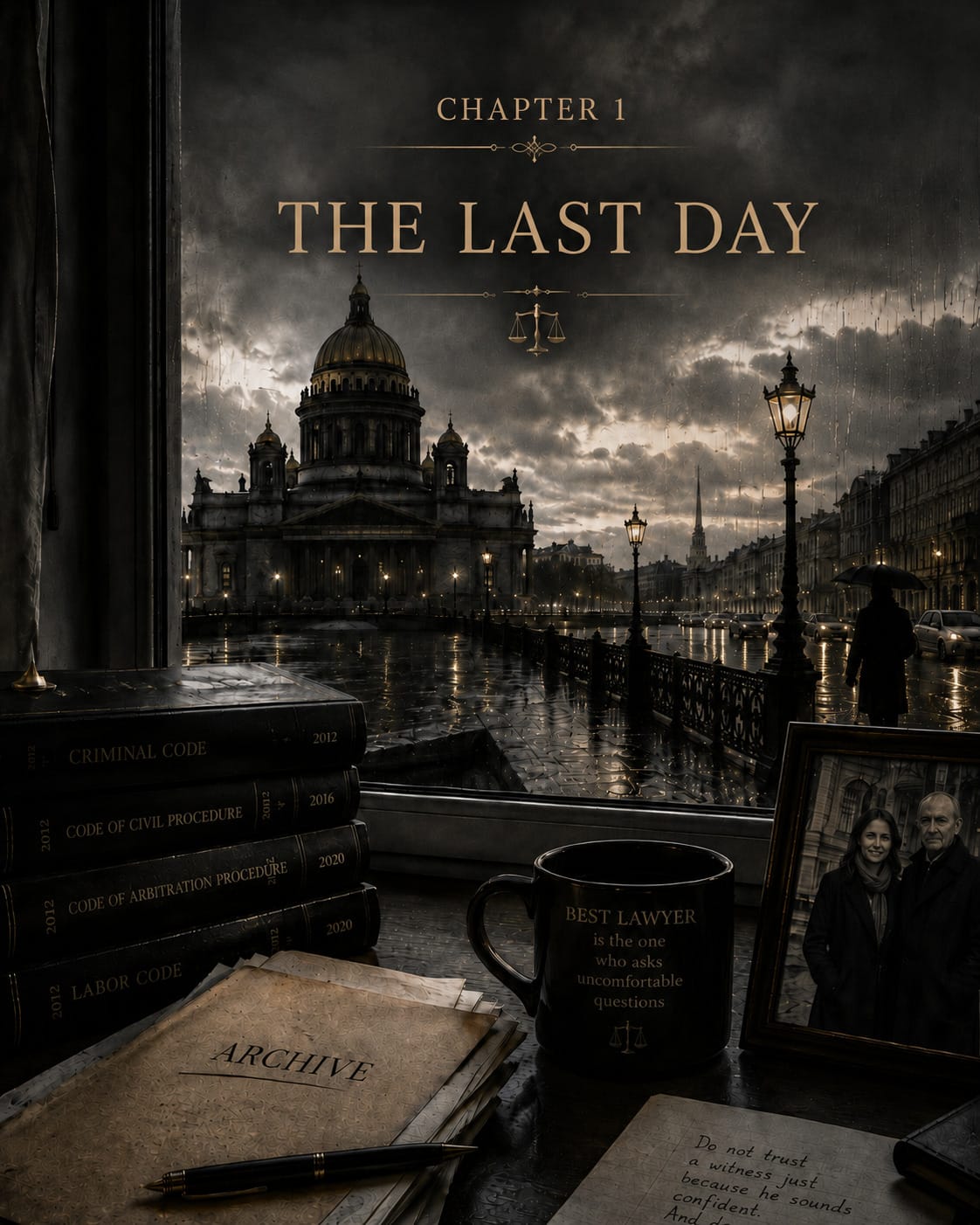
The Alibi of St Petersburg Chapter 1: The Last Day
Olga Vorontsova has spent more than twenty years practising law in St Petersburg and is preparing to leave both her profession and the city where she was born and raised. While clearing out her office before the move, she comes across an old murder case that she once regarded as one of her first real professional victories.
Then an anonymous message arrives. “You saved a murderer back then.” What begins as an ordinary last evening at the office soon forces Olga to look again at a case she believed had been settled twenty two years earlier.
The Alibi of St Petersburg Chapter 1
After more than twenty years of legal practice, I discovered that an entire life could fit into a few cardboard boxes, provided you did not ask yourself too many questions about why an old business card, a book you had not opened in ten years, or a photograph of someone whose number had long since disappeared from your phone had seemed important enough to occupy space in your office for so long. The books were the easiest part. The ones I genuinely intended to reread one day went into one box, the rest into another, and then came the notebooks, diaries, conference photographs, other people’s business cards, gifted pens and endless stacks of paper whose purpose had once been perfectly obvious and now required a small investigation of their own. I labelled one box “Archive”, another “Give Away” and a third “Throw Out”, but a few minutes later I crossed out the last label and replaced it with “Think About It”. By evening, that box had become the heaviest, which, in a way, described my personality rather accurately.
When I became an advocate, none of this existed. There was no office, no steady stream of clients and certainly no habit of scheduling consultations for ten in the morning while knowing perfectly well that at ten sharp I would still be drinking coffee and convincing myself that being five minutes late hardly counted. Back then I genuinely believed that any criminal case could be understood if you read the documents carefully enough, checked the dates and were not afraid to ask people the questions they would rather avoid answering. As the years passed, the paperwork multiplied and the certainty slowly disappeared. My phone rang while I was trying to decide the fate of an old volume of Russian Supreme Court rulings. Taking it to Tbilisi made no sense, but throwing it away felt wrong, even though I had probably not opened it since the days when important phone numbers were written down in paper diaries and somehow managed not to disappear forever.
It was Velsky. He informed me that my farewell to the profession was far too quiet and that, in his opinion, there should have been flowers, journalists and at least a few grateful former clients waiting outside the office. I pointed out that the last part sounded especially realistic, and Velsky replied that some of them probably still remembered my name.
“Some of them probably still hate it.”
He laughed, while I absentmindedly opened the book and noticed an old note on the inside cover.
Never trust a witness simply because he sounds confident.
Below it, in different handwriting, someone had added:
Or an advocate. A.V.
I could no longer remember when Velsky had written it. Judging by my handwriting, it must have been a very long time ago, back when I highlighted legal articles with coloured markers and believed that a good advocate should remember Supreme Court rulings the way normal people remembered birthdays. Velsky asked whether I was still at the office and when my flight was. When I told him it was the day after tomorrow, he said there was still plenty of time to change my mind.
“Alexander Lvovich, we’ve been having this conversation for three months.”
“Three months isn’t nearly enough time to get used to somebody else’s stupidity.”
“You got used to your own much faster.”
“Exactly. That’s what makes me an expert.”
I walked over to the window. Outside was a perfectly ordinary St. Petersburg evening at the end of August, when people still sat on outdoor terraces during the day, tourists wandered along Nevsky Prospect in T-shirts, and then the wind rose towards evening and reminded everyone that summer was already over, even if the calendar had not quite caught up. St. Petersburg was my home. I had been born here, grown up here, built my life here and become an advocate here, and it was also where I had learned not to trust overly confident witnesses or explanations that sounded a little too neat. The idea of leaving felt strange, as though I were not simply packing up an office and an apartment but leaving part of my own history behind.
I looked at the familiar rooftops, the people hurrying somewhere and the façades I had stopped noticing years ago. The city had changed over time in the quiet, almost invisible way cities do: restaurants closed, new cafés appeared, streets were repaired and familiar signs disappeared, while St. Petersburg remained around me as the circumstances of my own life kept changing. Perhaps that was why the thought of being the one to leave still felt slightly absurd.
Velsky asked whether I had truly made up my mind, and this time there was no trace of his usual sarcasm. I told him I had, and when he asked how long I intended to stay in Tbilisi, I admitted I had no idea. It might be a month, it might be a year, or perhaps two weeks before I called him and demanded the keys to my office back. He threatened to throw them away, I told him he would not, and after a brief pause he admitted that, of course, he would not.
An old photograph lay on the windowsill, where I had left it after finding it that morning between a stack of magazines. Velsky and I were standing outside a courthouse. I looked younger, thinner and carried the expression of someone who had not yet learned to doubt her own conclusions, while Velsky stood slightly behind me, looking at me rather than at the camera. I assumed he was simply proud of me and put the photograph into the box with my personal things.
Before hanging up, Velsky told me to call him when I finally finished packing. When I asked why, he said he wanted proof that I had actually left because there was a very real danger that I would discover a corpse in the archives at the last moment and stay for another twenty years.
“All my corpses are neatly filed and catalogued.”
“That’s exactly what worries me.”
After the call, the book joined the “Think About It” box and I moved on to the final cabinet. Most of my old case files had long since been destroyed, some documents had been returned to clients and others had been digitised, but a handful of folders still occupied the bottom shelf even though there was no practical reason to keep them anymore. They were not the biggest cases or even the most difficult ones. Each had simply found its own reason to remain in my memory: my first real defeat, the client who insisted he was innocent and lied to me from the beginning, the case that kept me awake for nights, and the client who confessed to a crime he had not committed because he could no longer endure the investigation.
Among them was the Gromov file. The label on the spine read:
Alexei Viktorovich Gromov. Part 1 of Article 105 of the Russian Criminal Code.
I had not opened it in years, but some cases are like that. You can leave a file untouched for fifteen years and still remember it better than something you worked on last week. A copy of the acquittal judgment lay on top, beginning with the familiar words:
In the name of the Russian Federation…
After that, I barely needed to read because I still remembered most of the circumstances.
Alexei Gromov had been thirty-one, a married businessman. He had been involved with Marina Lebedeva, a relationship he preferred not to discuss with either his wife or the investigators. Shortly before the murder they had argued, his fingerprints were found in her apartment, a neighbour heard a man’s voice, and Gromov lied about where he had been that evening. To the prosecution, the story had looked straightforward, but it had never convinced me. I was twenty-nine in 2004 and had held my advocate’s status for only a year, so I still approached the profession with the seriousness of someone who believed every contradiction had an explanation if you kept asking the right questions. If the prosecution claimed Gromov had been in Marina’s apartment at a specific time while an expert suggested she might have died earlier, then I believed that contradiction had to be explained.
The contradiction was never properly explained. Instead, the deeper I went into the file, the more questions appeared: inconsistencies in the crime scene report, witness statements that contradicted one another and evidence collected in ways that made it difficult to establish where certain items had originally been found. Little by little, the prosecution’s version of events stopped looking as convincing as it had at the beginning, and Gromov was acquitted. I remembered that day clearly: the wooden benches, the smell of wet coats, the dull light in the corridor, the judge’s calm voice and Gromov gripping the bars so tightly that his knuckles turned white. After the hearing, Velsky was waiting outside. He did not congratulate me and he did not hug me. We walked a short distance from the courthouse before he looked at me and said:
“Today you became an advocate.”
Formally, I had already been one for a year, but I understood exactly what he meant, and perhaps that was why I never forgot it. I began turning the pages, moving from reports to photographs, expert opinions and witness statements. In one photograph, Gromov looked impossibly young, and that was when my phone vibrated.
The message came from an unknown number. You saved a murderer back then.
I read it twice, then placed the phone face down and only a few moments later realised that I was still holding my finger between the pages of the file as though I did not want to lose my place.
Over the years, I had received all kinds of messages. Threats, gratitude, insults, people claiming to possess state secrets and people insisting they knew what had really happened. A few anonymous words should not have meant much, especially without a signature or explanation, so I deleted the message, closed the file and placed it in the archive box. Almost immediately, I changed my mind and took the folder back out, telling myself the box was already full and the file simply did not fit properly. After years of legal practice, I had become far better at recognising lies in other people’s statements than in my own explanations, so I decided not to argue with myself and left the file on the desk.
By half past eight, the office was almost empty. The metal plaque on the door still read:
Advocate Olga Sergeyevna Vorontsova
I could not bring myself to remove it and decided to leave it until tomorrow, but at that moment Velsky called again.
He asked whether I had finished.
“Almost,” I said.
“That’s such a lawyer’s answer.”
I told him that was precisely why I was leaving the profession. Velsky laughed, then unexpectedly asked whether I had found anything interesting. I would have said no to anyone else, but with Velsky I told the truth.
“An old case.”
“Which one?”
“Gromov.”
The pause was brief, so brief that I might not have noticed it at all if I had not known Velsky for so many years. He asked why I still kept the file, and when I said sentimentality, he advised me to throw it away. I reminded him that it had been my first acquittal and that advocates did not usually throw cases like that into the rubbish. Sometimes, he said, old cases were exactly the things that should be thrown away. His tone was perfectly ordinary, and the conversation moved calmly back to my departure. Before hanging up, he told me not to get lost.
I asked whether he meant in Tbilisi.
“Just in general.”
I laughed and told him it was far too late for warnings. That evening, the anonymous message and my decision to take the Gromov file home seemed far stranger than an ordinary conversation with Velsky. I slipped the folder into my bag, switched off the lights and left the plaque on the door for one more night. My flight was only two days away, my suitcase was still almost empty, and at the time that seemed like the most immediate problem I had.
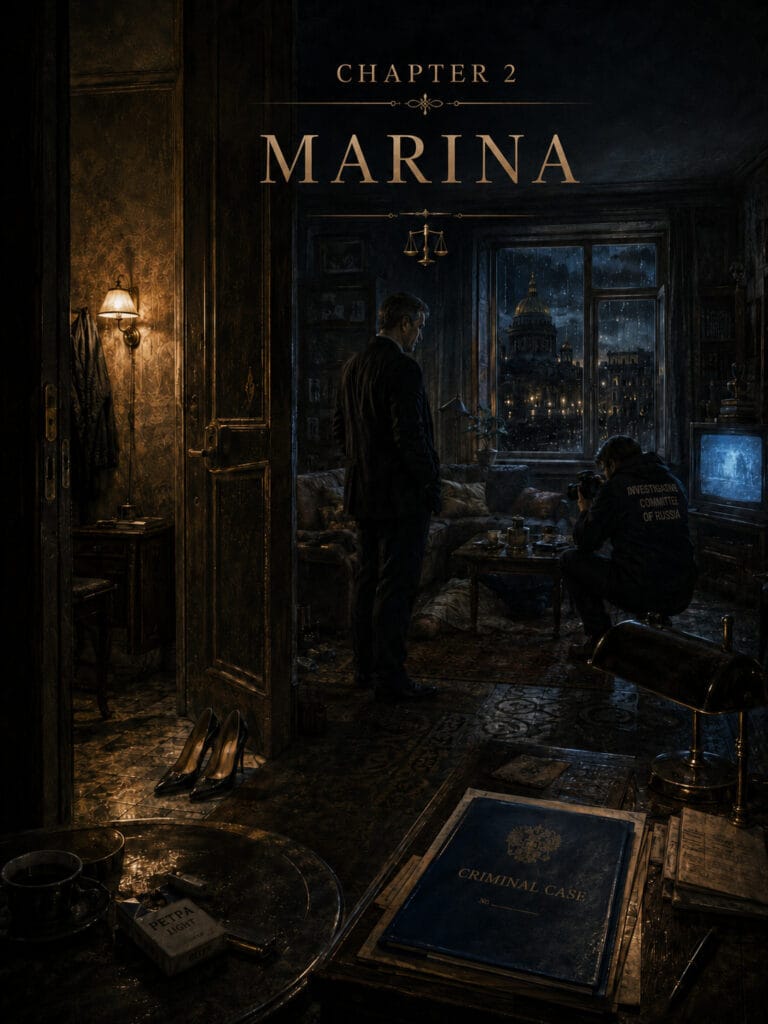
The Alibi of St. Petersburg Chapter 2: Marina
Twenty-two years ago, one case ended in an acquittal. Now the old file is open again, and some of its details look very different from the way they did in 2004.