

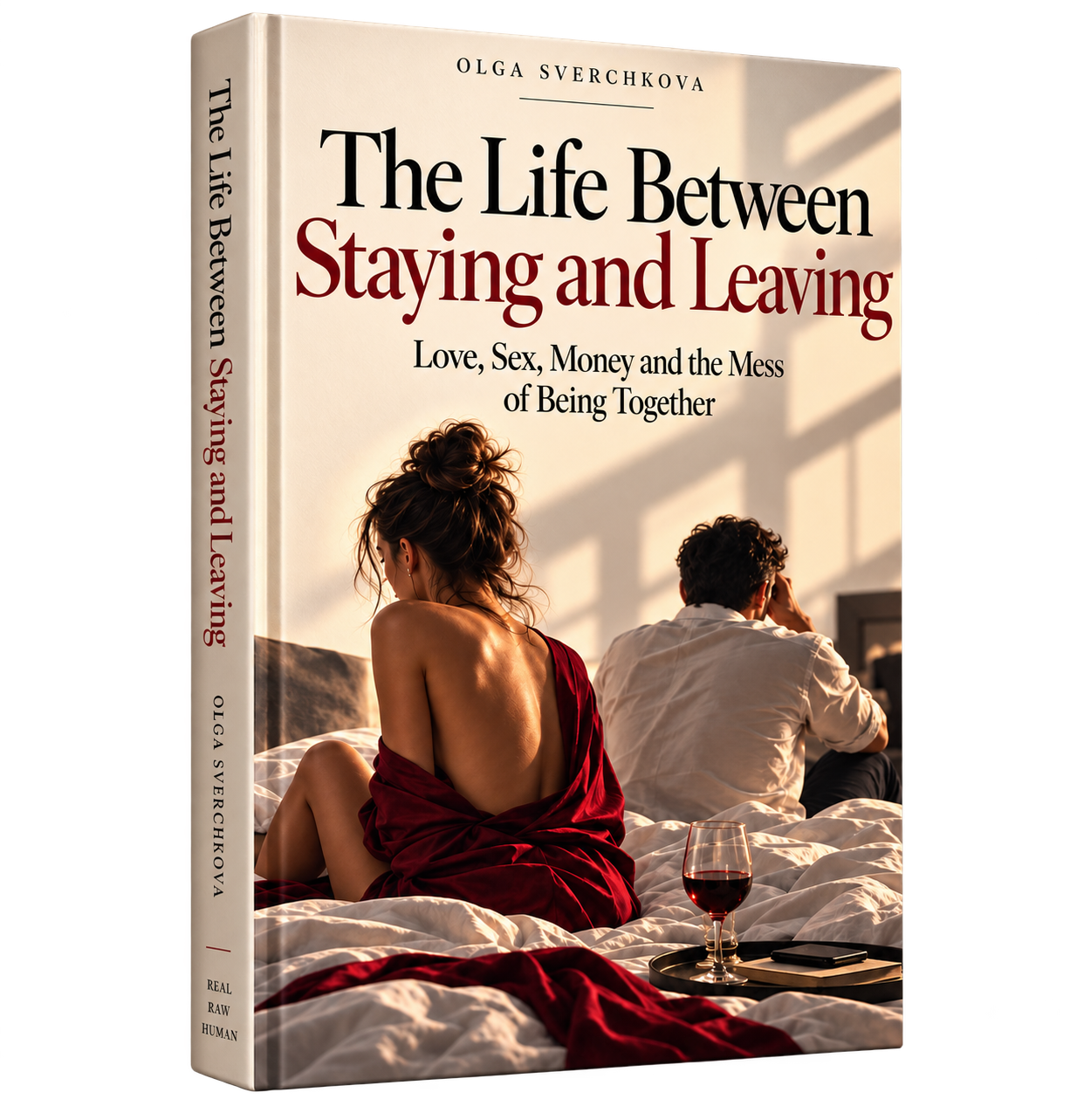
Read The Life Between Staying and Leaving Free
The first three chapters of The Life Between Staying and Leaving are available here in full, with no registration required.
Anna and Max's story begins with their ordinary life in Tbilisi and an offer from their landlord to sell them the house they rent. Everything else is better discovered in the book itself.
Anna and Max's story begins with their ordinary life in Tbilisi and an offer from their landlord to sell them the house they rent. Everything else is better discovered in the book itself.
The Life Between Staying and Leaving
Chapter 1. Why We Stay When We Already Know
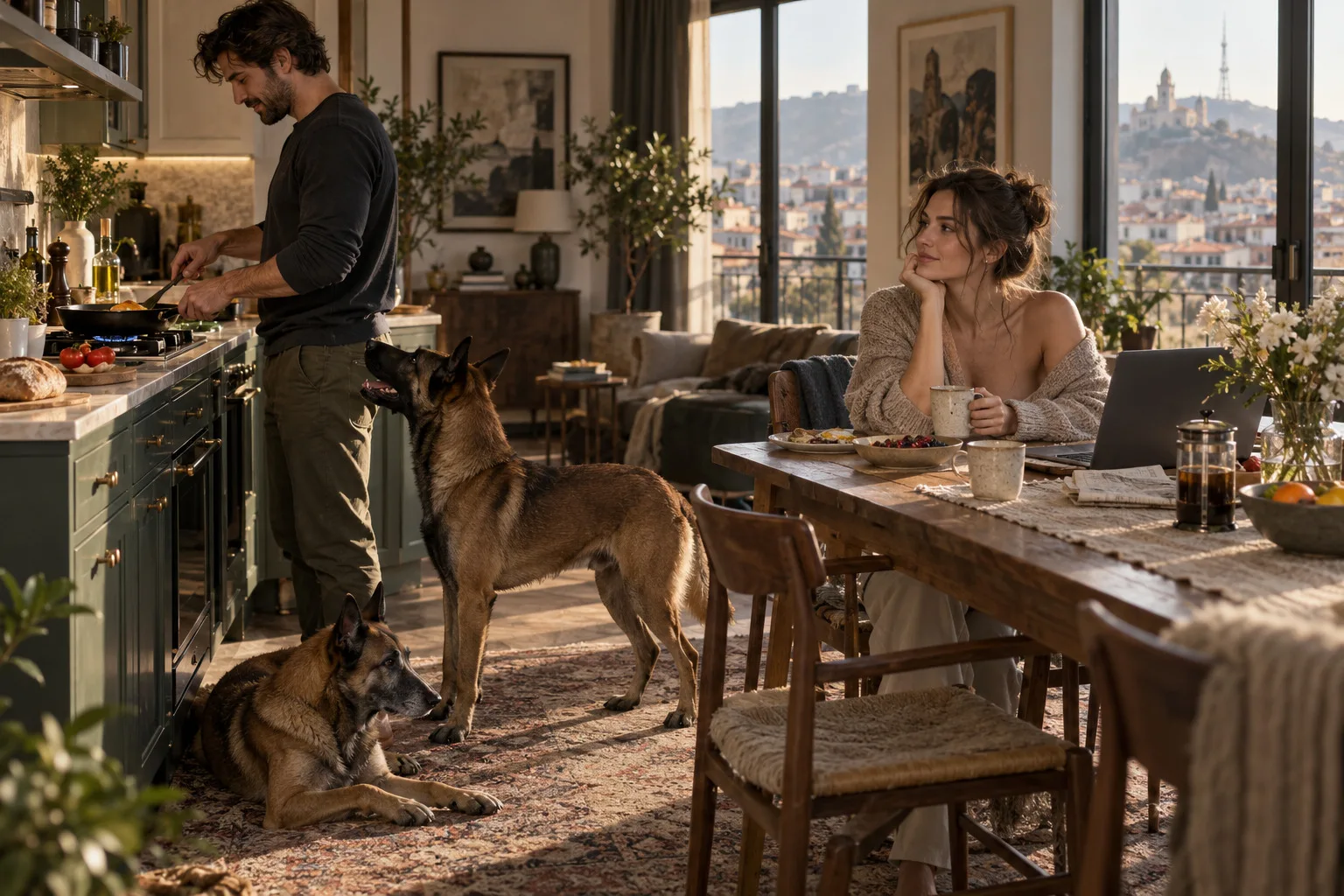
The morning began with Thor deciding he wanted to come into my bedroom. First he pushed the door with his nose, then scratched at it with one paw, then tried the nose again, and when it became clear that the authorities had no intention of entering negotiations, he lay down in the corridor and let out the sort of sigh you would expect from someone who had spent the last few years supporting the entire family, paying for the house and asking for one small thing for himself for the first time in his life. Thor was a huge young Malinois and officially my dog, although he had rather modern ideas about family loyalty.
The moment Max picked up meat, cheese or even a vaguely suspicious bag that might theoretically contain something edible, Thor transferred his allegiance without the slightest moral hesitation to the parent offering the stronger economic outlook. Nora, Max’s dog, was almost twice his age and never chased anybody for food. She had worked out the essential truth about humans long ago: there was no point making an effort, because sooner or later somebody would drop something.
I opened the door. Thor charged in, checked whether anything interesting had happened to me overnight and immediately left for the kitchen. Loyalty was all very well, but that was where the breakfast smell was coming from.
Max was standing at the cooker.
“Why are you up so early?”
He looked at the clock.
“Twenty past eight.”
“Exactly.”
“What’s wrong with that?”
I looked at him.
“Nothing.”
For a man who usually got up about ten minutes before he had to drive my son to school, twenty past eight was practically dawn. But I had no intention of wasting energy proving it to Max. Years of family life had taught me to save my strength for arguments that actually mattered, and besides, the man was making me breakfast. I try not to quarrel with people who are currently responsible for my eggs.
We had three bedrooms: my son had one, Max had one and I had one. There was no great marital drama behind the arrangement. Max simply slept as though he had been assigned a secret mission every night. He would wake up, go downstairs for water, come back, remember his phone, get up again, check the front door, lie down, turn over half an hour later, then turn over again, and somehow appear perfectly fresh in the morning. By his third nocturnal expedition I could begin to resent even the neighbours, because they were almost certainly asleep and therefore clearly doing it to spite me.
At some point we moved into separate rooms and discovered that nothing terrible happened. The marriage survived, my son appeared to suffer no visible psychological damage, and I finally began to sleep. After that I had no desire to return to a shared bed simply to demonstrate marital unity. My son, incidentally, cared less about the whole arrangement than anybody. He had his own room, good internet and a door he could close. His parents’ sleeping arrangements interested him about as much as household gas tariffs.
Max and I had met when we were already adults. We had both been married before, I had a son, and for some reason I believed that the second time around people ought to understand a little better whom they were choosing and why. We were adults, after all. Experienced. Surely we must have learned something. Now we lived in Tbilisi, rented a large house, raised two Malinois and believed we knew each other very well.
Max put a plate in front of me.
“Eat. I’ll take him to school, then I’m going to the market.”
“Get tomatoes.”
“I will.”
“Good ones.”
“Anna, I know how to buy tomatoes.”
He said it more sharply than I expected, and I looked at him properly. We were, after all, discussing tomatoes.
“I was only saying.”
“And I was only saying I’ll get them.”
For a few seconds neither of us spoke. I was about to ask where that tone had come from when my son came downstairs, sleepy, dishevelled and already holding his phone, and the morning immediately returned to more familiar business.
I stopped thinking about it too.
“What’s for breakfast?” he asked.
“Eggs,” Max said.
“Can I just have the white?”
“You can.”
My son brightened.
“Really?”
“Of course. Take the eggs, separate the white and cook it.”
He sat down.
“Fine. I’ll eat this.”
I laughed. Twenty minutes later Max was standing in the hall.
“Got your bag?”
“Yes.”
“Phone?”
“Yes.”
“Jacket?”
“I’m not cold.”
“I didn’t ask whether you were cold. Take the jacket.”
I finished my coffee and watched a grown man and an almost grown boy perform the same morning play they had performed countless times before, both of them fully aware not only of their own lines but of the other person’s as well. Max drove my son to school almost every morning. Then he went to the market, stopped somewhere else on the way, bought groceries, dog food, everything I had remembered to ask for and usually another couple of things I only remembered once he was already home. He did a great deal around the house and rarely seemed to count any of it. After a few years together, love begins to look rather strange. A person knows the dog food is running out, remembers where the good meat is sold and goes to pick up your child from school without needing to be reminded. It is not the sort of thing you boast about to your friends at the beginning of a relationship, but later you discover that life works rather better with this than it does with rose petals.
Max shouted from the door:
“What kind of cheese?”
“Any.”
“You’ll say it’s the wrong one.”
“Then why are you asking?”
“So it’s on record that I checked.”
“You’ve been living with a lawyer for too long.”
“I think so too.”
He smiled. So did I. And whatever irritation had been there that morning disappeared. The car pulled out of the drive and I was alone. I loved those few hours when nobody opened the door saying, “Just one second.” In family life, that is one of the most dangerous phrases in existence. It is almost never followed by one second, one question or anything remotely brief. I opened my laptop and started working. An hour later my phone beeped. Max had sent me a photograph of tomatoes. There were about twenty red tomatoes in the picture, and the only thing I could establish with confidence was that they were, indeed, red.
“These?”
“Are you asking me to judge their flavour from a photograph?”
“You said good ones.”
“Max, I can confirm the colour.”
“I’m buying them.”
A second message arrived almost immediately.
“No complaints afterwards.”
I smiled.
“Complaints are always accepted. You should know that by now.”
He sent a laughing emoji. By evening it turned out that the tomatoes were excellent. The three of us had dinner together. Max and my son were arguing about some car neither of them owned, which did nothing to prevent either of them from holding firm and completely incompatible opinions about its engine. I tried a tomato. Max looked at me at once.
“Well?”
“What?”
“The tomatoes.”
“Fine.”
“Fine?”
“Very respectable representatives of their species.”
“I told you.”
I decided not to give him any more than that. One victory in an evening was quite enough. After dinner my son went upstairs, the dogs settled in the sitting room, Max picked up his phone and I opened my laptop beside him. The house went quiet. It was an ordinary evening, the sort when nobody was leaving, nobody was having a serious conversation and tomorrow seemed likely to look very much like today.
A few minutes later Max said:
“Anna.”
“Mmm?”
“The landlord messaged.”
I kept looking at the screen.
“What does he want?”
“To talk.”
“About what?”
“Didn’t say. Wants to come by tomorrow.”
Now I looked up.
“Fine. Let him come.”
“I told him we’d be home.”
“Okay.”
Max went back to his phone. I went back to my work. I had things to finish, my son was upstairs in his room, Thor had once again dragged a branch of completely unreasonable proportions into the yard, and I already knew that my promise to go to bed early would not survive the evening. The fact that our landlord wanted to talk to us interested me least of all.
Between Us
Other people’s relationships are remarkably easy to understand. Especially once you already know how the story ended. Then it becomes obvious what the woman should have noticed, what she should have said and after which conversation she ought to have left.
When you are still living inside your own story, things are much less tidy. We do not always stay because we understand nothing. Sometimes it is the opposite. We understand too many things at once. That the way he spoke to you just now was unpleasant. That he made you breakfast that morning. That sometimes he irritates you beyond belief. That ten minutes later he will take your child to school. That by the evening you will probably be laughing together again. The bad parts of a long relationship rarely arrive on their own, neatly wrapped and labelled “reason to leave”. They lie mixed in with everything good, familiar, funny and dear, and then try explaining to yourself exactly which day all of it stopped being simply normal life.
That evening Max told me the landlord was coming over the next day, and I said, “Okay.”
I thought we were simply going to talk about the house.
The Life Between Staying and Leaving
Chapter 2. Not Temporary Any More
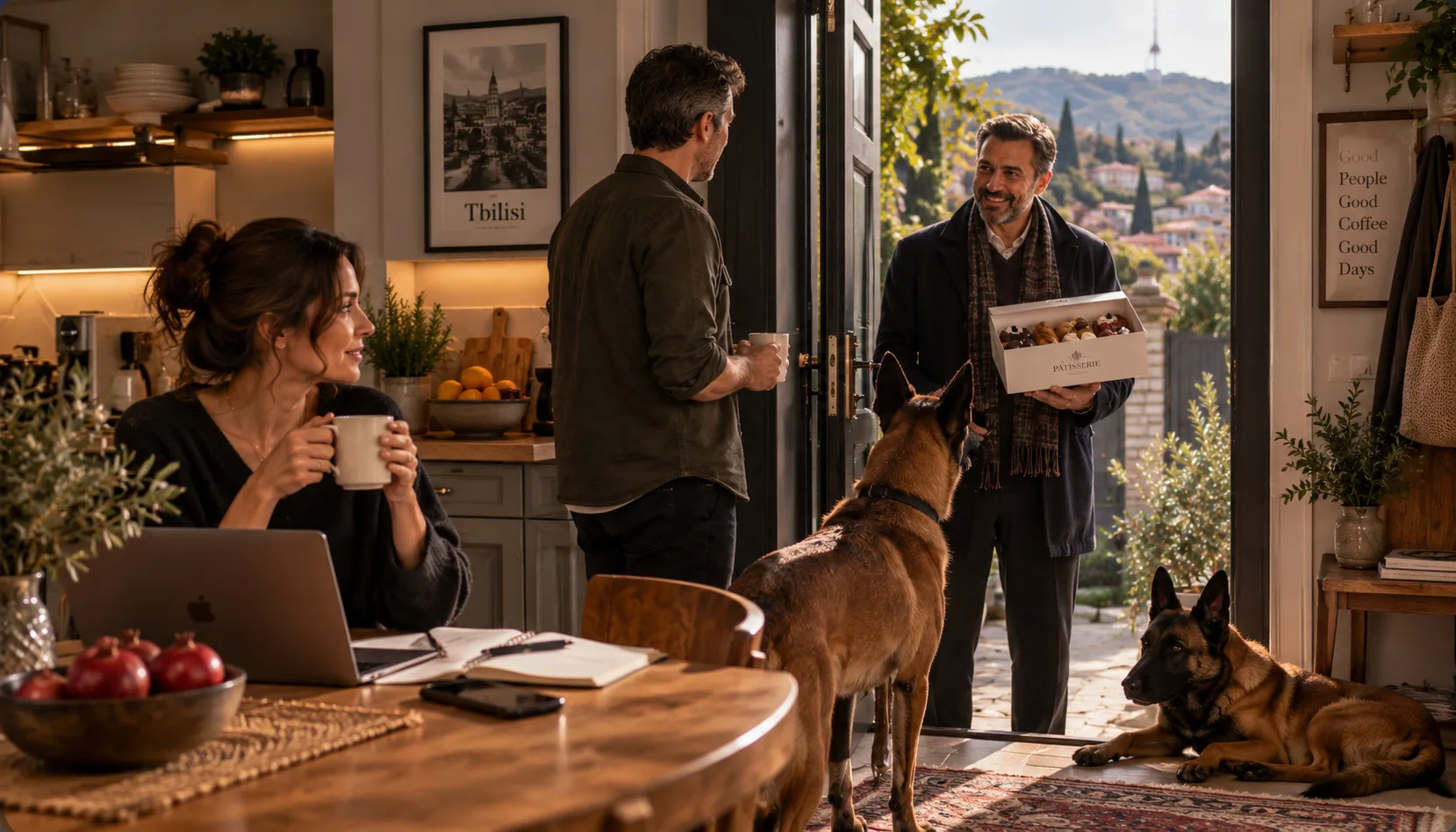
The landlord came round the next day at about midday and brought a bag of churchkhela, those long strings of walnuts or hazelnuts dipped in thickened grape juice and dried until they look like brown candles, which for some reason immediately put me on my guard. I don’t entirely trust people who show up to discuss something important with food in their hands, although in Tbilisi that does make life complicated: here a person is perfectly capable of bringing you something delicious simply because they were passing, and the bag may carry no hidden meaning whatsoever.
But our landlord usually came without presents, so I still didn’t like the churchkhela. If a man wants to ask whether the tap’s still leaking, whether we’re planning to move out, or why the dogs dug another hole by the fence, he doesn’t need to bring food. Max saw no threat in the bag whatsoever and immediately asked where it was from. This was one of the oldest differences between us: when something unfamiliar appeared, I generally tried to work out its legal significance, and Max wanted to know if it was edible.
Thor heard the car from the street and shot towards the gate with the sort of zealous devotion you’d expect from a dog who’d secretly been training for border patrol his whole life and had finally been called up. Nora lifted her head off the mat, listened, and went back to sleep. Nora had always taken a fairly relaxed view of male enthusiasm. If a young male wanted to bark, then run the length of the fence, then forget why he’d been running, a grown woman didn’t necessarily need to get involved.
“Thor, place,” Max said.
Thor stayed by the door.
“He thinks this is his place,” I said.
“He has a very broad interpretation of the command.”
The landlord came in, patted Nora, tried to pat Thor, thought better of it, put the churchkhela on the kitchen table, and started by saying how pleased he was with us as tenants. I didn’t like the sound of that either. Years of legal work had taught me that when someone starts a conversation with “I’m very happy with everything,” there’s a but coming. Sometimes big, sometimes small, but it always comes.
It came about three minutes later.
“I’ve decided to sell the house.”
Max stopped pouring the coffee and looked at him.
“What do you mean, sell it? Do we have to move out?”
“No, no, that’s why I came to you first. You’ve lived here a long time, you know the house, I know you. If you want to buy it, I’ll offer it to you first. If not, I’ll put it on the market.”
For some reason I looked straight out of the window. Thor was lying in the yard, a bag of dog food stood against the wall, a towel Max had hung across the line that morning for no obvious reason was still drying, and everything looked exactly the same as it had yesterday. This always struck me as strange about news that was supposed to change something. Someone tells you something genuinely serious, and outside the window everything just stays exactly where it was, and even the towel doesn’t feel any need to react. Max asked the price first. The landlord named a figure.
I looked at Max and watched him start calculating. Not on his phone, not on paper, just internally. It was a quality of his that sometimes made my life wonderfully easy and sometimes made me want to hide every calculator in the house. He moved from “there’s a problem” to “here’s what we’re doing” faster than almost anyone I’d ever met. If a tap broke, Max knew who was coming to fix it within five minutes. If the dogs needed something, he’d find three options, ring two people and go and fetch the third. If someone said “maybe one day,” Max heard “Tuesday afternoon.”
“Have you listed it yet?” I asked.
“No. I’m telling you first.”
“What’s the timeframe?”
“Not tomorrow. Think it over. Two or three months. I’m not rushing you.”
“Is the price final?”
The landlord smiled.
“For you, we can talk.”
Max smiled too, and I realised they’d both slipped into some sort of male dialect where “we can talk” doesn’t mean talking at all, it means a specific number that one person wants and the other doesn’t want to pay, and somehow both of them consider this a pleasant form of human connection.
Half an hour later the landlord left, leaving us the churchkhela, a price and the very strange sensation that we’d woken up in one house that morning and were now sitting in a slightly different one, even though nothing had physically changed. Max walked him to the gate, came back to the kitchen, opened the bag and looked inside.
“Want one?”
“No.”
“Sure?”
“Yes.”
He took one.
“Don’t say later that I ate them all.”
“I haven’t said anything yet.”
“Just getting in early.”
“This is why we can’t keep honest accounts, you and me.”
“You’re not eating, I’m eating. That’s about as honest as it gets.”
He sat down across from me, bit off a piece of churchkhela and asked, “So, what do you think?”
“I think the landlord left seven minutes ago.”
“And?”
“And in seven minutes I have not made a decision about purchasing real estate.”
“How long do you need?”
“Max, I spend longer choosing shoes.”
“A house is simpler. You already know the size.”
I laughed, although it wasn’t really funny. Not because I was against the house. That was exactly the problem. I liked the house. I liked the neighbourhood, the yard, the big window in the sitting room, the terrace that caught the morning sun, even that ridiculous pantry door that swelled after heavy rain and would only shut if you approached it from precisely the right angle, using language not generally recommended for family use. Max had already started listing the advantages.
“No moving. Easier for the boy. Perfect for the dogs. Good neighbourhood. We know every fault in the place.”
“That last one is particularly reassuring.”
“What? Better to buy a house where you already know the faults than find new ones later.”
“The small bedroom’s cold in winter.”
“We’ll insulate it.”
“The gate’s crooked.”
“We’ll fix it.”
“The terrace roof leaks.”
“We’ll sort it.”
I looked at him.
“Have you already bought this house?”
“No.”
“It sounds like you’ve already finished the renovation.”
“I’m just thinking it through.”
“No, you’re already mentally hiring builders somewhere.”
Max considered this.
“I do know some builders.”
“I knew it.”
He smiled and finished the churchkhela. This, incidentally, was also part of why I loved him. Max had a gift for making things concrete. Out of some anxious, hazy “we should really see to that one day,” he could produce a phone number, the address of a shop and a man named Givi who’d come round tomorrow after four. Sometimes I thought that without him, half our household would simply exist forever in the form of my own notes reading “need to look into this.”
“We need to live somewhere either way,” he said. “We’re already settled here. We know everything about this place. Why go looking for another rental, hauling boxes, moving the dogs?” By “boxes”, Max meant an entirely unreasonable amount of stuff for a family who, a few years earlier, had thought they could pack up and move anywhere. The first time you move, you own a few suitcases and a very clear sense of your own mobility. Then, somehow, an extra saucepan appears, four blankets, dog bowls the size of a small basin, a box of cables nobody can identify, and various objects nobody’s seen in a year but can’t possibly throw away, because they might come in useful.
“I’m not saying we shouldn’t buy it.”
Max looked at me.
“But you’ve already started looking for reasons not to.”
“I’ve started thinking.”
“You always start thinking by looking for the catch.”
“Because sometimes there is one.”
He put his cup down on the table.
“Right, of course.”
I looked up.
“Max, don’t start. I never said no.”
He was quiet for a second, then shrugged.
“I’m not starting anything.”
“Good.”
“I just think you could look at the good side first, before you go hunting for a catastrophe.”
“I’m not hunting for a catastrophe.”
“Great, then.”
A minute later he was asking whether I’d have some churchkhela after all, because “this one, the hazelnut one, is decent,” and the conversation slid back onto its normal track so quickly that I felt almost embarrassed still being annoyed. I stayed in the previous conversation a while longer, feeling like someone who keeps watching a film after everyone else has already changed the channel. Max picked up his phone and started looking something up.
“What are you doing?”
“Checking how much decent internet costs these days.”
“Of course you are.”
“If the house is ours, we can finally get it installed properly.”
I looked at him and suddenly remembered.
“Remember when you used to stand out in the freezing cold for the internet?”
He laughed.
“For you.”
“Don’t flatter yourself. You went out there for the Wi-Fi.”
“The Wi-Fi was a means to an end.”
That was back at the very beginning, when there was no shared house even in theory, when I lived in St Petersburg and Max lived in another country, and most of our relationship fit inside a phone. We met in a Facebook group, and I genuinely no longer remember what it was about. Presumably something so important that humanity has coped perfectly well with my complete loss of the information. I only remember that we ended up arguing about something in the comments, and then he messaged me privately to ask whether I always spent this long explaining to complete strangers that they were wrong.
I told him only the ones who didn’t understand the first time.
He wrote back: “Then this is serious.”
That’s how it started.
At first we wrote to each other in the evenings, then in the mornings, then, for some reason, all day long, and a couple of weeks later I knew when he woke up, what time he finished work and when he was in a bad mood from the first two words of a message. He knew my schedule, asked how the hearing had gone, reminded me to eat if I’d written that I was busy all day, and could ask in the evening, “Did you get home all right?”, even though there was a national border between wherever I was going and his own front door.
There was something funny and very tender about it. He had no physical way of checking whether I’d got home, couldn’t meet me, carry a bag, open the door or put the kettle on, but it still mattered to him to know that I was home. We talked about everything, because in essence there was nothing else we could do. About our first marriages, our childhoods, parents, work, money, children, about what had hurt each of us before and what we wanted now. When people live side by side, life keeps interrupting the conversation. Someone has to make dinner, answer the phone, buy dog food, switch off the washing machine, find the charger, and then it’s late and all you want is sleep. At a distance the domestic part almost disappears, and you’re left with a great deal of time to talk as though the talking itself were the relationship.
One winter Max called me on video, and I saw snow behind him.
“Where are you?”
“Outside.”
“I can see that. Why?”
“The Wi-Fi’s terrible indoors.”
He stood near some building with his phone in front of his face, taking a step to one side then the other whenever the picture froze. Then the connection would drop entirely, his face would dissolve into pixels, the sound would vanish, he’d step back and reappear on screen.
“Go home.”
“In a minute.”
“What’s the temperature there?”
“It’s fine.”
“I can see your breath.”
“It’s atmospheric.”
“You’re about to lose your fingers.”
Max looked down at his hand.
“I’ve got another one.”
“Very forward-thinking.”
“One’s enough to hold the phone.”
“You’re insane.”
“But you can see me.”
And I could see him. Sometimes all of him, sometimes half, sometimes just a frozen forehead and one eye, but at that moment it somehow mattered more than any common sense. I liked that a grown man would stand outside in the cold behaving like an idiot for the sole reason that he wanted to talk to me. Perhaps love generally lowers one’s standards for sensible behaviour, as long as the foolishness is committed in one’s favour.
“And you still nagged me to go inside,” Max said now.
“I was concerned about your extremities.”
“You underestimated the romance of it.”
“I’m a lawyer. It’s an occupational hazard. I needed a man with a full set of fingers.”
He laughed. We spent a little longer remembering that first year, the calls, the photographs, the time he fell asleep in the middle of a conversation and I went on telling him something for another five minutes before I realised my audience had ended. And all of it was real. I never thought we had invented each other back then, the way people like to explain long-distance relationships. We knew a great deal about each other. It was only later that it turned out knowing a person’s story and living next to them every day are not quite the same thing.
After lunch Max went off to run errands, my son shut himself in his room, the dogs stretched out on the terrace, and I opened my laptop with every intention of working. For about forty minutes I genuinely did. Then I caught myself reading the same sentence for the third time, closed the document, and opened the notes app on my phone instead.
At the top I wrote: The house.
Then: pros.
The yard. The neighbourhood. Good for my son. Good for the dogs. No moving. We know the landlord. We know the house.
I thought about it and added: Max likes it.
Looked at that line and deleted it. Not because it didn’t matter, but because I couldn’t work out which column it belonged in.
Then I wrote: cons.
Heating. The terrace roof. The gate. Some paperwork to check.
That was it.
The list looked remarkably calm for a question that refused to feel calm at all.
I added: not temporary any more.
Looked at it.
Didn’t delete it, though I knew perfectly well no property surveyor in the world would list that as a defect. Thor lay in the yard, chin on his paws. Nora slept by the door. A lead hung on the railing that Max had been meaning to put away for days, a box of tools sat in the corner, the churchkhela was still on the kitchen table. We knew everything about this house. Where it got cold in winter, where the morning sun fell, which socket cut out if you ran the kettle and something else at the same time, the exact spot where Thor had once tried to dig his way into the neighbouring country. And suddenly, someone was offering to make all of it ours. Max came back that evening with shopping bags.
“You said you were just running errands.”
“I was.”
“And this?”
“I stopped at the shop.”
“You cannot just drive home. Ever.”
“We were out of milk.”
He set the bags down on the counter, then noticed me with my phone.
“What are you doing?”
“A list.”
“What kind?”
“About the house.”
“Show me.”
“No.”
“Why not?”
“Because it’s mine.”
“Lovely start to a joint purchase.”
I handed him the phone.
Max read it, frowned.
“Why does it just say ‘the yard’? It’s a great yard.”
“Write ‘wonderful yard’ on your own list, then.”
“And the school’s close by.”
“That’s the neighbourhood.”
“That’s separate.”
“Separate for you. For me it’s the neighbourhood.”
He got to the last line.
“‘Not temporary any more.’ That’s a con?”
“I haven’t decided yet.”
Max looked at me, then handed the phone back.
“Fair enough. People don’t usually buy a house for the weekend.”
“Thanks, very helpful.”
“Any time.”
He sat down next to me, put his hand on the back of my neck and stroked my hair the way he always did, usually without even noticing he was doing it.
“I’d buy it,” he said.
“I gathered that.”
“But we’ll decide together.”
“Of course.”
“Tea?”
“Please.”
“With lemon?”
“Yes.”
He went to the kitchen and came back a few minutes later with my tea and a small bar of chocolate he’d picked up for me at the shop. He’d just seen it and bought it. And that was the most inconvenient part. It would have been so much easier to think about our life if Max had been just one thing all the time. Inattentive. Rude. Lazy. A man about whom everything had long been clear. But he brought me chocolate because he knew which kind I liked, drove my son to school, cooked dinner, could get angry over nothing, forget five minutes later that he had been angry, and then sit beside me discussing where to put a table if we did end up buying the house.
“We could put a proper awning on the terrace,” he said, turning on the television.
“Are we renovating a house we don’t even own yet?”
“I’m just thinking out loud.”
“You get an awful lot done for someone who’s only thinking.”
He smiled. I opened the notes app again and looked at the two columns. The house itself, when it came down to it, was straightforward enough. I could check the paperwork, get a valuation, understand the market, discuss the price, work out the costs. That was the part where I felt entirely confident. When a question could be laid out on a table, broken down into points and checked, I always felt steadier. The trouble was one particular line. I couldn’t quite manage to put it into words, even to myself.
Between Us
If someone had asked me that day whether I loved Max, I’d have said yes without hesitation, and probably would have been faintly surprised anyone needed to ask something so obvious. Of course I loved him. I knew the way he laughed when something was genuinely funny. I knew he’d never walk past good meat at the market, even if he’d only gone out for tomatoes. I knew that if I got ill, he’d come and check on me every fifteen minutes to ask if I needed anything, until I wanted to get better purely so he’d stop asking.
But the landlord hadn’t asked whether I loved my husband. He’d offered to sell us a house. While we were renting, our life could go on for another month, another year, however long it lasted. There’s a strange comfort in renting: almost everything can be treated as temporary, even when it lasts for years. Buying was different. Suddenly I had to picture not just the house, but myself still living in it five years from now. Ten years from now. With the same man, in the same rooms, with the same “tea?” every evening.
And that was when I first noticed something I’d apparently never put into words before. Loving someone and wanting to keep living exactly this life with him turned out not to be quite the same question. And I didn’t have an answer to the second one yet.
The Life Between Staying and Leaving
Chapter 3. In a Marriage Everyone Keeps Score, Even Those Who Say They Don’t
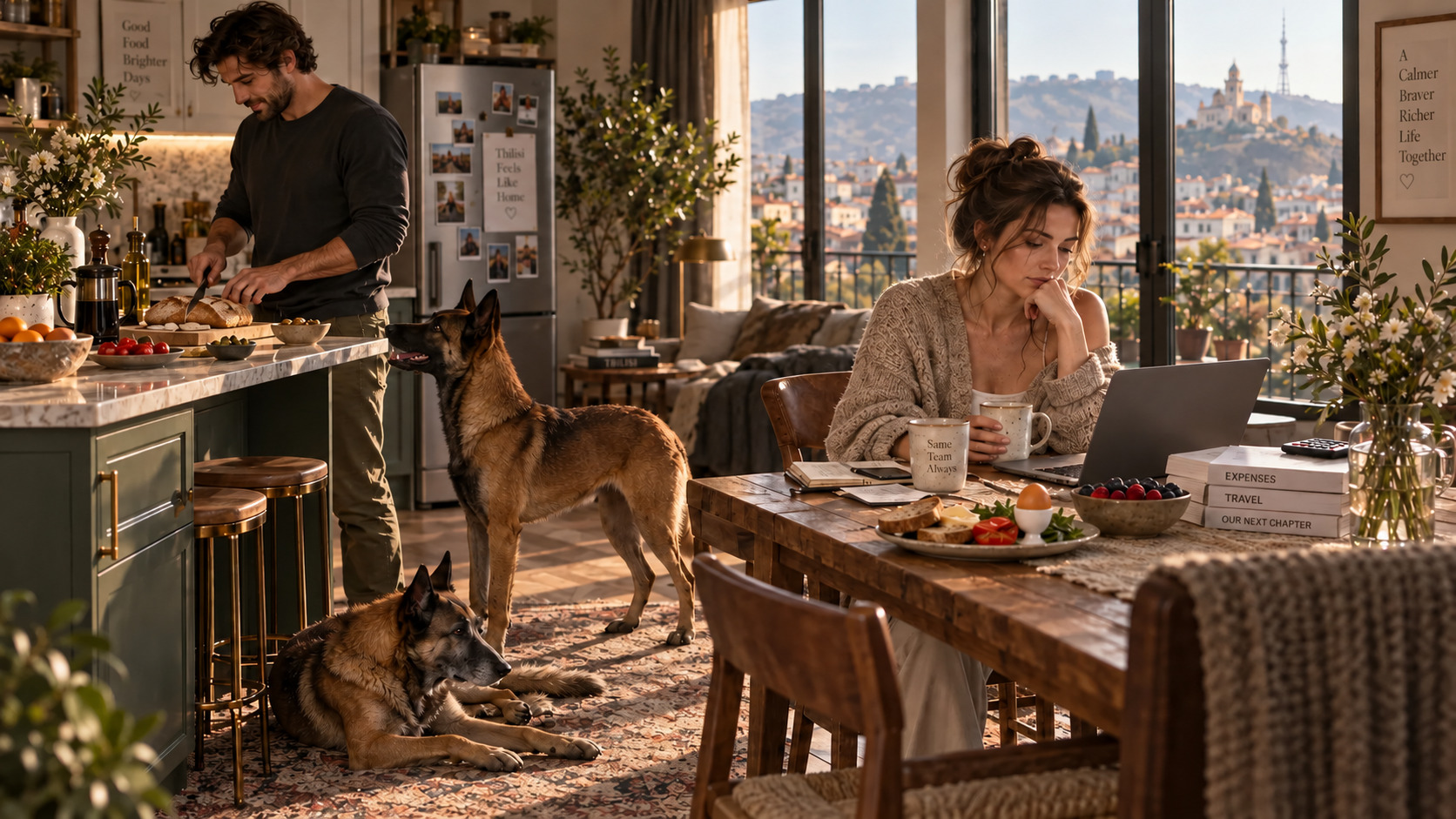
The next morning I opened the banking app before my email, which was in itself a fairly telling sign, because normally I had a whole ritual: messages first, then email, then the news, then messages again, on the grounds that in the seven minutes it took me to read the news the world might well have sent me something urgent, and only after all that would I move, with a certain caution, to money. Money was something I preferred to check only when I was in a good mood, ideally after coffee and before anyone in the house had a chance to announce that the dog food had run out, the car had broken down, the school fees needed paying urgently, or there was an absolutely incredible discount on something we had been living perfectly well without only yesterday. But now the price of the house was sitting there on my phone screen, the figure the landlord had named the day before, and it had that unpleasant quality shared, it seems, by property everywhere: while another person is saying it out loud, it sounds like a big number, but the moment you start measuring it against your own account, it suddenly turns into years of your life.
I sat in the kitchen with my coffee and calculated, not because I intended to buy the house that day, and not even because I had decided to buy it, but because if you tell a lawyer a price, she will start calculating regardless, even when it concerns her own marriage and it would be far more sensible to just play the part of a normal woman capable of saying “let me think about it” and going off to drink her coffee with a clear conscience. I subtracted what couldn’t be touched, looked at the money I actually had, converted the currency back and forth in my head, and then caught myself already working out the costs of registering a house we hadn’t even started haggling over, and, mildly annoyed with myself, closed the app.
I lasted about a minute, then opened it again, because a figure that has once moved into your head doesn’t go anywhere just because the screen is closed. Max came into the kitchen in tracksuit bottoms, put a bag of bread on the table and looked at me with that familiar expression of a man who immediately senses that his wife isn’t just sitting there, but is busy with some private morning arithmetic of her own.
“Why so serious this early?”
“Calculating.”
“The house?”
“The house.”
He nodded as calmly as if we’d been discussing a new washing machine rather than our future together, and, by the look of it, had already mentally moved on to breakfast.
“And how’s it going?”
“The house, against all expectations, still costs money.”
“I thought as much.”
And he began getting out the bread, the cheese and the tomatoes, which since the photographs from the market two days earlier had taken on an almost symbolic significance in our family, though they themselves, naturally, had no idea.
“The landlord’s asking too much, obviously,” said Max, not looking up from the chopping board. “We’ll have to haggle. I reckon we can knock the price down a fair bit.”
“Possibly,” I said, and he looked at me with that mixture of tenderness and mild irritation that appeared whenever I answered too briefly and too professionally at the same time.
“You’re answering like a lawyer again.”
“I am a lawyer.”
“You’re allowed a break at home sometimes.”
“Tell that to the people who sign contracts at home.”
He smirked and went on cutting the cheese, and I watched his hands and thought about how yesterday we’d spent almost an hour discussing buying the house and hadn’t once asked the most obvious question out loud. In a way it was even rather lovely: two grown adults sitting in a kitchen, discussing the price, the roof, the gate, the internet, the builders and the awning on the terrace as though the entire financial side of the matter consisted purely of persuading the landlord to give us a discount. When I finally took a sip of coffee and asked how much Max himself could put in, he didn’t stop cutting the cheese. The knife just slowed down a little.
“Into the house?”
“No, Max. Into the cheese. Of course into the house.”
“Well, I’d have to check.”
I knew that phrase well, because married life develops its own dictionary fairly quickly, one in which perfectly ordinary words take on entirely different meanings: “we’ll see” sometimes means “never,” “just a second” can stretch to forty minutes, “we need to buy” almost always means that the buying will be done by whoever happens to have the banking app open at that moment, and the phrase “I’d have to check,” when it’s about money, means that a conversation is about to begin in which there will most likely be considerably less money than words.
“Check what, exactly?”
“Well, how much I’ve got right now.”
I set my cup down rather more pointedly than necessary.
“You really don’t know how much money you have?”
“Roughly.”
For some reason that amused me almost exactly as much as it annoyed me.
“How much is ‘roughly’?”
Max put down the knife.
“What are you getting at?”
Once again I was reminded that all conversations about money between married people work in exactly the same way: they begin with an innocent number, and within three minutes one person is asking the other why they’re using that tone.
“I’m not getting at anything. We’re discussing buying a house. Yesterday you said, ‘I’d buy it.’ I’m trying to understand the maths of that statement.”
“I said the house was worth buying.”
“No. You said, ‘I’d buy it.’”
“Anna, don’t split hairs.”
For someone who had spent more than twenty years earning a living precisely by splitting hairs, hearing this was especially funny, but I decided not to dwell on the irony.
“How much?”
Max sighed.
“Not much right now.”
That was at least an approximation of a number, though still not one I could put in a spreadsheet.
“How much exactly is ‘not much’?”
“Are you interrogating me?”
“At an interrogation I’d at least have a written record.”
Max finally looked at me and named a sum. I said nothing, and he repeated it, as though hoping that on the second telling it might grow a little. Naturally, the sum did not grow with repetition, although for a second I did wonder why he had said it twice. I had somehow expected more, and not because Max had ever shown me bank statements or told me he had savings, but simply because somewhere in my head, a grown man who’d spoken that confidently about buying a house ought to have had some share of it to put in: not half, not even a third, but at least a sum you could name without then having to spend a long time studying the cheese.
“I see.”
“See what?”
“How much money you have.”
“And?”
“Nothing.”
Max gave me the look that meant my “nothing” had long meant anything in this house except nothing, and so I told him that his “I’d have to check” had just turned out to equal roughly seven per cent of the price of the house.
“Why seven?”
“Because I worked it out.”
“Of course you worked it out.”
He said it without any anger, just with that familiar expression that appeared whenever my figures started interfering with his general sense that everything would somehow sort itself out in the end. At that moment Thor appeared in the kitchen and sat down next to Max, because there was cheese on the table and a conflict brewing at it.
“Don’t look at me like that,” Max said.
It took me a moment to realise he was talking to the dog, not to me.
“He’s just assessing his parents’ solvency.”
“Then the dog’s clearly picked the wrong one.”
We both laughed, and that was rather inconvenient too, because it sometimes seemed to me that genuinely difficult marriages ought to look quite different. People ought to slam doors, go weeks without speaking, hate each other over breakfast and ideally possess one big, dramatic, presentable-to-your-friends conflict. Ours kept turning out remarkably unprofessional: we could perfectly well be talking about something that genuinely stung me and a minute later be laughing at the dog, and Max would make me an omelette, and the problem would still be there between us, completely intact, only now there was a plate beside it.
“I never said I had the money for half a house,” he said.
“You didn’t.”
“Then what’s the problem?”
I looked at him and realised it was genuinely hard to answer. The problem wasn’t that he didn’t have half the price of the house. We had never agreed that we ought to contribute equally, we had no prenuptial agreement either, and we hadn’t got married in the first place in order to run a joint enterprise, and at different points in life one person may earn more and the other less, one works and the other is temporarily not working, one pays for the flat and the other looks after the children, and over time that balance may well shift. All of this I knew perfectly well, could explain in detail and would probably even have written a decent article about. Except that the theory of household economics has the same flaw as many good theories: it works beautifully right up until you open your own banking app.
“I just want to understand.”
“Understand what?”
“How we live.”
Max frowned.
“We live fine.”
At that point any sensible person could safely have stopped, but I didn’t, and explained that I wasn’t talking about quality of life at all, but about money.
“You earn more anyway.”
“That’s not an answer.”
“Then what answer do you want?”
And once again I had nothing to say, which only made the whole conversation more irritating, because if I could have formulated a concrete accusation everything would have been much simpler, but I didn’t want to accuse Max at all. He genuinely did an enormous number of things in the house that I couldn’t stand doing myself: he cooked almost every day, went to the market, bought the groceries, drove my son to school and picked him up, looked after the dogs, found tradesmen and solved minor domestic catastrophes before I’d even managed to notice they’d happened, and whenever some incomprehensible symbol lit up on the dashboard, I would simply photograph it and send it to Max, and if the gas ran out, I would also tell Max, and if we needed to work out where to buy decent meat, dog food, a light bulb of some strange shape or a part for the gate that I was convinced didn’t exist in nature at all, Max would somehow find a man named Givi, Levan or Zura who knew another man and could come round after four.
You couldn’t say Max did nothing. That would have been untrue. But you couldn’t say we paid for our life equally either. That would have been untrue too. I opened the banking app again.
“What are you looking at?”
“Our spending.”
“Why?”
“I got curious.”
Max laughed quietly.
“Now that’s dangerous.”
He was entirely right, because I began scrolling through last month’s transactions, where rent gave way to school, school to groceries, groceries to dogs, dogs to the car, the car to utilities, and between them, again and again, appeared restaurants, more groceries and various purchases I couldn’t even remember. Max looked over my shoulder.
“What, are you doing a family audit?”
“Just a preliminary review.”
“Do I need a lawyer?”
“Too late. The lawyer’s already acting for the other side.”
He set an omelette down in front of me and told me to eat it before it got cold. I put the phone away. The omelette really was excellent, which was also very inconvenient. Over breakfast we talked no more about the house: Max mentioned we needed to buy dog food, since the bag would last two days at most, my son texted to say he didn’t need picking up after school today because he was going somewhere with friends, Nora asked to be let into the yard, and Thor stole a piece of bread off the table and then spent a good five minutes pretending he had no idea what bread we were talking about, so that after a few minutes you could quite easily have thought there had been no conversation about money that morning at all.
But after lunch I did sit down to count, and not Max, but us. First I decided to look at one month, then three, then reasoned that if I was going to lose my mind I might as well do it on an adequate statistical sample, and pulled up six months at once. For the first twenty minutes I told myself I was not, in fact, drawing up an indictment, until a spreadsheet appeared, and once a spreadsheet appears in front of a lawyer there is usually no way back. I entered the rent, the utilities, the school, the groceries, the dogs, the car, the household expenses, the restaurants, the trips and everything else I could reconstruct from the bank transactions: some expenses were obvious at once, others I recognised only by the name of the shop, and some remained a mystery, because four months later it’s almost impossible to work out why anyone needed to leave a hundred and twenty lari in a place whose name now means absolutely nothing to them.
After an hour the figure at the bottom of the spreadsheet had become fairly unpleasant, after an hour and a half I opened another period, after two I closed the laptop, then opened it again, but the figure, naturally, hadn’t gone anywhere, and I sat looking at it with that particular irritation you feel not towards another person but towards your own capacity to spend far too long not noticing the obvious.
Max came back towards evening with dog food, two bags of groceries and some new sauce for the barbecue, and proudly showed me the bottle.
“We’ve got sauces.”
“Not this one.”
And here I nearly said the thing I would have considered petty and stupid five minutes later, and not because of the sauce, which in itself was entirely blameless, but because after two hours spent with the spreadsheet I suddenly saw in that little bottle not a little bottle but a whole system. Max had a perfectly reasonable explanation for every purchase of this kind: this was on offer, we had to go there anyway, it was cheaper to get it now, and that one had simply come up at a good price. And no single purchase ever looked like a problem in itself, because life rarely bankrupts a person with one big bottle of sauce. It does it much more delicately. A little at a time. On offer.
“Any good?”
“Don’t know. We’ll try it.”
Max put the bottle in the fridge, and I said nothing, and it was probably at that moment that I first truly understood that money becomes a problem in a relationship far earlier than it runs out: sometimes there’s plenty of it, it’s just that one person knows exactly what it’s worth, and the other knows which sauce was on offer today.
Between Us
Before the conversation about the house, my attitude to the money from the St Petersburg flat had been fairly simple: it was kept separate, and I liked the very word: separate. Not because I opened the banking app every evening to admire my own financial independence, and not because I was planning to leave Max, but because a grown-up simply feels calmer with something that lets her avoid making important decisions purely out of fear. I sold that flat after Max had already come into my life, but the flat itself had been mine long before him, and so in my head the money still belonged to that other life, the one where I answered only for myself and could, at some point, say: fine, from now on things will be different. Perhaps that isn’t very romantic, but after twenty years of practising law my romantic attitude to property matters was poorly developed at best.
Only now did I see something strange that I had carefully avoided putting into words. If we bought this house, that money would become its walls, its terrace, its gate, its roof, my son’s room and the yard where Thor and Nora ran about. What was sitting in my account right now, and could, if it came to it, let me choose a different life, would turn into our shared life in the most literal, material sense. I hadn’t drawn any legal conclusions yet, because professional habit occasionally saved me from the urge to advise myself without the documents and the statute in front of me, but the human conclusion was unpleasantly simple: putting that money into the house meant more than buying property. It meant making the decision to stay much heavier, more expensive and more permanent.
That was probably why Max’s seven per cent had stung so much, although it had nothing to do with wanting him to pay half. I wanted to know that we were both staking something on this decision that mattered comparably to each of us. Instead it turned out that for Max, buying the house was still mostly a plan, a renovation, builders, internet and a man named Givi who would certainly find someone, while for me it could mean turning my own insurance against the future into our shared present. And the most inconvenient part was that Max hadn’t asked me for anything or pushed me into anything. He didn’t even know yet that I was sitting there thinking about it in exactly these terms.
I closed the spreadsheet and looked again at the sum left over from the sale of the St Petersburg flat. Only yesterday it had just been money. Today, suddenly, it had an address.
Contact the Author
Questions about the book, reviews, interviews, or collaborations? You can reach me directly.