

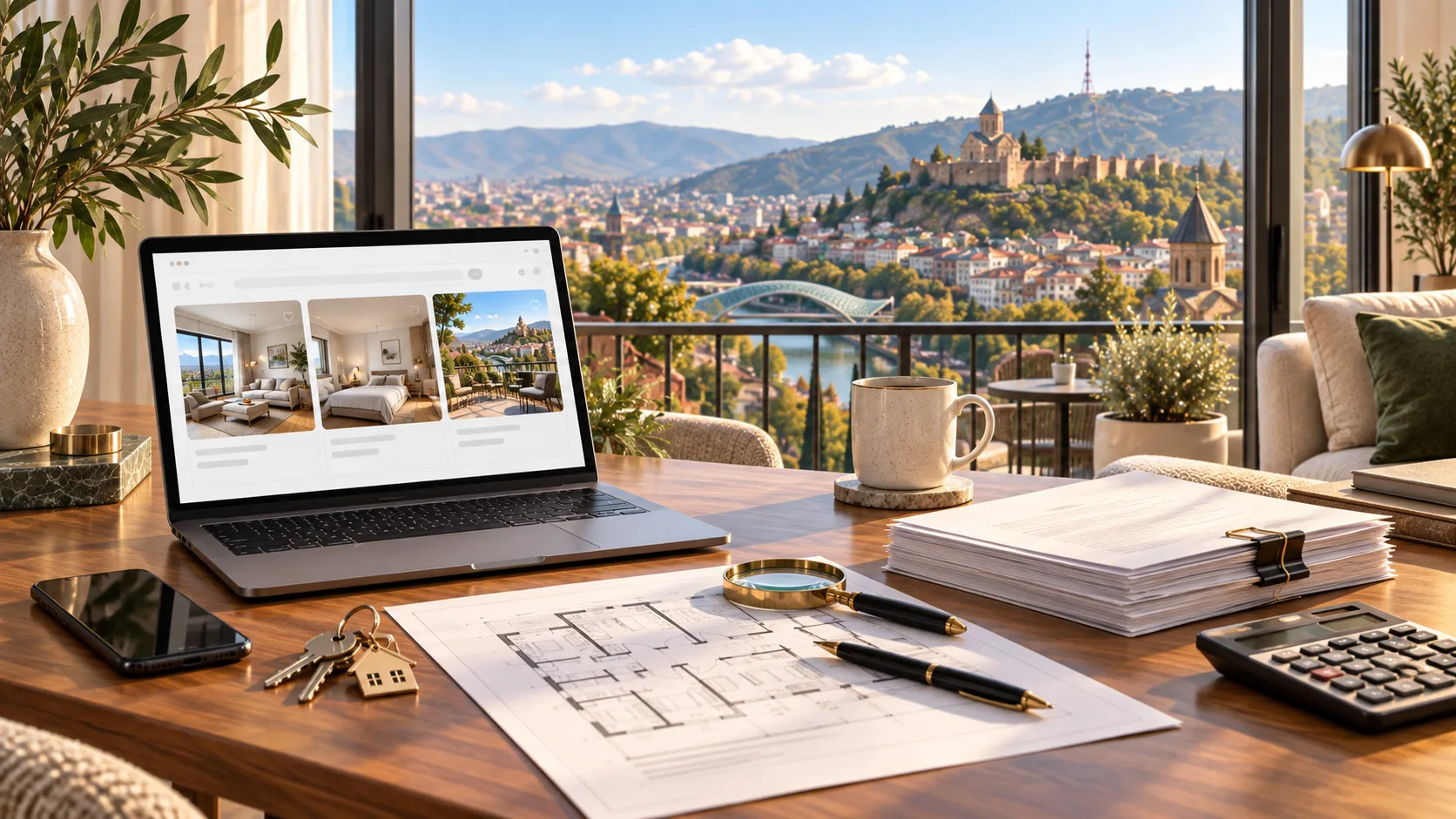
Buying Property in Tbilisi in 2026: What to Check Before You Buy
Buying property in Tbilisi can look almost suspiciously simple from the outside because once the apartment has been found, the price agreed and the documents prepared, the transfer of ownership in Georgia really can be registered very quickly. The speed is real, but it is easy to draw the wrong conclusion from it: the Public Registry can register ownership quickly if the required documents are in order, but it will not decide for the buyer whether the neighbourhood suits them, whether the building is in good condition, whether the apartment is worth the asking price, whether the terrace shown in the photographs is actually part of the registered property or whether the attractive view from the window will still exist once construction begins on the empty plot opposite.
After more than twenty years practising law, I still have the habit of asking uncomfortable questions before money changes hands, and when it comes to property that habit is usually considerably cheaper than the alternative. I have lived in Tbilisi since 2023, so here I combine my own experience of living in the city with the professional habit of looking not only at the apartment itself, but also at the documents, the sequence of the transaction and the questions that are much easier to ask before completion than afterwards. I do not practise Georgian law, so where a particular purchase requires a legal opinion under Georgian law, that part of the due diligence should be carried out by a specialist practising in that jurisdiction.
Article updated in October 2026.
In Short
I help people find property in Tbilisi, communicate with owners and agents, and work out which practical questions should be answered before money is transferred and ownership is registered.
Before buying an apartment or house in Tbilisi, I would check a recent extract from the Public Registry, the registered owner and the authority of anyone acting on their behalf, the cadastral code, the registered area and composition of the property, any mortgage or other restrictions, whether the apartment you see actually corresponds to the documents, the condition of the building, the terms of the contract, the currency of payment and the sequence in which money and registration will be handled. If the purchase is also connected with a residence permit, the immigration requirements should be checked in advance, because for that purpose what counts is the market value established by a certified assessor, not the price agreed in the contract.
First Decide What You Are Actually Buying and Why
Before seriously viewing apartments, it is worth answering a rather unexciting question: what exactly do you want this property for? A home for your own use, an investment property and a property bought partly because you intend to apply for a residence permit may all be in the same building and cost roughly the same amount, yet still be completely different purchases. If the apartment is for you, I would imagine an ordinary Tuesday rather than a pleasant Sunday viewing: where will you travel every day, what happens with traffic and parking, is it easy to walk to a shop, does the elevator work, how noisy is the street in the evening and will that picturesque uphill walk still feel picturesque in February when you are carrying shopping home?
With an investment purchase, personal taste matters less than the likely tenant, the number of similar apartments nearby, running costs and the likelihood that the property will be easy not only to rent but eventually to sell. If the purchase is also connected with plans for a residence permit, the immigration requirements should be checked before the contract is signed. As of September 2026, a short-term residence permit based on property ownership requires non-agricultural property with a market value exceeding the equivalent of USD 150,000 in Georgian lari. The market value must be established by a certified assessor of a body accredited by the Unified National Body of Accreditation, the Accreditation Centre. The threshold increased from USD 100,000 on 1 March 2026, so some older guides may still quote the previous figure. The price agreed between the buyer and seller does not determine whether the property qualifies for this purpose. The current requirements are published by the Public Service Development Agency.
The same apartment can be a wonderful home, an average investment and an unsuitable property for an immigration objective.
Foreign buyers also need to understand the difference between ordinary urban property and agricultural land. A standard apartment in an apartment building is generally a very different proposition from agricultural land, which is subject to a separate ownership regime in Georgia. A house, villa or plot therefore requires the registered classification of the land to be checked from the outset. I would never try to work out the legal status of a plot from how it looks: a beautiful garden may tell you a great deal about the owner and their relationship with roses, but absolutely nothing about the cadastral classification of the land underneath them.
At Some Point You Have to Close the Photos and Open the Documents
There comes a point in every property search when the photographs stop being the most interesting part and the cadastral code suddenly becomes much more attractive. The first questions are fairly straightforward: who is registered as the owner, is there one owner or several, what exactly is registered and at what size, and are there mortgages, restrictions or other registered rights that need to be understood before the transaction goes any further. The official real estate register is maintained by the National Agency of Public Registry of Georgia. If the negotiations are being handled by someone other than the owner, it is worth checking what authority that person is acting under, and if there is an entry in the registry extract that nobody can explain clearly, the time for that explanation is before the deposit is paid, not afterwards.
The date of the extract matters too because a document obtained several months earlier may be useful for understanding the history of the property, but it does not necessarily reflect its position today. The registry is not a substitute for full due diligence, but it is still the logical place to begin.
The next step is to compare the apartment you can see with the apartment described in the documents. An advertisement may give one floor area, the plan another, a developer may use its own method of calculation and the register may describe the property slightly differently again, so what matters is not only how many square metres you saw at the viewing but what exactly you will become the registered owner of after completion. If the price includes a terrace, storage room, parking space, enclosed balcony or additional room, it is worth checking how that space appears in the documents and whether it actually forms part of the registered property. I would be especially careful with older buildings, where walls may have moved, balconies may have become rooms and additional spaces may have appeared years before anyone thought about whether the registry still matched reality. A room does not acquire a different legal biography merely because somebody painted it nicely and put a sofa in it.
A completed apartment and a new development also require very different kinds of checking. A resale apartment has one major advantage: it exists in the real world. You can open the windows, turn on the water, look for damp, walk through the entrance, listen to the elevator and work out whether the neighbours upstairs have been renovating since the collapse of the Soviet Union or only started on Tuesday. In a building that is still under construction, a large part of what you are buying currently exists in plans, documents and promises, so attention shifts towards the developer, the land, the project, the construction stage, the payment schedule and the contract itself. The brochure is supposed to make you want the apartment. The contract has a different job.
The Contract, the Money and the Registration Need to Fit Together
I never judge the quality of a contract by the number of pages it contains. After reading it, the buyer should understand who is selling the property, exactly what is being sold, how much it costs, when and how the money will be transferred, when the documents will be submitted for registration and whether either party still has obligations after signing and before the property is physically handed over.
Currency needs separate attention because property prices in Tbilisi are very often discussed in US dollars while the actual payment may be made in Georgian lari. If a conversion is required, it is better to agree in advance which exchange rate will be used and at what point it will be fixed than to discover on payment day that the buyer and seller had been imagining two entirely different calculations. The same applies to furniture, appliances, lighting and anything else that is supposed to remain in the apartment: the phrase “of course, everything stays” sounds wonderfully convincing when everyone is standing in the kitchen and rather less convincing when an expensive appliance disappears shortly before the keys are handed over.
Registration of ownership is part of the same sequence rather than a separate formality that begins after everything else has already been settled. Article 183 of the Civil Code of Georgia provides for written form and registration of the buyer’s ownership in the Public Registry. The Georgian registration system can indeed work quickly, but the speed of registration does not mean that the due diligence should somehow be compressed into the same twenty-four hours. Before signing, I would want to understand the whole transaction as one sequence: when the contract is signed, when the money is transferred, when the registration application is filed, how payment is evidenced and what happens if registration is suspended or, for some reason, does not complete as expected. Large transfers are rarely improved by improvisation, and a transaction becomes considerably calmer when everyone understands the sequence before anybody starts moving money.
Look Past the Renovation
A beautiful kitchen, good lighting and new furniture have an extraordinary ability to make everything else almost invisible for a while, while the roof, pipes, entrance, heating system and empty plot opposite quietly wait for somebody to remember them. I am much more interested in the things that are difficult or expensive to change after purchase: the condition of the building, damp, noise, common areas, the route home, the possibility of future construction outside the windows and the neighbourhood itself. Five hundred metres on a map and five hundred metres in Tbilisi can have a fairly formal relationship with one another, so the street, the hill, the traffic and the walk home are worth testing on foot.
If You Are Buying to Invest
If the apartment is being bought as an investment, I would check the promised return with the same degree of calm. An attractive projected return means very little until you know what rent has been assumed, what occupancy rate is built into the calculation, how much furnishing and maintenance will cost, whether there are management expenses and how long the property may stand empty between tenants. A spreadsheet is easy to improve by changing a few assumptions. An apartment with weak demand or poor resale prospects is considerably harder to persuade.
When You Already Love the Apartment
The hardest moment for due diligence often arrives not when the documents are especially complicated but when you already really like the apartment. The seller says there is another buyer, the property suddenly feels like the only one of its kind in the entire city, another day of checking begins to feel dangerous and an ordinary request for one more document starts to look like an irritating obstacle between you and the keys. That is exactly when the questions matter most. Good due diligence should not search for a reason to reject every apartment or turn an ordinary purchase into an investigation; its job is much simpler than that. It should allow the buyer to understand what physical property they are acquiring, what rights are registered, what the contract actually says and how the money will move. If, once the first excitement has settled, all of that still looks sensible, fast Georgian registration becomes exactly what it should be: a convenient final stage of the transaction rather than a reason to rush everything that comes before it.
Planning to Buy Property in Tbilisi?
If you are looking for an apartment or house in Tbilisi, I can help you find suitable properties, communicate with owners and agents, and work out what should be checked about the property and the practical terms of the transaction before you transfer money. If you have already chosen a property, I can also help you take a careful practical look at the documents, registry information, payment arrangements and sequence of steps before the purchase.
FAQ
A foreign citizen can generally buy a standard apartment in an apartment building. Agricultural land is subject to a separate legal regime, so when buying a house or plot it is important to check the registered classification of the land.
I would start with the registered owner, cadastral code, registered area, mortgages and other restrictions, then compare the physical property with the documents before moving on to the contract, payment arrangements and registration sequence. A registry extract alone is usually not enough to understand the entire transaction.
No. It is an important starting point, but it will not tell you about the technical condition of the apartment or building, physical alterations, the quality of the contract, the payment structure or the investment prospects of the property.
As of September 2026, a short-term residence permit based on property ownership requires ownership of non-agricultural property in Georgia with a market value exceeding the equivalent of USD 150,000 in Georgian lari. The market value must be established by a certified assessor of a body accredited by the Unified National Body of Accreditation, the Accreditation Centre. The threshold increased from USD 100,000 on 1 March 2026, which is why some older information still refers to the previous figure.
Not necessarily. The transaction price is agreed between the buyer and seller, while for certain purposes, including a short-term residence permit based on property ownership, the officially established market value is relevant.
Author Olga Sverchkova