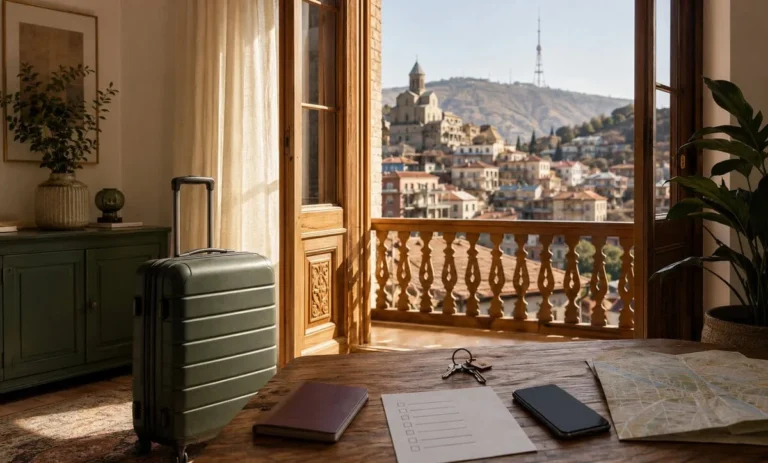


Moving to Tbilisi: My Experience. I Only Meant to Come for a Little While
When I moved to Tbilisi in 2023, for quite a long time I did not even call it a move because I was only planning to stay for a little while, and “for a little while” sounded much calmer and did not seem to commit me to anything in particular.
In St Petersburg I knew the streets, the familiar routes and all those tiny details of everyday life that you never think of as knowledge until one day you find yourself in a city where you know none of them. I knew where to buy something quickly, who to call if something broke, which road was better at a certain time of day and, sometimes more importantly than it probably should have been, which shop had not yet raised the price of butter that week.
Then I found myself in a city where even buying a light bulb could occasionally require a small investigation.
Moving to another country does something rather strange to a perfectly independent adult because it suddenly turns you into a beginner again. You can know how to work, negotiate, understand contracts, run a household and deal with problems that would ruin the mood of any reasonably organised person for the rest of the day, but none of that tells you where to find a plumber on Sunday, whether the address you have just been given actually exists in exactly the form you heard it, or why the route on your phone suddenly ends at a staircase.
During the first few weeks, that was probably the most exhausting part of moving to Tbilisi. There was no single dramatic problem, just an endless collection of small questions I had never needed to think about before. Where do you buy this? Who fixes that? Is it always like this? Does this bus actually stop here? And why does everyone say to turn after the green gates when there are at least six sets of green gates?
Article updated in October 2026.
Moving to Tbilisi: My Experience
What follows is not a relocation checklist but the part that is harder to put into one: what it actually felt like to become a beginner again, build an ordinary life in a new city and eventually stop feeling like a visitor.
Tbilisi makes such a strong first impression that for a while it distracts you from everything else. Balconies, hills, courtyards, traffic, bread, dogs, old houses, new towers and conversations happening absolutely everywhere take up all your attention, and at first you do not even notice how many ordinary skills of daily life disappeared simply because you changed countries.
In St Petersburg I rarely had to think about the mechanics of an ordinary day because most things had been automatic for years. In Tbilisi, a simple household task could suddenly involve several stages, a phone call, a minor misunderstanding and somebody’s cousin, and although that irritated me at first, I fairly quickly began to enjoy it. I did not even notice when some of those things became automatic here as well. I stopped translating every situation into the system I already knew and gradually accepted that this city had its own way of organising everyday life, which did not have to be less logical simply because nobody had consulted me when designing it.
Tbilisi and I took particularly long to agree on geography. During my first months I spent an indecent amount of time looking suspiciously at Google Maps because the city can show you a perfectly simple eight-hundred-metre route and modestly fail to mention that part of it goes uphill, several staircases appear halfway through, and one section of pavement seems to have resigned from its duties years ago.
People who know the city because they live here explain directions very differently from a navigation app. Go past the bakery. Turn where the pharmacy used to be. No, not that entrance, the next one. Then you will see the green gates. For someone who had only recently arrived, instructions involving a shop that no longer existed and gates that looked exactly like five other sets of gates felt like a fairly advanced test of local knowledge.
A few months later I caught myself giving somebody directions in exactly the same way, using a bakery and green gates instead of a street number, and realised that somewhere along the way the city had stopped needing translation.
Housing and ordinary life
Housing teaches you one thing fairly quickly: a beautiful apartment and a comfortable apartment are not necessarily the same apartment. One place I loved at first had high ceilings, beautiful light, a terrace and exactly the sort of old Tbilisi atmosphere that looks exceptionally good in photographs. There was even a cat living on the staircase, and at the time I considered that further proof that I had made the right decision.
Then winter arrived.
Winter is when you discover that high ceilings create a surprisingly large volume of air that also needs to be heated, old windows may consider draughts part of the building’s historic heritage, and a beautiful wall can grow mould with far more enthusiasm than you would expect from an architectural feature. A landlord may confidently tell you that the apartment is warm because technically a heating system does exist somewhere inside it, while in practice your main source of warmth sometimes turns out to be positive thinking.
Location works in much the same way. Ten minutes on a map may be a pleasant walk through the neighbourhood, or it may become a daily uphill climb with shopping bags, and a promise that a journey takes twenty minutes by car is always better tested at the time of day when you will actually need to make it. If I had to move to Tbilisi again, I would pay as much attention to the building and the daily route as I would to the apartment itself, because a beautiful kitchen does surprisingly little to improve a morning spent in traffic or a winter evening when the bedroom wall turns out to be colder than the refrigerator.
If you are choosing where to live or trying to work out a realistic budget, I cover those questions separately in Best Neighbourhoods in Tbilisi and Cost of Living in Tbilisi. Everything involving viewings, payments, rental agreements and dealing with landlords belongs in Renting an Apartment in Tbilisi, because what interests me here is not another instruction manual but the way your idea of a comfortable life changes once you actually begin living it.
More than twenty years of legal practice could not tell me which neighbourhood I would personally like, but they did almost completely remove my ability to look at an important agreement and think that everything would somehow sort itself out later. An extraordinary number of disputes begin with two perfectly reasonable people who are both absolutely certain that they understood the same conversation in exactly the same way, especially when money, repairs, deadlines or obligations are involved.
That lesson turned out to be useful far beyond rental agreements. In a new country it is very tempting to assume that something works roughly as it did before. Sometimes it does. Sometimes it does not. Asking one more question at the beginning is usually much easier than discovering later that everyone involved has been living inside a different version of the same agreement.
What I learnt after moving
There are days when the water disappears exactly after you have shampooed your hair, the electricity chooses the minute before an important call to remind you how dependent modern civilisation is on sockets, the road you used perfectly normally yesterday appears to be undergoing a major transformation today, and somewhere in the city somebody is almost always drilling something.
None of that makes Tbilisi unique. Every city is inconvenient in its own particular way.
What mattered to me were the things that came with those inconveniences: the shopkeeper who noticed I had not been in for several days, the neighbour who arrived with information I had not asked for but eventually needed, a conversation with a taxi driver that managed to become a family history before we reached the destination, and hot bread bought for dinner that once again failed to arrive home intact.
Tbilisi becomes likeable not because everything works perfectly. Quite often it does not. It becomes likeable when ordinary life gradually fills with people, habits and stories, and one day in the middle of complaining about something you suddenly realise you are complaining like somebody who lives here.
If I were preparing for the move again today, I would still organise the practical things in advance because spontaneity becomes considerably less romantic when documents, money and somewhere to sleep are involved. I would calculate a realistic budget, keep a separate reserve for the first month, choose several neighbourhoods but refuse to fall in love with any of them from photographs, test my actual routes in the morning and evening, and ask far more questions about heating than politeness might normally allow.
Most importantly, I would give myself permission not to understand everything immediately.
When you have known for decades how your own life works, feeling like a beginner can resemble a small personal failure for about five minutes several dozen times a day, even though it is really just the process of forming new habits. Eventually you know which supermarket you prefer, which taxi route you hate, where the better bread is and why the road that looks shorter is somehow never faster, and then you simply stop researching your own life quite so much because you have finally started living it.
If you need practical steps rather than a personal story, I have collected documents, temporary accommodation, renting, budgeting and long-term residence questions separately in How to Move to Tbilisi.
When a city becomes home
I do not remember ever making an official decision to call Tbilisi home, and there was no particular day when everything suddenly changed. I simply stopped counting how long I had been here, started buying things for the house without wondering whether it made sense to buy them for somewhere temporary, began making plans several months ahead and one day heard myself saying, “Here in Tbilisi, we…”
It was the “we” that surprised me because it probably said more than any conscious decision could have done.
By then the city had also started turning into notes. Taxi drivers, neighbours, balconies, dogs, old lifts, small shops, strange misunderstandings and all the little things that seemed too insignificant for a serious story kept finding their way into my notebooks. I write more about how those notes eventually became a book in The Story Behind Nobody Told Me About Tbilisi.
I came here for a little while.
Somewhere along the way, I stopped opening Google Maps to find those green gates.
Planning a move to Tbilisi?
If you are thinking about moving and want to discuss your own situation before choosing a neighbourhood, renting an apartment or making a decision that may later become difficult or expensive to change, I can help you work through the budget, housing, neighbourhoods and practical sequence of steps. Sometimes one conversation before a move saves far more time, money and frustration than several weeks spent correcting decisions that looked perfectly sensible when they were made.
Where a question requires a formal legal opinion under Georgian law, it should be handled by a lawyer practising in Georgia.
Nobody Told Me About Tbilisi
That is how the book about ordinary Tbilisi began, the Tbilisi that appears once you stop thinking all the time about how to live here.

FAQ
I now live in Shindisi, a mountain village about 7 kilometres from Tbilisi at roughly 1,100 metres above sea level. Before that I lived in Tabakhmela, so I know this side of Tbilisi not from a map or a property listing but from ordinary life, driving into the city, watching the weather, working out routes and discovering how much difference a few kilometres and a change in altitude can actually make.
I like coming back from the city to somewhere quieter, cooler and with more space around the house. That matters even more because we have two Belgian Malinois, and life with two dogs like that changes the way you look at an area very quickly. Cafés and pretty streets are still nice, but you also start paying serious attention to where you can walk, how easily you can get out of the house and whether there is enough space for ordinary daily life.
Probably how quickly a competent adult can become a beginner again. It was not the big problems that surprised me most, but all the small things that used to happen automatically: where to buy something, who to call, how to get somewhere, whether an address actually looks the way you expect it to and which of the six green gates somebody meant when they told you where to turn.
A great deal. With two active dogs, “Is the apartment beautiful?” very quickly gives way to questions like “Where do we go in the morning?”, “Is there enough space around the house?” and “Does this place actually work for everyday life with large dogs?” Without them I would probably look at housing differently, but now the area around the house matters to me almost as much as the house itself.
Heating, windows, damp, the building itself and the daily route. I still notice a beautiful kitchen, good light and a terrace, of course, but now I know that in winter the more interesting questions are how warm the bedroom is and how much the previous tenants paid for heating in January.
Yes. I would simply do certain things more calmly, ask more questions before making expensive decisions and stop expecting myself to understand the entire city immediately. I would still leave room for the things that cannot be planned because, in the end, many of the best parts of my life here came from exactly those things.
If you need documents, temporary accommodation, renting, budgeting and long-term residence information rather than a personal story, I have collected it separately in How to Relocate to Tbilisi.
Author Olga Sverchkova