Book Appointment Now



Living in Tbilisi: What I Didn’t Understand in My First Months
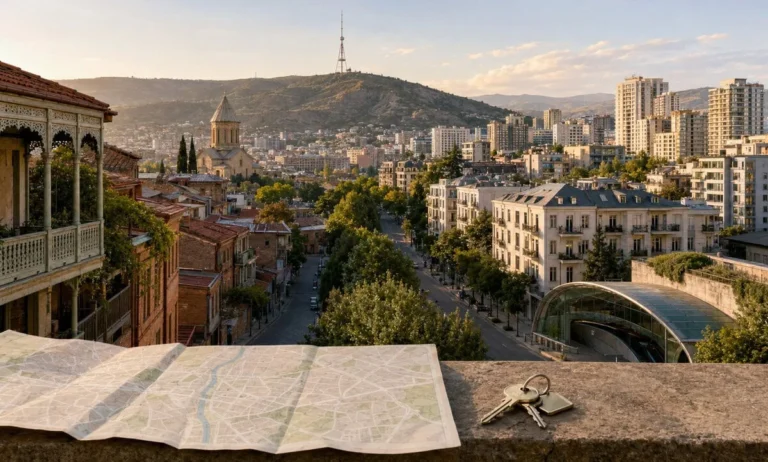
When I arrived in Tbilisi in 2023, I honestly thought I’d come for a little while. Now that living in Tbilisi feels like everyday life to me, that sentence sounds rather funny. “For a little while” brings to mind someone with a suitcase who tries not to buy too much, not to get too attached, and keeps reminding herself she’ll be moving on soon. Things turned out a little differently for me. Very quickly there was a home, my son’s school, work, dogs, familiar roads, my usual shops, people I could message if something broke, and far too much stuff for someone who was supposedly about to leave. At some point, “for a little while” started to sound like an old family legend: everyone remembers we used to say it, but nobody quite believes it any more.
Before the move, I thought the hard part would be over the moment we arrived. You gather the documents, decide what to take, find somewhere to live, sort out the journey, move a child, dogs, belongings and yourself, ideally without losing your passport or your common sense along the way, then open the door of the new home, put down the suitcases and finally breathe out. My first months in Tbilisi soon showed me that the suitcases were only the introduction. Real domestic life starts afterwards, when it suddenly turns out you need towels, hangers, a clothes airer, a decent kettle, an adapter for one socket, then another adapter because the first somehow doesn’t fit everything, boxes, containers and some utterly unpredictable fifteen-lari item you lived without perfectly well yesterday and today can’t imagine how you managed. Each purchase on its own looks like nothing, but within a week the house holds so many small possessions it’s as if the family hadn’t moved to another country at all, but had secretly decided to open a homewares shop.
The Costs That Aren’t in Any Spreadsheet
I like to understand the numbers. Perhaps it’s a professional habit: I’ve been practising law for more than twenty years, most of my professional life has been tied to St Petersburg, and the phrase “we’ll see how it goes” has never had a calming effect on me. Before the move, of course, I did the sums: rent, utilities, food, transport, school, phone. It all looked reasonable, until the usual expenses were joined by an army of small purchases, each of which cost very little but which together seemed remarkably sure of themselves. Taxis, deliveries, things for the house, buying again what I’d first bought in the wrong place or in the wrong size, small household bits whose purpose I couldn’t recall a month later. And this may be one of the most honest things you can tell anyone before a move: however carefully you budget, there will always be a separate sum for the things you don’t yet know you’ll need.
Then it gets easier. You know where to buy groceries, whom to call when the water stops, where to go for the thing you need, and that you don’t have to grab everything at once just because you suddenly want it. The house stops demanding daily sacrifices in the form of shopping trips, and you finally realise you’re living rather than endlessly settling in. I think home begins not with a beautiful view from the window but with the moment you know exactly where the bin bags are, which socket is behaving suspiciously, and which drawer you put the scissors in for some reason before spending two weeks looking for them.
When the Old Rules Stop Working
With money, at least, things were clear. It took me far longer to accept that Tbilisi didn’t have to work the way I expected. I grew up in St Petersburg, spent most of my life there, worked there, raised my son there, and knew a great many things nobody had ever taught me. How long a journey takes. When someone is genuinely running late and when they’re “already on the way”. When to worry and when you can calmly finish your coffee. What someone means, from their tone alone. Which problem needs solving right now and which, a couple of hours later, will turn out to have somehow solved itself. All this knowledge feels like common sense right up until you find yourself in another city and discover that common sense is local too.
At first I wanted to understand everything, preferably in advance. How seriously to take an arrangement. Why a situation that felt urgent to me didn’t seem to worry anyone else. Why some things happened differently from what I was used to. I compared constantly. It would have been different in St Petersburg. It would have taken this long in St Petersburg. Someone in St Petersburg would have put it another way. Then at some point I grew tired of being an interpreter between two cities and simply stopped. Not because I’d decided everything here was better, and not because St Petersburg had suddenly got worse, but because Tbilisi had finally earned the right to be Tbilisi without sitting an exam on how well it matched my habits.
That’s when things began to change. You no longer think every day how strangely things work here. You drive along a familiar road, know which way to go, where to buy bread, whom to message if something’s happened, and don’t even notice that a few months ago you didn’t know a single turn. I don’t remember the day Tbilisi stopped feeling foreign. There probably wasn’t one. Nobody gathered the neighbours in the courtyard to announce that my probation was over, and I didn’t wake up one morning with the solemn thought that the city had finally begun to feel like home. There were just familiar places, people, our own stories, and plans that belonged not to my previous life but to this one. The city acquired its own yesterday, its own today and its own tomorrow.
How Nobody Told Me About Tbilisi Began
Then I started writing it all down. Not because I’d decided to write a book about Georgia, and certainly not because I meant to explain to anyone how to live in Tbilisi properly. Someone who’s lived in a city for a few months is a particularly dangerous kind of expert: they’ve already spotted the differences, haven’t yet understood the reasons for half of them, and usually have enough confidence for a full lecture. I just wanted to keep the small scenes, conversations, people, dogs, neighbours, domestic absurdities and details that didn’t seem to mean much on their own, but out of which my new life was being built.
That’s how Nobody Told Me About Tbilisi came about. It isn’t a book about where to go, where to eat and what you must see in three days. I was more interested in something else: what a city looks like once you stop being a tourist in it, when you know not only the pretty street but the shop round the corner, when you get annoyed, get used to things, laugh, argue, find your own routes, and one day catch yourself defending Tbilisi to someone who arrived three days ago and has already worked it all out: what’s good here, what’s bad and how everything ought to have been done.
That was when I realised “for a little while” had ended long ago.
I started living, and little by little the city explained itself.
The prologue and first five chapters of Nobody Told Me About Tbilisi are free to read on the website.
Author Olga Sverchkova
I’m a writer and Russian-qualified lawyer. I spent more than twenty years practising law in St Petersburg. I write about relationships, choices, memory, cities and everyday life.

New books and stories by email
New chapters, blog posts and book news, sent by email. Not often.