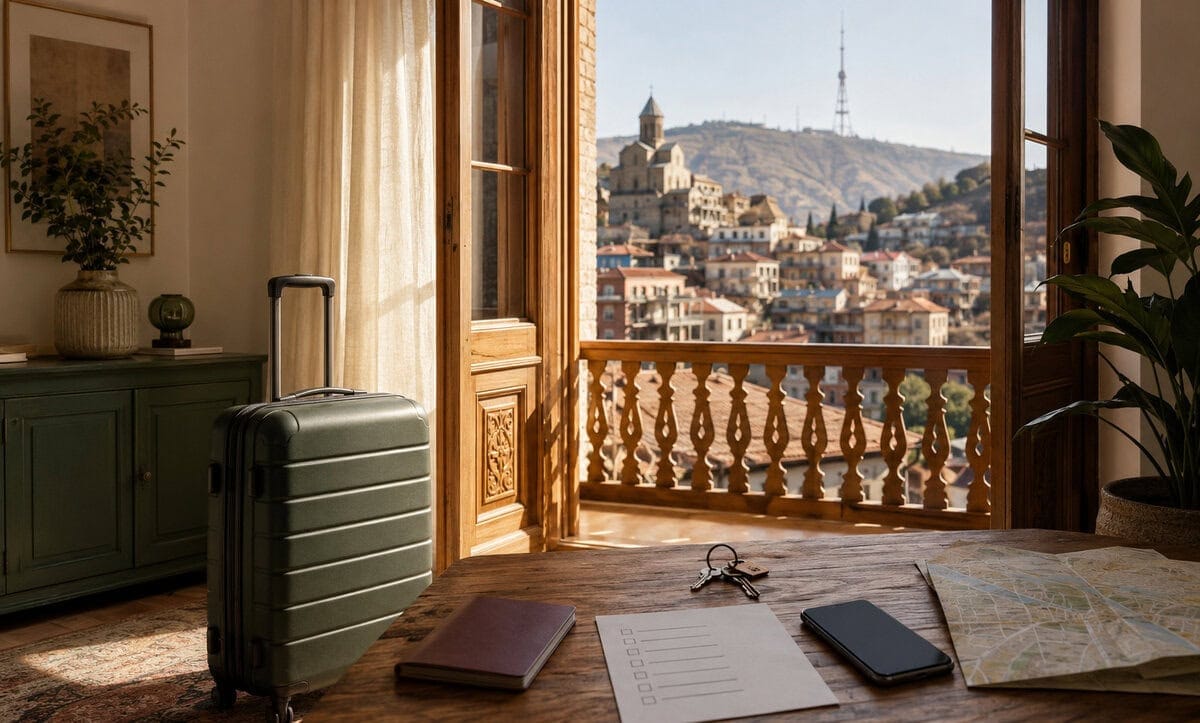
How to Relocate to Tbilisi: Practical Guide
Relocating to Tbilisi becomes much easier once you stop trying to solve every part of the move at the same time. Before you sign a lease, start collecting documents you may never need or spend three evenings comparing apartments in neighbourhoods you have never actually walked through, there are a few decisions worth making first, because they determine almost everything that follows.
If you are trying to work out how to relocate to Tbilisi, I would start with your legal basis for entering and staying in Georgia, the documents that may be difficult to obtain once you have left home, a realistic budget for both the move and ordinary life, temporary accommodation for the first weeks and, perhaps most importantly, some idea of what your everyday life in Tbilisi is supposed to look like.
I learned most of this after moving to Tbilisi myself in 2023, when questions that looked simple from a distance turned out to have a remarkable number of practical details once I was actually here.
Someone arriving for three months with a laptop needs a completely different plan from a family moving for several years with children and two dogs. The dogs, incidentally, will probably develop opinions about neighbourhoods before everyone else.
This guide was updated in September 2026. Immigration rules and administrative procedures can change, so anything connected with entry, residence status or official documents should always be checked against current Georgian government information for your citizenship and circumstances. Official information about entering Georgia and visas is available through GeoConsul, the service of the Ministry of Foreign Affairs of Georgia.
How to Relocate to Tbilisi: What to Prepare Before You Move
The useful part of relocation planning is not trying to predict every problem in advance, because that is impossible, but identifying the decisions that are expensive, slow or difficult to reverse once you have already arrived.
A forgotten frying pan can be replaced in twenty minutes.
A missing original certificate that is sitting peacefully in a drawer three thousand kilometres away is a different kind of problem.
Check Your Entry and Stay Rules
Start with the official rules that apply to your passport rather than somebody else’s experience in a Facebook group two years ago.
Entering Georgia, being allowed to remain for a particular period, working in Georgia and qualifying for a residence permit are related questions, but they are not identical. The Ministry of Foreign Affairs provides official information about entering Georgia and visas through GeoConsul, while residence permit requirements are published by the Public Service Development Agency.
If you expect to stay for a longer period, it is worth looking at your possible residence options before you move, even if you do not intend to apply immediately, because the moment to discover that you need an original document from another country is generally before that document becomes an international logistics project.
Bring the Documents You May Actually Need
I would bring originals of the documents that could realistically matter to your particular situation, which may include passports, birth and marriage certificates, children’s documents, diplomas, proof of income, banking documents, medical records, prescriptions and veterinary documents if you are moving with animals.
This does not mean translating and legalising your entire filing cabinet just in case.
Whether a document needs translation, notarisation, an apostille or another form of certification depends on what the document is, where it was issued and what you intend to use it for, so it makes more sense to identify the likely procedure first and prepare accordingly.
If somebody may need to handle paperwork for you in your home country after you leave, consider whether a power of attorney should be arranged before travelling. This is one of those things that seems unnecessarily cautious until the first time you need somebody to collect a document from an office where your charming explanation over the phone turns out not to be a recognised form of authority.
Book Temporary Accommodation First
Unless you already know Tbilisi well enough to have strong opinions about particular streets, I would not choose a permanent apartment from abroad simply because the photographs look beautiful.
Photographs are exceptionally bad at showing traffic noise, damp, weak heating, the condition of the entrance, construction outside the bedroom window or the hill you will have to climb every evening carrying groceries.
Maps are not much better at hills.
Five hundred metres on Google Maps and five hundred metres uphill in Tbilisi are two entirely different measurements.
A couple of weeks in temporary accommodation gives you time to walk around the areas you are considering, see apartments in person and discover which details actually affect your day. If you work from home, you may care most about internet, noise and enough space to work without conducting every video call from the end of the bed; if you have children, the school route may matter more than the view; if you do not drive, a metro station can become considerably more attractive than a decorative balcony.
The neighbourhood you were certain you wanted before arriving may turn out not to be the one you want to wake up in every morning, and it is much cheaper to discover that before signing a lease for a year.
Your First Week in Tbilisi
You do not need to organise your entire new life during the first weekend, and attempting to do so is a surprisingly efficient way of making an already complicated week feel worse.
Use the first few days to make ordinary life possible. Sort out your phone and internet, find the supermarket and pharmacy you will actually use, learn the routes you are likely to travel regularly and spend some time walking through the neighbourhoods you are considering before you start making permanent decisions about housing.
If work or school will involve crossing the city every day, test that journey at the time you will actually need to make it, because a route that looks perfectly reasonable on Sunday afternoon can acquire a very different personality on Monday morning.
Keep digital copies of important documents somewhere secure, make sure you have more than one way to access money and give yourself a few days before assuming that every inconvenience requires an immediate solution.
Some of it really can wait until Monday.
Choose the Neighbourhood Around Your Daily Life
There is no single best neighbourhood in Tbilisi.
There is only a neighbourhood that works better or worse for the life you actually intend to live.
The useful questions are therefore very ordinary ones. Where will you work? How often will you need to cross the city? Will children travel to school every day? Do you use the metro? Do you have a car? Where will you walk the dog? How much noise do you tolerate? How much of your life are you prepared to spend in traffic?
Two apartments that appear equally central on a map can create completely different daily routines, and in Tbilisi the exact street often matters almost as much as the district name.
I compare the main areas in much more detail in Best Neighbourhoods in Tbilisi 2026, including Vake, Vera, Saburtalo, Isani, historic Tbilisi and newer residential areas.
Do Not Sign a Rental Agreement Too Quickly
Renting is often the point where relocation stops being theoretical and suddenly involves a substantial amount of money.
Apartments appear and disappear quickly, the same property may be advertised by several people, and some of the most important information has a remarkable tendency to emerge only after you are already standing in the kitchen imagining where the coffee machine will go.
Before signing, clarify the rent, deposit, payment currency, agency commission if there is one, the duration of the agreement, notice rules, utilities, responsibility for repairs and exactly what furniture and appliances are included.
If the owner promises to repair, replace or remove something, put it in writing.
Verbal promises have an unfortunate habit of becoming slightly less memorable later, particularly when fulfilling them costs money.
I would also photograph the apartment when you move in, including meter readings, furniture, appliances, existing damage and the tiny dent in the refrigerator that everybody agrees has always been there until the day the deposit is due to be returned.
A written agreement is useful not because you have already decided that the other person cannot be trusted, but because six months later nobody should have to reconstruct an important conversation from memory, particularly when that conversation involved money.
Plan Two Budgets, Not One
One of the easiest mistakes when working out how to relocate to Tbilisi is calculating the cost of an ordinary month and assuming that the first month will look anything like it.
It usually does not.
The relocation budget includes things that will not recur every month, such as temporary accommodation, a security deposit, the first rent payment, possible agency costs, document expenses, transport and all the small purchases required to make an apartment function.
For reasons nobody has ever adequately explained, moving countries also seems to require buying several objects you had previously managed to live your entire adult life without, all of which become urgently necessary on the same afternoon.
Your normal monthly budget is a separate question involving rent, groceries, transport, utilities, eating out and whatever level of comfort you consider normal rather than extravagant.
I break those costs down separately in Cost of Living in Tbilisi 2026, because keeping current prices in one article is considerably more useful than allowing slightly different numbers to age quietly across six pages of the website.
Money and Banking
Georgia uses the lari, or GEL, for everyday payments, although rental prices are often discussed or advertised in US dollars, which means that during the first weeks you may find yourself thinking about the same apartment in one currency, paying for groceries in another and mentally converting both into a third.
Before moving, make sure you have at least two independent ways to access your money rather than relying on a single card or account. You may need to pay temporary accommodation, a deposit and the first month’s rent within a short period, so the important question is not simply how much money you have, but whether you can actually access it when you need it.
If you intend to open a Georgian bank account, check the current requirements directly with the bank you are considering, because the documents a bank asks for can vary depending on the bank and the applicant.
A backup payment method feels unnecessarily cautious right up until the moment when it becomes the only useful one.
Residence Permits and Longer Stays
A residence permit is not a single universal procedure with one document list for everybody.
The relevant route depends on the legal basis that applies to the person concerned, and the Public Service Development Agency publishes the current categories, procedures and application requirements.
Under the agency’s general rule, a foreign national applying for a Georgian residence permit must apply 40 calendar days before their lawful stay in Georgia expires. The agency lists several categories to which this timing requirement does not apply, so the current rules for the particular residence basis should always be checked before an application is prepared.
The sensible order is to identify the basis that may apply to you first and only then begin collecting documents.
Otherwise it is surprisingly easy to spend time and money preparing a beautiful folder of paperwork for a procedure that was never yours in the first place.
Healthcare
Healthcare is one of those things people often intend to organise later, and later has an unfortunate habit of arriving on a Friday evening.
If you take regular medication, bring enough for the first period after arrival and keep the relevant prescription or medical documentation with you. If you are arranging insurance, read what the policy actually covers rather than relying on the comforting presence of the word insurance, because exclusions, limits and reimbursement rules matter much more once you actually need treatment.
It is also worth identifying a clinic, pharmacy and emergency plan before you need any of them. This takes very little time when you are healthy and feels substantially less entertaining when you have a fever.
Moving With Children
If you are relocating with children, I would look at schools before committing to permanent housing.
Teaching language, admissions, fees, school transport and the length of the daily journey can determine where it makes sense to live much more than the reputation of a particular neighbourhood.
A slightly smaller apartment that gives everybody a manageable weekday can be a much better choice than a beautiful larger apartment on the opposite side of the city.
The building matters too, particularly with younger children. An apartment on the fourth floor without a lift has a different personality once a pushchair, shopping bags and a sleeping child are involved.
Moving With Pets
If you are bringing animals, check the current veterinary entry requirements before booking the journey and make sure you have the necessary original documents.
When renting, tell the owner about your pets from the beginning and make sure any agreement about them is clear.
With dogs, I would look not only at the apartment but at the building and the streets immediately around it, because a working lift, decent pavements and somewhere practical for an ordinary morning walk become far more important after several weeks than they appeared while you were admiring the living room photographs.
A charming apartment on the fifth floor without a lift usually becomes slightly less charming by the third rainy evening.
Your dog will probably reach this conclusion before you do.
The Mistakes Worth Avoiding
The expensive mistakes are usually not dramatic ones. They tend to begin with perfectly ordinary decisions made too quickly, such as signing a lease before seeing the apartment properly, choosing a neighbourhood because everybody says it is desirable, discovering only in winter that nobody asked enough questions about the heating or assuming that a verbal promise about the deposit will be remembered exactly the same way six months later.
Another common mistake is trying to make the first month fit an ordinary monthly budget, even though deposits, temporary accommodation, documents and all the small things required by a new apartment have very little interest in your spreadsheet.
The same principle applies to immigration questions. A simple entry regime does not automatically mean that every question about work, residence status or a longer stay will be equally simple, so those issues are worth separating rather than treating them as one general question called “moving to Georgia”.
You cannot prepare for everything, and trying to do so usually produces more anxiety than useful planning. The decisions worth slowing down for are the ones that cost significant money, have legal consequences or become difficult to reverse once they have been made.
That is probably the most useful answer I can give to the question of how to relocate to Tbilisi.
You do not need to have your entire future organised before the plane lands. You need the important things clear enough that the rest can be learned after you arrive.
If you want the less practical version of what happens once the checklist is finally over, that is the part I write about in Nobody Told Me About Tbilisi.
Need Help Planning Your Move to Tbilisi?
If you are planning a move to Tbilisi and already have specific questions about documents, neighbourhoods, renting, residence options or the order in which it makes sense to deal with everything, write to me. It is much easier to clarify the important decisions before you start collecting unnecessary documents, sign a lease or organise the move around assumptions that later turn out not to fit your situation.
Need help?
For questions about renting, buying property or residency in Georgia, get in touch.