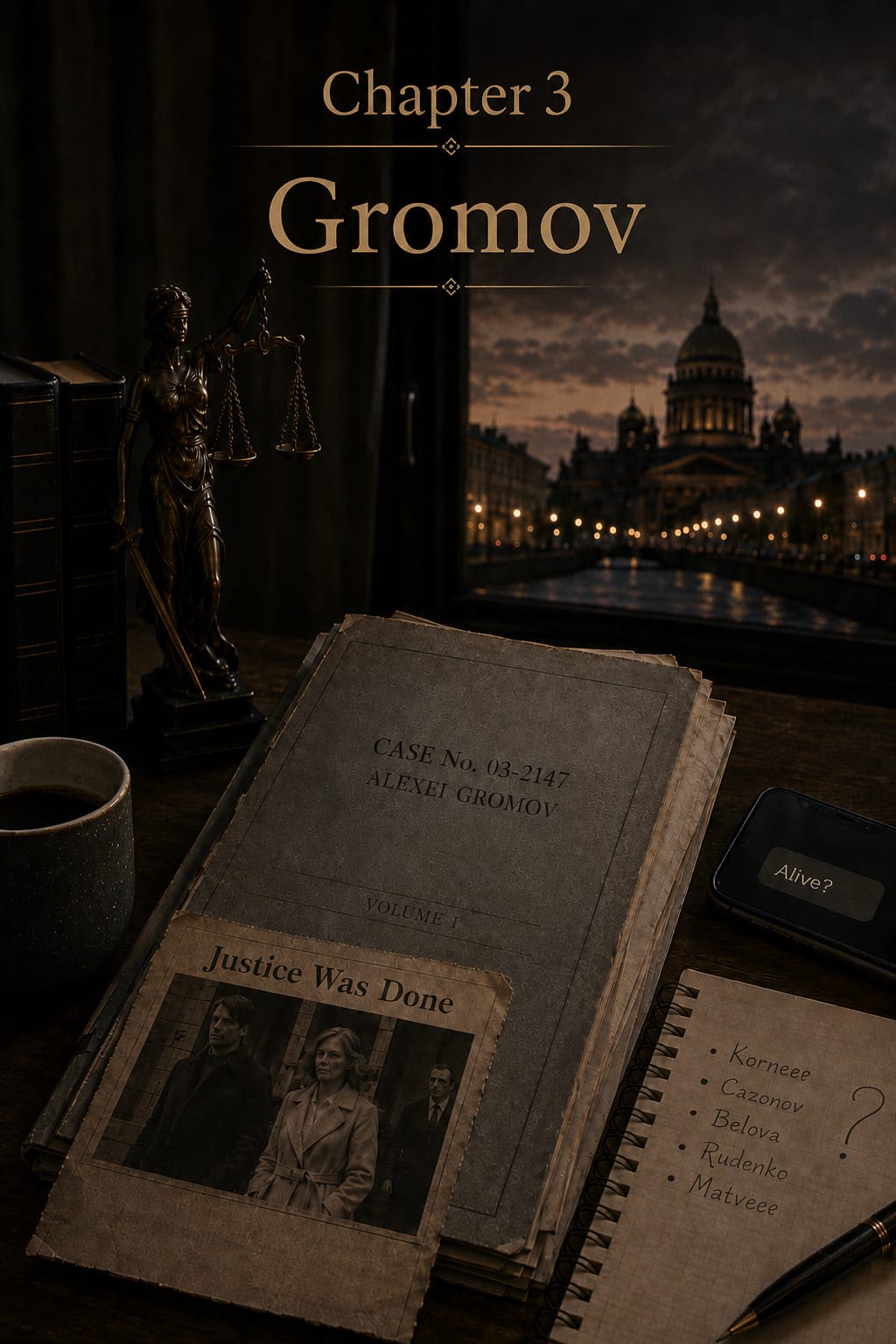
The Alibi of St. Petersburg – Chapter 3
Twenty-two years ago, Olga Vorontsova helped secure Alexei Gromov’s acquittal. Now one conversation makes her question not only what happened then, but what she may never have known.
The Alibi of St. Petersburg Chapter 3: Gromov
The following morning I woke up earlier than usual and immediately found myself thinking about Gromov, even though I had intended to spend the day thinking exclusively about suitcases, tickets and the move. Life has a habit of showing just how little it cares about our plans: all you have to do is decide that a new chapter begins on Monday, and by Sunday evening a person, an old murder case or at least a broken tap will appear and somehow become more important than all your carefully considered decisions.
Instead of packing, I made coffee and opened the grey folder again. It still contained old addresses, phone numbers and information about Gromov’s family and work, most of it long out of date, so I opened my laptop and quickly discovered that his company no longer existed, other people now lived at his former address and he himself had almost completely disappeared from public view.
What I did find was an old newspaper article about his acquittal, and beneath it was a quotation attributed to me:
“Justice has been served.”
I read it twice and decided that I did not particularly like the woman who had said it. At twenty-nine, I had apparently thought that winning one case gave me the right to make sweeping statements about justice itself. These days I would put it more simply: my client had been acquitted. That was enough. In the photograph accompanying the article, Gromov was leaving the courthouse, I was walking beside him and Velsky stood a step behind us. I closed the page and continued searching until I found a phone number for Gromov’s older brother, although I still waited until nine before calling because legal practice destroys many ordinary human habits, but basic manners occasionally survive even that.
The man recognised my surname and informed me, without any obvious enthusiasm, that I had once been his brother’s lawyer. When I asked how I could contact Alexei now, he wanted to know why I was looking for him twenty-two years later. I explained that I had come across an old case by accident and wanted to clarify a few things. He gave a short laugh and remarked that after ten years the call would have seemed strange, whereas after twenty-two it was almost amusing, then added that Alexei could decide for himself whether he wanted to speak to me.
“Could you give him my number?”
“I will.”
He was about to hang up when I asked why he found the call unusual in the first place.
“Unusual? No,” he said. “Late.”
The conversation ended there, but I sat looking at my phone for a while afterwards, trying to understand why that one word had stayed with me. Relatives of former clients rarely feel much affection toward their lawyers, so the coldness itself meant very little, but the word late stayed with me. At around half past nine, Velsky called. I did not answer because I had no desire to explain why I was spending the morning searching for a man connected to a twenty-two-year-old murder case instead of packing for my move, and a minute later he sent a message asking if I was alive.
Unfortunately, yes, I replied.
He sent back a laughing emoji, and that was the end of the conversation. I spent the rest of the morning reading through Gromov’s case file and gradually remembering details that had not crossed my mind in years. One of them was his first interrogation, during which he claimed he had seen Marina two days before her death, although it later emerged that he had visited her the day before the murder.
I remembered our conversation in the detention centre as well. Gromov sat across from me, pale, unshaven and furious, while I explained that if he intended to lie to me the way he lied to the investigator, there was very little I could do for him. He insisted that he had not killed Marina, and I kept telling him that, at that moment, we were discussing something else entirely while asking again where he had been that evening. I never received an answer, which even then struck me as unusual. People accused of murder usually cling to every possible opportunity to prove they were somewhere else, remembering phone calls, meetings, receipts, petrol stations and people whose names they barely know, building an alibi out of anything available. Gromov did the opposite and seemed almost determined to leave several hours of his life completely blank.
Shortly before eleven, an unfamiliar number appeared on my screen, and I did not recognise the voice immediately. Gromov informed me that his brother had already called him, and when I suggested we meet, he wanted to know why, so I told him about the anonymous message I had received the previous evening. When he heard the words You saved a murderer back then, he did not sound offended and did not ask whether I believed the murderer was him. Instead, he wanted to know who had sent it. I asked why that was the first thing he wanted to know, but rather than answering he asked for the sender’s number. I refused, and Gromov said that the case had ended many years ago, he had been acquitted and had no intention of revisiting any of it. That was when I finally asked the question that had been bothering me all morning.
“Where were you that night?”
He pretended not to understand which night I meant, although we both knew perfectly well. When I clarified that I meant the night Marina was killed, he reminded me that he had heard the same question twenty-two years earlier and had not answered it then either.
“Things are different now,” I said.
“What exactly is different?”
“I believed you then.”
For a moment he said nothing, and when he spoke again his voice sounded calmer.
“So now you’re checking whether you made a mistake?”
Then he said that in 2004 I had been interested not in whether he had killed Marina but in whether Kornev could prove it. The irritating part was that he was right. At twenty-nine, I often said something very similar myself: my job was not to uncover the ultimate truth, but to decide whether the prosecution had proved its case. Hearing the same idea now, however, it sounded different, and strangely familiar, as though I had heard almost the same words somewhere before. I suggested meeting again, but Gromov refused.
“Why?”
He was silent for a moment before answering.
“Because you’re late again.”
I immediately remembered his brother’s word.
Late.
“What do you mean, again?”
“After the trial, I tried to contact you.”
“When?”
“A few days later.”
“Why?”
“It doesn’t matter anymore.”
“If you’re talking to me twenty-two years later, then it clearly does.”
Gromov laughed quietly but did not answer.
“Who did you call?”
Something slammed in the background and someone started speaking, and a moment later the connection was gone so abruptly that I continued holding the phone to my ear for several seconds before trying to call back. The number was unavailable.
For the rest of the day I kept returning to the same phrase: You’re late again. If Gromov had really tried to contact me after the trial, why had I never heard about it? Perhaps he had called the firm, or left a message with a secretary or one of my colleagues and it had simply been lost. Twenty-two years ago, that was entirely possible, because people then managed to lose not only phone messages but occasionally entire volumes of criminal case files, so building a conspiracy theory around one missing phone call would have been premature. And yet that missing call bothered me far more than the anonymous message.
That evening I opened Gromov’s file again, but instead of reading it from beginning to end, I found an old notebook and wrote down the names of everyone I could remember from the case: Kornev, Sazonov, Belova, Rudenko, several police officers and the prosecutor. The list turned out to be longer than I expected, and almost every name pulled a fragment of memory behind it: a question asked in a corridor, a signature on a document, an offhand remark, a face glimpsed during a court hearing. I sat looking at the page and wondering which of those people could still know enough about a twenty-two-year-old case to send me four words from an unfamiliar number.
I had no answer yet, but for the first time it became clear that if I wanted to find one, I would have to look not at what I remembered about the case, but at everything I had once dismissed as unimportant.