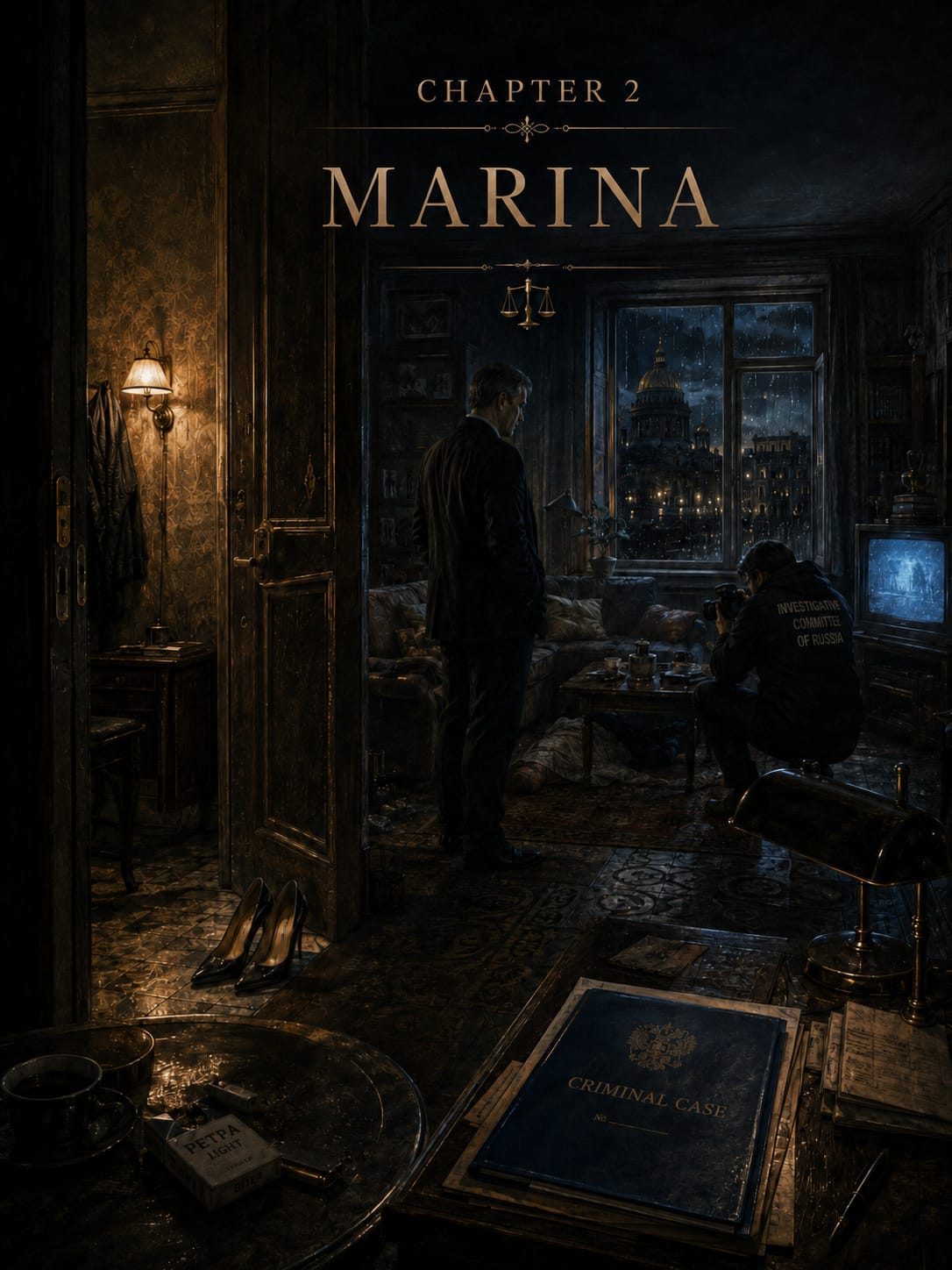
The Alibi of St. Petersburg Chapter 2: Marina.
The Alibi of St. Petersburg Chapter 2. For the neighbours, it is a tragedy. For the police, a murder investigation. For Sergei Kornev, it is a night that will look very different years later.
The Alibi of St. Petersburg Chapter 2
2004
The door to Marina Lebedeva’s apartment was closed but not locked, so Larisa Belova simply pressed down on the handle, called out to her neighbour and stepped inside, still unaware that within a few hours she would be asked to return to that exact moment again and again, explaining to complete strangers how the door had been positioned, whether it had been firmly shut and whether she had needed to use any force to open it. The hallway light was on, and a pair of black high-heeled shoes stood neatly against the wall, a detail Larisa would later remember more clearly than almost anything else she saw that evening. A television was playing somewhere in the apartment, a male voice calmly predicting rain and colder weather, while the kitchen light was on as well and two coffee cups stood on the table, one empty and the other with a little coffee left inside, beside a packet of cigarettes that immediately struck Larisa as wrong because Marina did not smoke.
They had lived on opposite sides of the same wall for four years, and in old St. Petersburg apartment buildings neighbours sometimes know more about one another than relatives do, simply because they hear everything: who comes home late, who leaves early, who has visitors, who argues and how long the doors keep slamming after everyone has supposedly calmed down. Marina did not answer, so Larisa walked further into the apartment and first saw a hand beside the sofa, then took another step and saw Marina herself, lying between the sofa and the coffee table with her hair covering part of her face and a dark stain spreading across the parquet beneath her head.
Larisa did not scream, although later she would find that oddly difficult to understand. People screamed in films, but real life rarely followed the rules of cinema so neatly, and sometimes a person simply stood there staring while the mind struggled to catch up with what the eyes had already understood. She backed away, returned to the hallway and called the police, and when the woman on the emergency line asked whether Marina was breathing, Larisa said she did not know and would not go back into the room to check.
Before long, the landing filled with people. Police officers arrived, a local district officer appeared, neighbours emerged from their apartments and gathered near the stairwell, some smoking by the window, some trying to peer into Marina’s apartment over other people’s shoulders, while others had already managed to construct detailed theories of what had happened and were explaining them with the confidence of people who had apparently been present at the murder in person. Every apartment building seems to contain at least one resident who solves the crime before the investigation has properly begun, and this building was no exception.
Larisa was given a chair and a glass of water. A young district officer asked whether she had heard anyone visiting Marina that evening, and Larisa said there had been a man, although she had not seen him and could only remember his voice. When the officer asked whether there had been one male voice or more, she first answered confidently that there had been one, then hesitated and admitted that later she might have heard someone else as well, perhaps another man, although by the end of the conversation she could no longer say for certain whether she had really heard a second voice or whether the detail had appeared later, somewhere among other people’s questions and other people’s versions.
A man in a dark suit came up the stairs while she was still trying to decide what she really remembered, showed his identification and introduced himself as Sergei Andreevich Kornev, an investigator from the prosecutor’s office. He spoke to Larisa separately and was noticeably calmer than the district officer, never rushing or interrupting her, and several times bringing her gently back to what she actually remembered rather than what she thought she might have remembered. In the end he suggested that, for now, they record only what she was certain about, because within a few hours it would become difficult to separate her own recollections from everything she would hear from neighbours, police officers and the inevitable collection of people who would soon be ready to explain to her exactly what had happened in the apartment. Larisa thought about it and agreed that she was certain of one thing: she had heard one male voice.
Back inside the apartment, Kornev asked what time the call had come in. Someone told him 9:47 p.m., and after glancing at his watch he asked for the official start of the crime scene examination to be recorded as 9:53 p.m. The forensic expert pointed out that the time the body had been discovered would be recorded separately, Kornev agreed, and the exchange ended with the same dry routine as dozens of other conversations that took place at crime scenes every day.
Pavel Rudenko had begun photographing the apartment before all the objects had been catalogued and prepared for collection, which made sense because the first task was to preserve the room exactly as it had been found. Soon enough people would begin opening cupboards, moving objects, collecting samples and turning the scene into an ordinary workspace where everyone got in everyone else’s way, and by then the original arrangement of things would already be gone. One of Rudenko’s photographs included a blue folder lying on the writing desk beside several sheets of paper. It looked no different from the other papers and folders scattered across the desk, and Rudenko photographed the room, then the desk, the window, the doorway and several details near the sofa before moving into the corridor.
Kornev, meanwhile, was examining the kitchen, where the two coffee cups and the packet of cigarettes still sat on the table, and later asked the forensic expert whether there were any signs of forced entry at the front door. The expert said there were none and suggested that Marina had either let the visitor in herself or had simply left the door unlocked.
“The door was closed,” Kornev said.
The expert looked at him and asked how he knew that. Kornev hesitated briefly before saying that the neighbour had told him. The expert did not pursue the matter. In the corridor, Kornev asked Rudenko whether he had photographed the entrance door, the lock and the passage into the living room, and Rudenko looked at him with the expression of a man who had just been offered a beginner’s lesson in using a camera.
“Sergei Andreevich, I’ve been photographing dead bodies for twenty years.”
“You’re thirty-two.”
“I started very young.”
Kornev looked at him, and Rudenko grinned.
“All right. Twenty years was approximate.”
He photographed the door, the lock and the windows again anyway, then asked whether Kornev would also like a picture of the ceiling. Kornev did not answer, which Rudenko appeared to take as permission to leave the ceiling alone. Later, when the roll of film was finished, Kornev asked for the cassette.
“It needs to be developed first,” Rudenko said. “If you open it now, all you’ll get are some extremely expressive black squares.”
Kornev simply held out his hand, and after looking at him for a moment Rudenko removed the cassette and handed it over. Kornev slipped it into the inside pocket of his jacket, took several steps and then stopped.
“Where’s the second one?”
Rudenko did not answer immediately.
“The second what?”
“The film.”
“There isn’t one.”
For a moment they simply looked at each other.
“Of course,” Kornev said, and left the kitchen.
Rudenko waited until his footsteps had faded down the corridor, then slipped a hand into the inside pocket of his own jacket and felt the second cassette still there. By midnight, the apartment had almost emptied. Marina’s body had been removed, Larisa had been allowed to go home, the forensic expert and photographer had left, the police officers gradually disappeared from the stairwell and the neighbours retreated behind their doors, although some of them continued talking quietly for a while longer. By then, the blue folder was no longer on the writing desk, but it did not appear on the list of seized items either. Nobody noticed the omission that night because there had been too many papers, too many objects and too many people moving through the apartment for the disappearance of one ordinary blue folder to seem worthy of a separate question.
Kornev reviewed the paperwork once more and paused at the recorded start time of the examination, 9:53 p.m. Everything had been documented exactly as he had asked, so he closed the file, went downstairs and got into his car. For several minutes he sat watching the illuminated windows of Marina’s apartment before taking out his phone and dialling a number.
“We’re finished.”
He listened to the reply.
“No.”
There was another pause before he added:
“Nothing yet.”
The person on the other end continued speaking, because Kornev frowned and repeated, more sharply this time:
“I said there’s nothing yet.”
He ended the call, tossed the phone onto the passenger seat and only then noticed the damp parking ticket lying beside it, with the time of entry printed clearly across the top: 8:58 p.m. Kornev stared at the numbers for a while, then folded the ticket in half and slipped it into the ashtray. The case file would record 9:53 p.m. as the official start of the crime scene examination. There would be no mention anywhere that Sergei Andreevich Kornev had arrived outside Marina Lebedeva’s building almost an hour earlier.
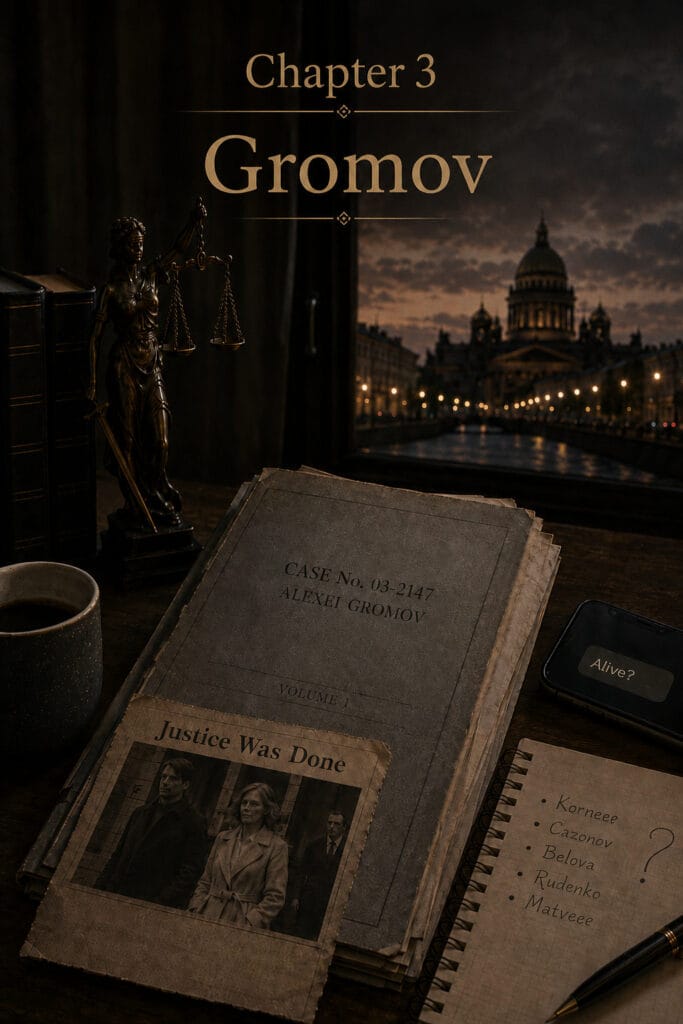
The Alibi of St. Petersburg Chapter 3: Gromov
Olga finds the man she once defended in court. But their conversation turns an old question – whether he was guilty – into a far more disturbing one: what really happened twenty-two years ago?