Chapter 2. Can You Love Someone and Not Want to Live Together?
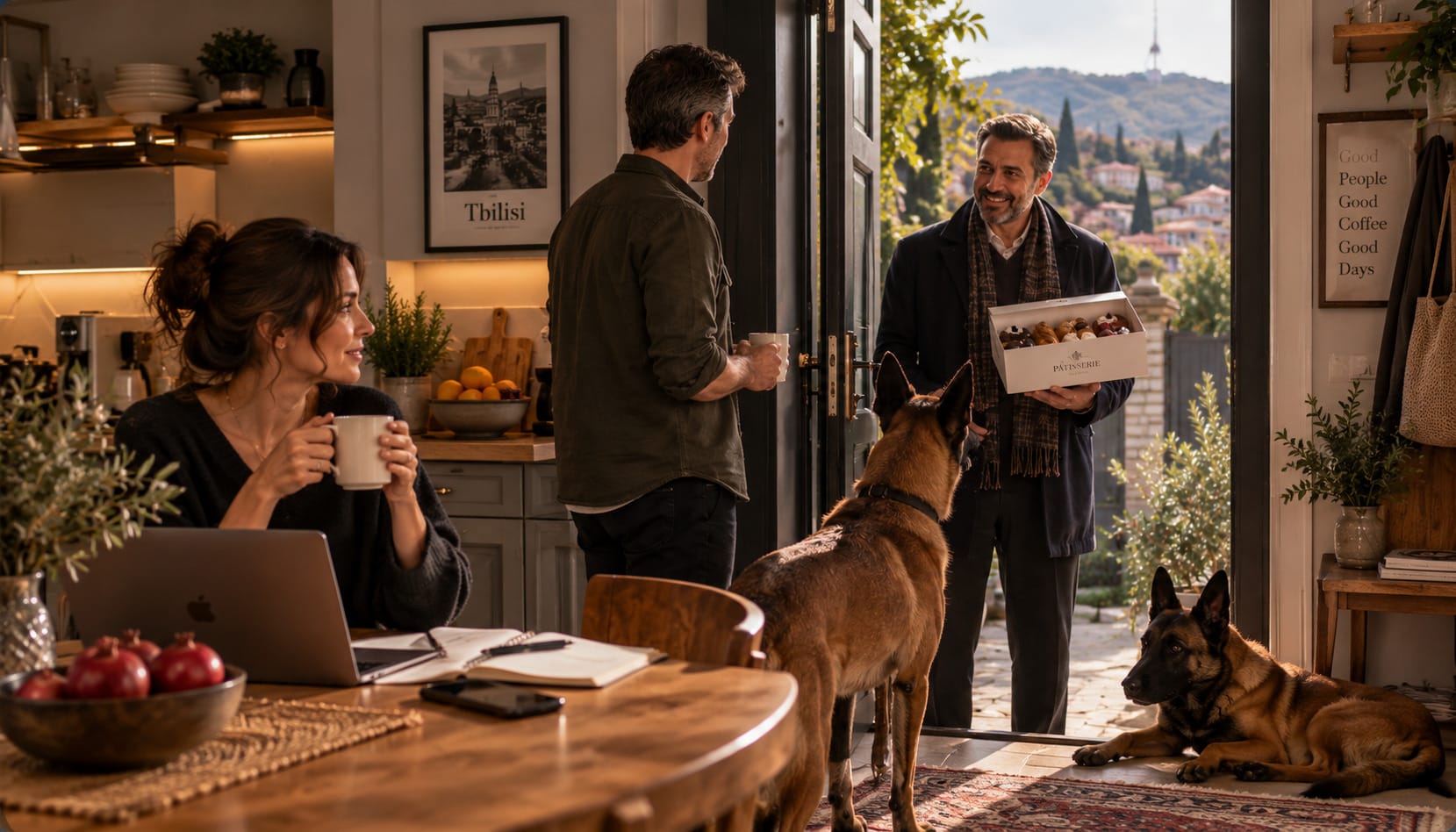
The landlord came round the next day at about midday and brought a box of pastries, which immediately put me on my guard. I don’t entirely trust people who show up to discuss something important with food in their hands. If a man wants to ask whether the tap’s still leaking, whether we’re planning to move out, or why the dogs dug another hole by the fence, he doesn’t need éclairs for that. Pastries meant one of three things: the conversation was going to be unpleasant, it was going to be expensive, or someone had already decided we’d need sugar for whatever came next. Max saw no threat in the box whatsoever and immediately asked where they were from. This was one of the oldest differences between us. When something unfamiliar appeared, I generally tried to work out its legal significance. Max wanted to know if it was edible.
Thor heard the car from the street and shot towards the gate with the sort of zealous devotion you’d expect from a dog who’d secretly been training for border patrol his whole life and had finally been called up. Nora lifted her head off the mat, listened, and went back to sleep. Nora had always taken a fairly relaxed view of male enthusiasm. If a young male wanted to bark, then run the length of the fence, then forget why he’d been running, a grown woman didn’t necessarily need to get involved.
“Thor, stay,” Max said.
Thor stayed by the door.
“He thinks that counts as staying,” I said.
“He has a very broad interpretation of the command.”
The landlord came in, patted Nora, tried to pat Thor, thought better of it, put the pastries on the kitchen table, and started by saying how pleased he was with us as tenants. I didn’t like the sound of that either. Years of legal work had taught me that when someone starts a conversation with “I’m very happy with everything,” there’s a but coming. Sometimes big, sometimes small, but it always comes.
It came about three minutes later.
“I’ve decided to sell the house.”
Max stopped pouring the coffee and looked at him.
“What do you mean, sell it? Do we have to move out?”
“No, no, that’s why I came to you first. You’ve lived here a long time, you know the house, I know you. If you want to buy it, I’ll offer it to you first. If not, I’ll put it on the market.”
For some reason I looked straight out the window. Thor was lying in the yard, a bag of dog food stood against the wall, a towel Max had hung across the line that morning for no obvious reason was still drying, and everything looked exactly the same as it had yesterday. This always struck me as strange about news that was supposed to change something. Someone tells you something genuinely serious, and outside the window everything just stays exactly where it was, and even the towel doesn’t feel any need to react.
Max asked the price first.
The landlord named a figure.
I looked at Max and watched him start calculating. Not on his phone, not on paper, just internally. It was a quality of his that sometimes made my life wonderfully easy and sometimes made me want to hide every calculator in the house. He moved from “there’s a problem” to “here’s what we’re doing” faster than almost anyone I’d ever met. If a tap broke, Max knew who was coming to fix it within five minutes. If the dogs needed something, he’d find three options, ring two people and be out of the door before I’d finished thinking about it. If someone said “maybe one day,” Max heard “Tuesday afternoon.”
“Have you listed it yet?” I asked.
“No. I’m telling you first.”
“What’s the timeframe?”
“Not tomorrow. Think it over. A couple of months, maybe. I’m not rushing you.”
“Is the price final?”
The landlord smiled.
“For you, we can talk.”
Max smiled too, and I realised they’d both slipped into some sort of male dialect where “we can talk” doesn’t mean talking at all, it means a specific number that one person wants and the other doesn’t want to pay, and somehow both of them consider this a pleasant form of human connection.
Half an hour later the landlord left, having deposited a box of pastries, a price, and the very strange sensation that we’d woken up in one house that morning and were now sitting in a slightly different one, even though nothing had physically changed. Max walked him to the gate, came back to the kitchen, opened the pastry box, and peered inside.
“Want one?”
“No.”
“Sure?”
“Yes.”
He took one anyway.
“Don’t say later that I ate them all.”
“I haven’t said anything yet.”
“Just getting in early.”
“This is why we can’t keep honest accounts, you and me.”
“You’re not eating, I’m eating. That’s about as honest as it gets.”
He sat down across from me, bit off half the pastry, and asked, “So, what do you think?”
“I think the landlord left seven minutes ago.”
“And?”
“And in seven minutes I have not made a decision about purchasing real estate.”
“How long do you need?”
“Max, I spend longer choosing shoes.”
“A house is simpler. You already know the size.”
I laughed, although it wasn’t really funny. Not because I was against the house. That was exactly the problem. I liked the house. I liked the neighbourhood, the yard, the big window in the sitting room, the terrace that caught the morning sun, even that ridiculous pantry door that swelled after heavy rain and would only shut if you approached it from precisely the right angle, using language not generally recommended for family use.
Max had already started listing the advantages.
“No moving. Good for him. Perfect for the dogs. Good neighbourhood. We know every fault in the place.”
“That last one is particularly reassuring.”
“What? Better to buy a house where you already know the faults than find new ones later.”
“The small bedroom’s cold in winter.”
“We’ll insulate it.”
“The gate’s crooked.”
“We’ll fix it.”
“The terrace roof leaks.”
“We’ll sort it.”
I looked at him.
“Have you already bought this house?”
“No.”
“It sounds like you’ve already finished the renovation.”
“I’m just thinking it through.”
“No, you’re already mentally hiring builders somewhere.”
Max considered this.
“I do know some builders.”
“I knew it.”
He smiled and finished the pastry. This, incidentally, was also part of why I loved him. Max had a gift for making things concrete. Out of some anxious, hazy “we should really see to that one day,” he could produce a phone number, the address of a shop, and a man named Givi who’d come round tomorrow after four. Sometimes I thought that without him, half our household would simply exist forever in the form of my own notes reading “need to look into this.”
“We need to live somewhere either way,” he said. “We’re already settled here. We know everything about this place. Why go looking for another rental, hauling boxes, moving the dogs?”
By “boxes”, Max meant an entirely unreasonable amount of stuff for a family who, a few years earlier, had thought they could pack up and move anywhere. The first time you move, you own a few suitcases and a very clear sense of your own mobility. Then, somehow, an extra saucepan appears, four blankets, dog bowls the size of a small basin, a box of cables nobody can identify, and various objects nobody’s seen in a year but can’t possibly throw away, because they might come in useful.
“I’m not saying we shouldn’t buy it. I’m just thinking it over, that’s all.”
“You always start thinking by looking for the catch.”
“Because sometimes there is one.”
He set his cup down on the table slightly harder than necessary.
“Right, of course.”
I looked up.
“Max, don’t start. I never said no.”
He was quiet for a second, then shrugged.
“I’m not starting anything.”
“Good.”
“I just think you could look at the good side first, before you go hunting for a catastrophe.”
“I’m not hunting for a catastrophe.”
“Great, then.”
A minute later he was asking which pastry I actually wanted, because “there’s a decent chocolate one left,” and the conversation slid back onto its normal track so quickly that I felt almost embarrassed still being annoyed. That happened a lot with Max. He could flare up for a second, then genuinely forget about it and move on to something else entirely, while I’d stay stuck in the previous conversation a while longer, feeling like someone who keeps watching a film after everyone else has already changed the channel.
Max picked up his phone and started looking something up.
“What are you doing?”
“Checking how much decent internet costs these days.”
“Of course you are.”
“If the house is ours, we can finally get it installed properly.”
I looked at him and suddenly remembered.
“Remember when you used to stand out in the freezing cold for the internet?”
He laughed.
“For you.”
“Don’t flatter yourself. You went out there for the Wi-Fi.”
“The Wi-Fi was a means to an end.”
That was back at the very beginning, when there was no shared house even in theory, when I lived in St Petersburg and Max lived in another country, and most of our relationship fit inside a phone. We met in a Facebook group, and I genuinely no longer remember what it was about. I only remember that we ended up arguing about something in the comments, and then he messaged me privately to ask whether I always spent this long explaining to complete strangers that they were wrong.
I told him only the ones who didn’t understand the first time.
He wrote back: “Then we’re in serious trouble.”
That’s how it started. Before long, we were talking about everything and probably spent more time together on the phone than some couples who shared a flat.
One winter Max called me on video, and I saw snow behind him.
“Where are you?”
“Outside.”
“I can see that. Why?”
“The Wi-Fi’s terrible indoors.”
He stood near some building with his phone in front of his face, taking a step to one side then the other whenever the picture froze. Then the connection would drop entirely, his face would dissolve into pixels, the sound would vanish, he’d step back and reappear on screen.
“Go home.”
“In a minute.”
“What’s the temperature there?”
“It’s fine.”
“I can see your breath.”
“It’s atmospheric.”
“You’re about to lose your fingers.”
Max looked down at his hand.
“I’ve got another one.”
“Very forward-thinking.”
“One’s enough to hold the phone.”
“You’re insane.”
“But you can see me.”
And I could see him. Sometimes all of him, sometimes half, sometimes just a frozen forehead and one eye, but at that moment it somehow mattered more than any reasonable person’s common sense. I liked that a grown man would stand outside in the cold behaving like an idiot for the sole reason that he wanted to talk to me.
“And you still nagged me to go inside,” Max said now.
“I was concerned about your extremities.”
“You underestimated the romance of it.”
“I’m a lawyer. It’s an occupational hazard. I needed a man with a full set of fingers.”
He laughed, and we kept talking about that first year a little longer, before the conversation wound down on its own.
After lunch Max went off to run errands, my son shut himself in his room, the dogs stretched out on the terrace, and I opened my laptop with every intention of working. For about forty minutes I genuinely did. Then I caught myself reading the same sentence for the third time, closed the document, and opened the notes app on my phone instead.
At the top I wrote: The house.
Then: pros.
The yard. The neighbourhood. Good for my son. Good for the dogs. No moving. We know the landlord. We know the house.
I thought about it and added: Max wants it.
Looked at that line and deleted it. Not because it wasn’t true, but because I couldn’t work out which column it belonged in.
Then I wrote: cons.
Heating. The terrace roof. The gate. Some paperwork to check.
That was it.
The list looked remarkably calm for a question that refused to feel calm at all.
I added: not temporary any more.
Looked at it.
Didn’t delete it straight away, though I knew perfectly well no property surveyor in the world would list that as a defect.
Thor lay in the yard, chin on his paws. Nora slept by the door. A lead hung on the railing that Max had been meaning to put away for days, a box of tools sat in the corner, half the pastries remained in the kitchen. We knew everything about this house. Where it got cold in winter, where the morning sun fell, which socket cut out if you ran the kettle and something else at the same time, the exact spot where Thor had once tried to dig his way into the neighbouring country.
And suddenly, someone was offering to make all of it ours.
Max came back that evening with shopping bags.
“You said you were just running errands.”
“I was.”
“And this?”
“I stopped at the shop.”
“You cannot just drive home. Ever.”
“We were out of milk.”
He set the bags down on the counter, then noticed me with my phone.
“What are you doing?”
“A list.”
“What kind?”
“About the house.”
“Show me.”
“No.”
“Why not?”
“Because it’s mine.”
“Lovely start to a joint purchase.”
I handed him the phone.
Max read it, frowned.
“Why does it just say ‘the yard’? It’s a great yard.”
“Write ‘wonderful yard’ on your own list, then.”
“And the school’s close by.”
“That’s the neighbourhood.”
“That’s separate.”
“Separate for you. For me it’s the neighbourhood.”
He got to the last line.
“‘Not temporary any more.’ That’s a con?”
“I haven’t decided yet.”
Max looked at me, then handed the phone back.
“Fair enough. People don’t usually buy a house for the weekend.”
“Thanks, very helpful.”
“Any time.”
He sat down next to me, put his hand on the back of my neck, and stroked my hair the way he always did, usually without even noticing he was doing it.
“I’d buy it,” he said.
“I gathered that.”
“But we’ll decide together.”
“Of course.”
“Tea?”
“Please.”
“With lemon?”
“Yes.”
He went to the kitchen and came back a few minutes later with my tea and a small bar of chocolate he’d picked up for me at the shop. He’d just seen it and bought it.
And that was the most inconvenient part.
“We could put a proper awning on the terrace,” he said, turning on the television.
“Are we renovating a house we don’t even own yet?”
“I’m just thinking out loud.”
“You get an awful lot done for someone who’s only thinking.”
He smiled.
I opened the notes app again and looked at the two columns.
The house itself, when it came down to it, was straightforward enough. I could check the paperwork, get a valuation, understand the market, discuss the price, work out the costs. That was the part where I felt entirely confident. When a question could be laid out on a table, broken down into points and checked, I always felt steadier.
The trouble was one particular line.
I couldn’t quite manage to put it into words, even to myself.
Between Us
If someone had asked me that day whether I loved Max, I’d have said yes without hesitation, and probably would have been faintly surprised anyone needed to ask something so obvious. Of course I loved him. I knew the way he laughed when something was genuinely funny. I knew he’d never walk past good meat at the market, even if he’d only gone out for tomatoes. I knew that if I got ill, he’d come and check on me every fifteen minutes to ask if I needed anything, until I wanted to get better purely so he’d stop asking.
But the landlord hadn’t asked whether I loved my husband.
He’d offered to sell us a house.
While we were renting, our life could go on for another month, another year, however long it lasted. There’s a strange comfort in renting: almost everything can be treated as temporary, even when it lasts for years. Buying it was different. Suddenly I had to picture not just the house, but myself still living in it five years from now. Ten years from now. With the same man, in the same rooms, with the same “tea?” every evening.
And that was when I first noticed something I’d apparently never put into words before.
Loving someone and wanting to keep living exactly this life with him turned out not to be quite the same question.
And I didn’t have an answer to the second one yet.
Money in Marriage: Everyone Keeps Score, Even Those Who Say They Don’t
Chapter 3 of The Life Between Staying and Leaving
Max thinks they should buy the house. Anna asks one perfectly ordinary question: how much can he put towards it?