On the Language St Petersburg Speaks | St Petersburg. This Is Normal. – Chapter 2.
I never understood why people found the word porebrik so amusing. To me, a porebrik had always been a porebrik, a paradnaya was a paradnaya, and shaverma was shaverma. It was only much later that I discovered these weren’t simply words but a kind of identification system St Petersburg had installed at its borders without any assistance from the immigration authorities.
It’s actually quite easy to determine whether someone belongs to the city. You don’t need to ask where they were born, how long they’ve lived here or whether they can get from Nevsky Prospekt to Rubinstein Street without consulting a map. Just point at the edge of the pavement. If they call it a bordyur, you know.
Nobody will correct them, of course. St Petersburg is a cultured city. People here rarely tell someone directly that they’re wrong. They simply look at them for a moment.
That particular St Petersburg look deserves a study of its own. There’s no aggression in it and hardly any judgement. It’s closer to mild regret that a grown adult has managed to live this long without knowing something so elementary. It’s roughly the expression an old-school literature professor might give a student who has just confused Pushkin with Lermontov. It’s too late to be angry. One can only accept what has happened.
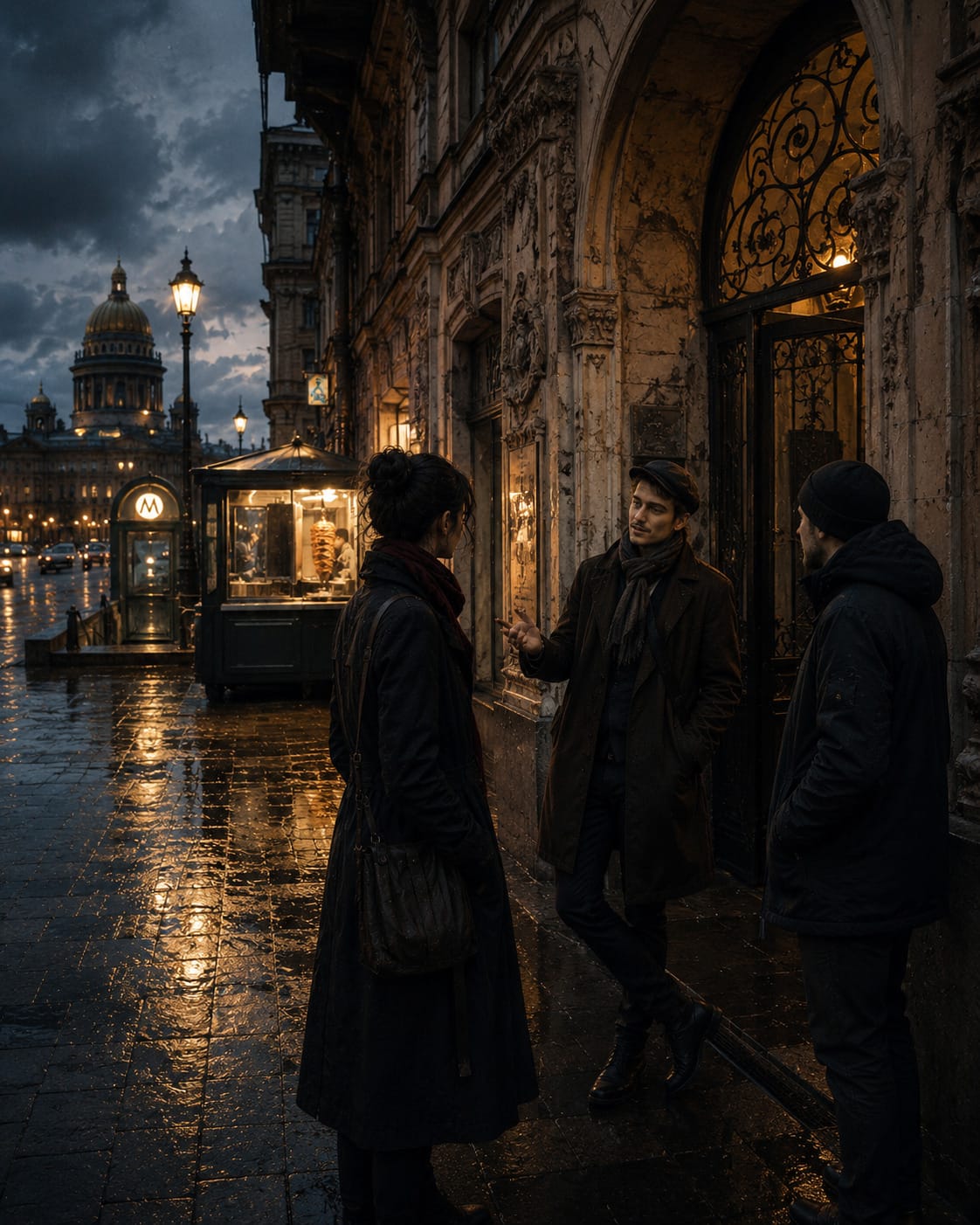
But it isn’t really about porebrik. St Petersburg has an entire language of its own, and the people who live here usually don’t even notice that they’re speaking it. A perfectly ordinary conversation can begin with, “I’m on Petrogradka,” and nobody feels the need to provide a street, a building number or the nearest landmark. The person has stated their position with what they consider sufficient geographical precision. The rest is your problem.
It’s equally natural to suggest meeting “by Gostinka”. Exactly where beside Gostiny Dvor, which occupies a considerable part of an entire city block, is something you can work out later, sometimes after both people have spent fifteen minutes standing on opposite sides of the building texting each other, “I’m here.” The best part is that both of them really are there, and both genuinely fail to understand how the other person has managed to get lost.
St Petersburg measures distance in its own way too. Ask, “Is it far?” and you may receive the perfectly comprehensive answer, “No, just two stops.” Metro stops, obviously. Nobody sees any reason to specify this. Admittedly, two stops can sometimes turn into a modest expedition involving a transfer, a long escalator, another passageway and that peculiar moment when you’re standing somewhere deep underground and can no longer quite remember why you came down here in the first place.
The city is also remarkably quick to give everything affectionate nicknames. Petrogradskaya becomes Petrogradka, Vasilyevsky Island becomes Vaska, and Gostiny Dvor becomes Gostinka. For more than two centuries St Petersburg has presented the world with palaces, colonnades, granite and imperial grandeur, while its residents speak about all of it among themselves as though it belongs to one large family and everyone agreed long ago that there was no need to be formal.
Even shaverma has its rightful place in this system, and arguing about the name is pointless. It has outlasted generations of newcomers who arrived confidently saying shawarma, gradually grew unsure of themselves, and within a few years found themselves quietly wincing whenever someone else said it.
Perhaps that’s the moment when a person finally becomes a Petersburger. Not when they register their address, buy an apartment or stop taking photographs of Nevsky Prospekt, but when they’re in another city, casually say, “Let’s meet by the paradnaya,” hear a bewildered “By the what?” and suddenly realise that St Petersburg made the decision for them a long time ago.
On Entrances, Counts and Food Delivery
Chapter 3 of St Petersburg. This Is Normal.
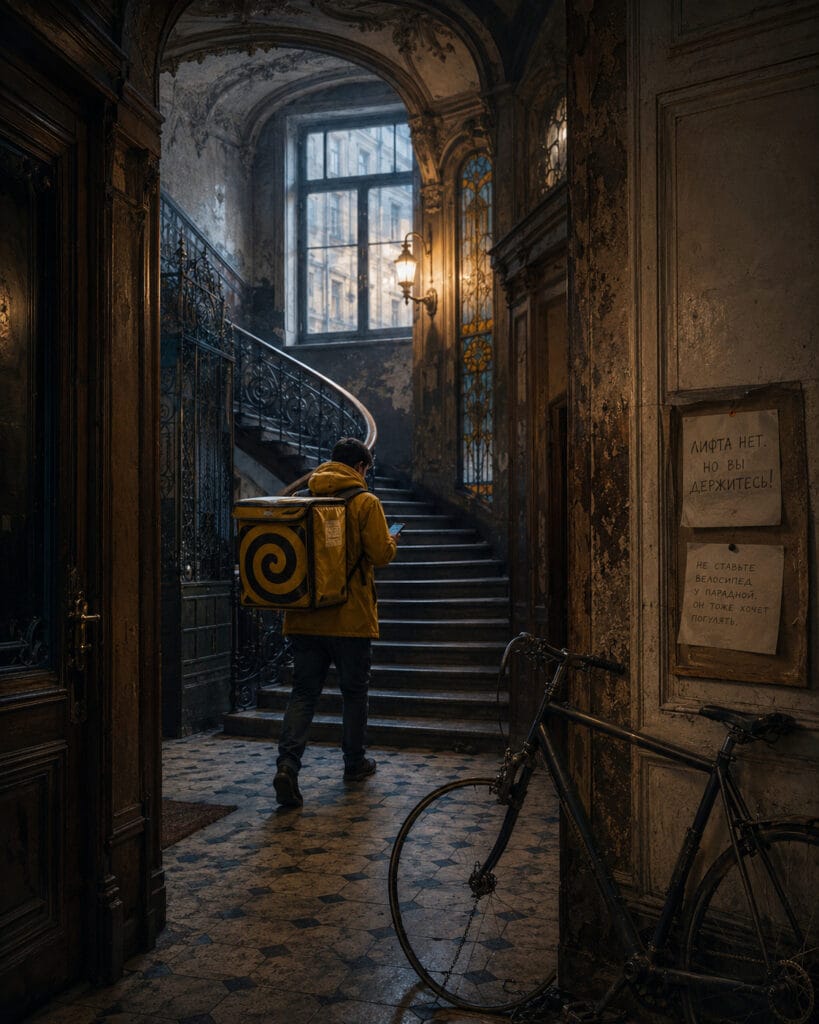
A count may once have lived here. His study may now be a parcel collection point. Nobody finds this particularly surprising.